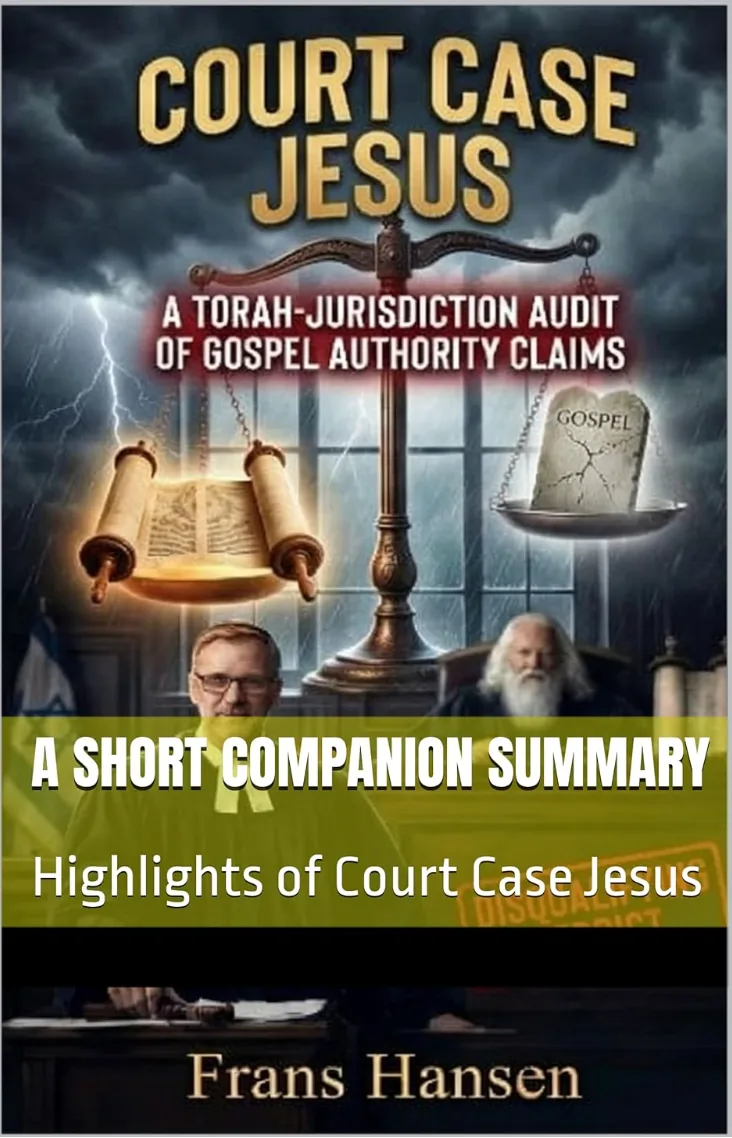
Why read Court Case Jesus — A Short Companion Summary: Highlights of Court Case Jesus? A Torah-first reader’s guide
This guide explains what the book actually examines, why that examination matters, and how to read it critically. It is not a substitute for the evidence in the book. It gives you the map before you enter the argument.
The fastest entry into the Court Case Jesus method: a compact companion for readers who need the main argument without starting with the full case file.
The question is not whether Christians can preach symbolic connections. They can. The harder question is whether the Hebrew Bible itself authorizes those conclusions before later theology supplies the decoder key.
Use this book as part of a reading path. Start with the short companion if you need the method quickly, move to Isaiah 53 for a focused prooftext audit, use 666 Shadows when typology or hidden “Jesus in Tanakh” claims appear, and use the Rabbis volume when the argument turns to Metatron, the Angel of the Lord, the Son of Man, or pre-incarnation claims.
The central issue is authority. A Christian conclusion cannot prove itself merely by quoting an earlier Hebrew text. The wording, speaker, audience, covenant setting, and public outcome still control what the earlier text can support.
The controlling method
The book uses a Torah-first test: begin with the Hebrew Bible in its own literary and covenant setting, state the strongest Christian reading fairly, then ask whether the later claim preserves the original subject, meaning, and authority.
Who should read it
Jewish readers can use the book to identify where missionary arguments cross from quotation into reinterpretation. Noahides and questioning Christians can use it to separate reverence for Scripture from automatic acceptance of New Testament conclusions. Teachers and debaters can use its structure to keep the burden of proof visible.
What this guide does not claim
A forceful verdict is not a licence to skip sources. This guide does not turn every disagreement into dishonesty, and it does not make possible interpretations proven. The book succeeds only where its textual comparisons, context, and burden-of-proof analysis can be independently checked.
FAQ
What this book tests: Court Case Jesus — A Short Companion Summary: Highlights of Court Case Jesus?
The fastest entry into the Court Case Jesus method: a compact companion for readers who need the main argument without starting with the full case file. The central issue is authority. A Christian conclusion cannot prove itself merely by quoting an earlier Hebrew text. The wording, speaker, audience, covenant setting, and public outcome still control what the earlier text can support.
The controlling method: Court Case Jesus — A Short Companion Summary: Highlights of Court Case Jesus?
The book uses a Torah-first test: begin with the Hebrew Bible in its own literary and covenant setting, state the strongest Christian reading fairly, then ask whether the later claim preserves the original subject, meaning, and authority.
Who should read it: Court Case Jesus — A Short Companion Summary: Highlights of Court Case Jesus?
Jewish readers can use the book to identify where missionary arguments cross from quotation into reinterpretation. Noahides and questioning Christians can use it to separate reverence for Scripture from automatic acceptance of New Testament conclusions. Teachers and debaters can use its structure to keep the burden of proof visible.