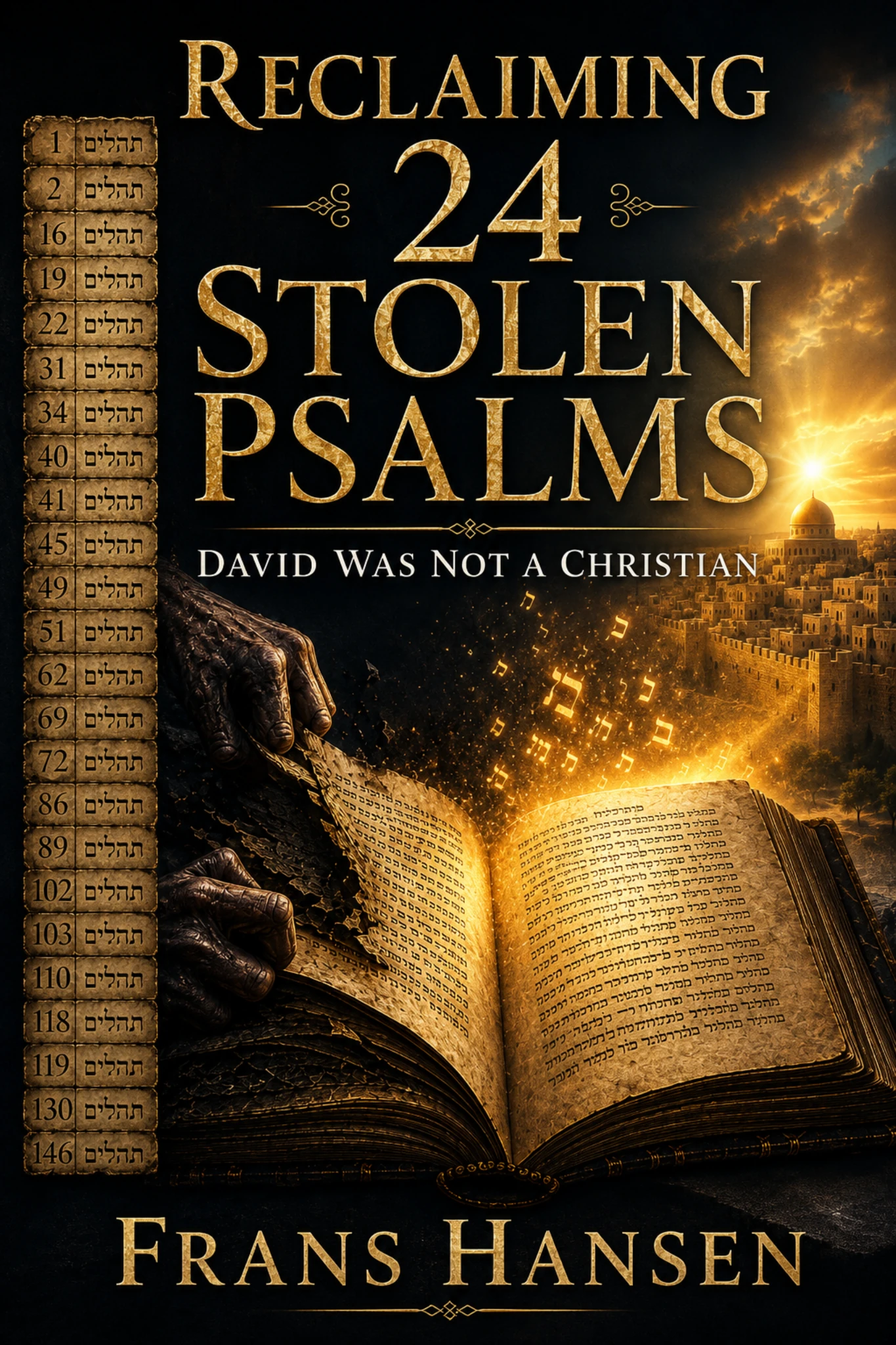
Reclaiming 24 Stolen Psalms cover

Search-focused Torah test

Does Psalm 110 prove Jesus sits at God’s right hand?

This article tests a common Christian claim against the Hebrew Bible before later theology is allowed to control the answer. The issue is whether the claim survives Torah, context, covenant identity, public meaning, and observable fulfilment.

The Christian claim

Claim tested: Does Psalm 110 prove Jesus sits at God’s right hand?

The usual claim is that Psalm 110 gives Christianity direct biblical authority. The verse, phrase, symbol, or narrative is treated as if it points forward to Jesus, the Church, a new covenant religion, a divine messiah, an abolished Torah, or a fulfilled prophecy in the Christian sense.

That move sounds persuasive when the reader begins inside Christian doctrine. It is much weaker when the reader begins inside the Hebrew Bible’s own legal and covenantal world. A later claim does not become the original meaning of the text just because the New Testament or church tradition uses the language later.

Text and context: Does Psalm 110 prove Jesus sits at God’s right hand?

1. Context before conclusion

Start with the passage in its own location. Ask who is speaking, who is addressed, what problem is being answered, and what outcome the text itself requires.

2. Covenant parties stay named

If the text names Israel, Judah, Zion, David, the nations, priests, Levites, or a specific generation, those parties cannot be silently replaced by a later theological group.

3. Public meaning beats decoder keys

A reading that only appears after Christian interpretation supplies a hidden key is not the public meaning of the Hebrew Bible. It may be theology, but it is not proof.

Where the prooftext fails: Does Psalm 110 prove Jesus sits at God’s

The claim depends on a shortcut. It lifts a word, image, or outcome from the Hebrew Bible and places it under Christian control before the original text has finished speaking.

The stronger procedure is slower and less flattering to inherited doctrine. First, let the Hebrew Bible define its own terms. Second, keep the legal function of the words stable. Third, ask whether the public conditions actually happened. Fourth, refuse to let later theology solve a contradiction by calling it mystery, fulfilment, or spiritual meaning.

Related book: Does Psalm 110 prove Jesus sits at God’s right hand?

For the full argument, use the linked book and the free PDF summary as your field reference.