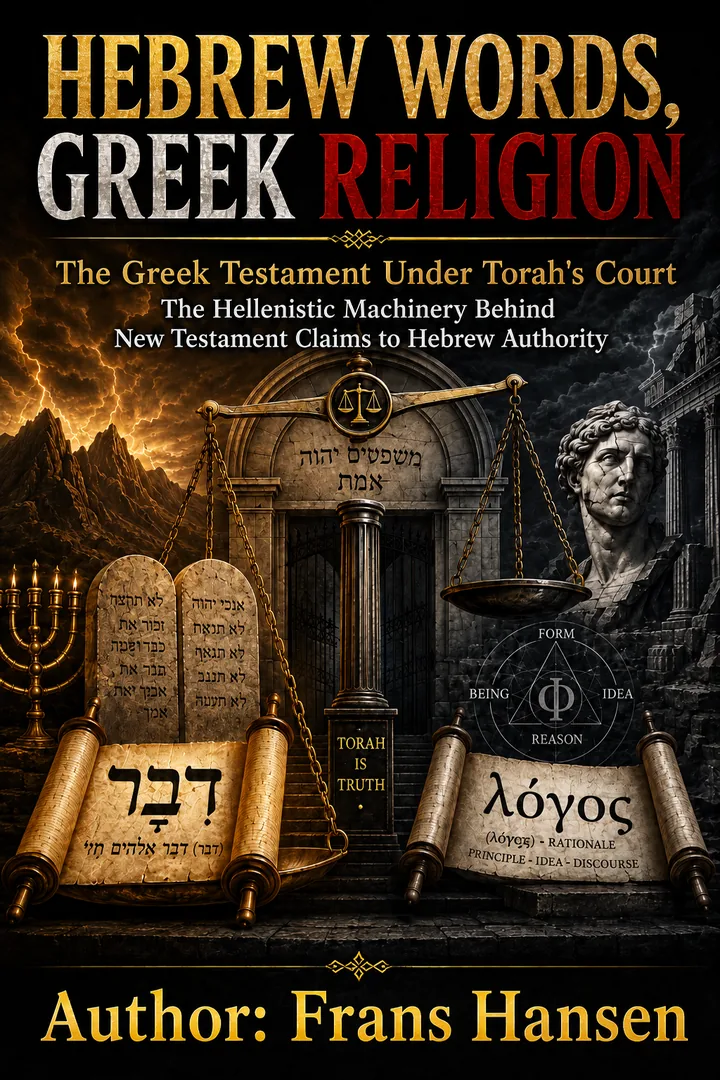
Why read Hebrew Words, Greek Religion: The Greek Testament Under Torah's Court? A Torah-first reader’s guide
This guide explains what the book actually examines, why that examination matters, and how to read it critically. It is not a substitute for the evidence in the book. It gives you the map before you enter the argument.
A forensic study of the Greek Testament under Torah’s court, exposing where Greek religious categories pull readers away from Hebrew Bible controls.
The Greek Testament Under Torah's Court. A forensic study of the Greek Testament under Torah’s court, exposing where Greek religious categories pull readers away from Hebrew Bible controls.
The central issue is authority. A Christian conclusion cannot prove itself merely by quoting an earlier Hebrew text. The wording, speaker, audience, covenant setting, and public outcome still control what the earlier text can support.
The controlling method
The book uses a Torah-first test: begin with the Hebrew Bible in its own literary and covenant setting, state the strongest Christian reading fairly, then ask whether the later claim preserves the original subject, meaning, and authority.
Who should read it
Jewish readers can use the book to identify where missionary arguments cross from quotation into reinterpretation. Noahides and questioning Christians can use it to separate reverence for Scripture from automatic acceptance of New Testament conclusions. Teachers and debaters can use its structure to keep the burden of proof visible.
What this guide does not claim
A forceful verdict is not a licence to skip sources. This guide does not turn every disagreement into dishonesty, and it does not make possible interpretations proven. The book succeeds only where its textual comparisons, context, and burden-of-proof analysis can be independently checked.
FAQ
What this book tests: Hebrew Words, Greek Religion: The Greek Testament Under Torah's Court?
A forensic study of the Greek Testament under Torah’s court, exposing where Greek religious categories pull readers away from Hebrew Bible controls. The central issue is authority. A Christian conclusion cannot prove itself merely by quoting an earlier Hebrew text. The wording, speaker, audience, covenant setting, and public outcome still control what the earlier text can support.
The controlling method: Hebrew Words, Greek Religion: The Greek Testament Under Torah's Court?
The book uses a Torah-first test: begin with the Hebrew Bible in its own literary and covenant setting, state the strongest Christian reading fairly, then ask whether the later claim preserves the original subject, meaning, and authority.
Who should read it: Hebrew Words, Greek Religion: The Greek Testament Under Torah's Court?
Jewish readers can use the book to identify where missionary arguments cross from quotation into reinterpretation. Noahides and questioning Christians can use it to separate reverence for Scripture from automatic acceptance of New Testament conclusions. Teachers and debaters can use its structure to keep the burden of proof visible.