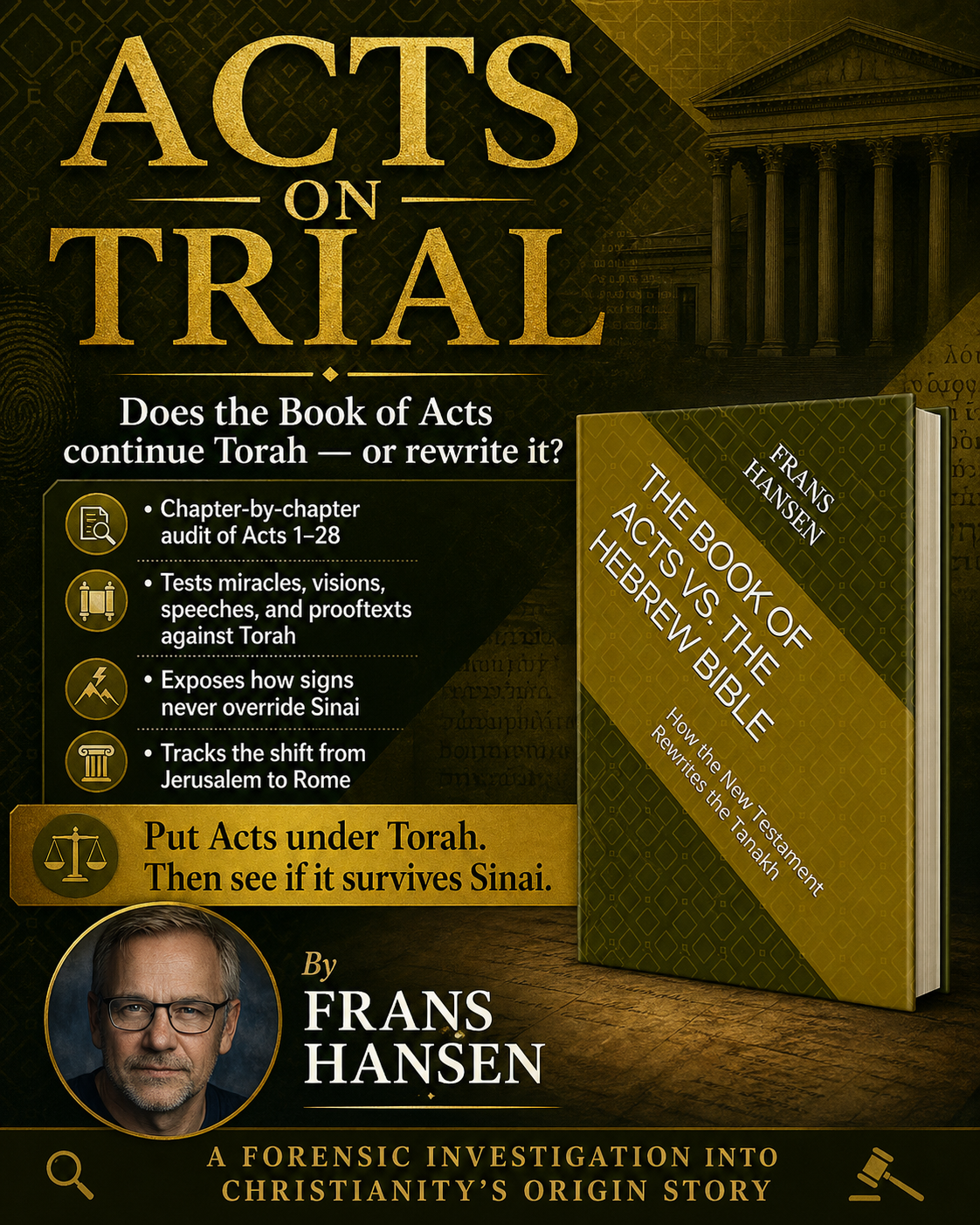
Author: Frans Hansen
What this book covers
Full detailed extended sales pitch from the sales-pitch workbook, column G.
FEATURES OF THE BOOK
The Book of Acts vs. The Hebrew Bible is not a devotional commentary. It is a full Torah-forensic audit of the Book of Acts — built to test whether Acts truly continues Israel’s covenant story, or whether it replaces Torah authority with charisma, visions, miracles, expansion, and institutional momentum. The manuscript runs to approximately 205 source pages, with the chapter-by-chapter audit covering Acts 1–28, followed by a Torah-forensic summary, final summary, and an Acts Pericope Hebrew Bible Reference Index. Final KDP page count may change with formatting, but the structure is already that of a serious study book, not a pamphlet.
BOOK STRUCTURE
The book contains:
- Author’s Introduction
- Why This Book Exists
- A clear explanation of what the book is and is not
- A Torah-based methodology
- 28 chapter-by-chapter audits of Acts
- Pericope-by-pericope analysis
- Chapter summaries
- Final verdicts for every chapter
- Repeated Torah testing under Deuteronomy 4, 13, and 18
- Analysis of miracles, visions, speeches, conversions, trials, and missionary expansion
- Tracking of how Acts uses the Hebrew Bible
- Tracking of how Acts reframes Jewish resistance
- Tracking of how Roman courts replace Torah adjudication
- A full Torah-forensic summary
- Final summary
- Acts Pericope Hebrew Bible Reference Index
Why this matters:
The book does not depend on one clever objection. It documents a system.
The reader is taken step by step through:
- why Acts claims continuity with the Hebrew Bible
- why claiming continuity is not the same as proving it
- why Torah standards must control the test
- why miracles cannot authorize new doctrine
- why visions cannot override covenant law
- why growth does not prove truth
- why resistance to the movement is repeatedly reframed as guilt
- why Hebrew Bible texts are repurposed to protect the new movement
- why Roman courts increasingly replace Torah courts
- why Paul becomes central to the narrative
- why Acts functions as a legitimacy engine for Christianity
- why the book must be judged under Sinai’s standards
STYLE
The style is forensic, direct, readable, and structured. Not devotional. Not church commentary. Not academic fog. Not soft interfaith reflection. It reads like a case file.
The book uses:
- chapter summaries
- pericope analysis
- textual coherence checks
- Tanakh alignment analysis
- halakhic and covenant legitimacy tests
- plain-language dismissals
- final hard verdicts
- chapter-level Torah verdicts
- pattern tracking across the whole book
- practical debate framing
Why this matters:
Most readers do not need another book praising Acts as “the birth of the church.” They need to see whether Acts survives the rules of the Torah it claims to inherit. This book gives them structure, clarity, and a repeatable method. It does not ask whether Acts is inspiring. It asks whether Acts is authorized.
CORE SECTIONS
AUTHOR’S INTRODUCTION
Explains the author’s refusal to accept inherited claims without inherited rules. Core point: Acts may sound biblical, but it must be judged by the Torah standards it claims to inherit.
WHY THIS BOOK EXISTS
States the governing problem: the Book of Acts has rarely been judged by the rules of the Torah. Core point: Acts claims continuity with Israel’s covenant, but the claim must be tested, not assumed.
WHAT THIS BOOK IS — AND IS NOT
Defines the book as a forensic audit, not an emotional attack on Christians or faith communities. Core point: The target is not people. The target is method, authority, and covenant legitimacy.
THE STANDARDS USED IN THIS STUDY
Establishes the legal controls:
Core point: Acts does not get to invent the rules by which it is judged.
- Deuteronomy 4:2 — nothing may be added to or subtracted from Torah
- Deuteronomy 13 — signs and wonders do not authorize new doctrine
- Deuteronomy 18 — prophetic claims must align with Torah
- Sinai model — covenant requires law, consent, and continuity
- Monotheism boundaries — God does not share salvific authority with human intermediaries
WHY NUMBERS MATTER
Explains that the book tracks patterns, not impressions. Core point: Acts is not dismissed because one passage is weak. It is exposed because the same replacement pattern appears again and again.
THE CENTRAL DISCOVERY
Shows the repeated substitution pattern inside Acts:
Core point: The problem is not occasional. It is systemic.
- law replaced by experience
- covenant process replaced by spectacle
- judicial testing replaced by growth
- Torah authority replaced by charismatic authority
- accountability replaced by momentum
ACTS 1 — AUTHORITY WITHOUT TORAH
Tests the ascension, restoration question, replacement of Judas, and apostolic succession. Core point: Acts begins by establishing leadership without Torah courts, prophetic verification, or covenant consent.
ACTS 2 — A REPLACEMENT-SINAI EVENT
Tests Pentecost, tongues, Peter’s speech, Joel, Psalm 16, baptism, forgiveness, and mass growth. Core point: Acts uses Sinai imagery without Sinai law, replacing covenant instruction with spectacle, emotion, and numerical expansion.
ACTS 3 — MIRACLE AS AUTHORIZATION
Tests the healing at the Temple, Peter’s sermon, repentance language, and claims about Moses and the prophets. Core point: Acts uses miracle and speech to validate authority, but Torah never allows signs to override covenant standards.
ACTS 4 — RESISTANCE REFRAMED AS REBELLION
Tests apostolic defiance, official resistance, Psalm use, communal unity, and boldness narratives. Core point: Acts turns institutional opposition into proof of the movement’s righteousness without submitting the claim to Torah adjudication.
ACTS 5 — SIGNS, FEAR, AND INTERNAL CONTROL
Tests Ananias and Sapphira, apostolic signs, imprisonment, angelic release, and Gamaliel’s counsel. Core point: Acts presents fear, miracles, and survival as validation, but Torah requires legal testing, not spiritual intimidation.
ACTS 6 — INSTITUTIONAL EXPANSION
Tests the appointment of the Seven, internal administration, Stephen’s rise, and conflict with synagogue opponents. Core point: Acts builds organizational structure before proving covenant authorization.
ACTS 7 — STEPHEN’S SPEECH AND ACCUSATION STRATEGY
Tests Stephen’s retelling of Israel’s history, Temple critique, Moses typology, and accusation against Israel’s leaders. Core point: Acts uses Israel’s own history to accuse Israel while avoiding the Torah’s own standards for judging new claims.
ACTS 8 — SAMARIA, MAGIC, AND ISAIAH 53
Tests Samaritan belief, Simon the magician, apostolic power transfer, and the Ethiopian eunuch reading Isaiah. Core point: Acts turns expansion and prooftext interpretation into legitimacy, but expansion and interpretation are not covenant authorization.
ACTS 9 — PAUL’S PRIVATE VISION
Tests Paul’s conversion, private revelation, blindness, healing, and sudden authority shift. Core point: Paul’s authority begins with private experience, not public Sinai-level verification.
ACTS 10 — CORNELIUS AND VISION-BASED OVERRIDE
Tests Peter’s vision, Cornelius, purity imagery, Gentile inclusion, and Spirit reception. Core point: Acts uses a vision to pressure covenant categories, but visions cannot rewrite Torah boundaries.
ACTS 11 — DEFENDING THE VISION
Tests Peter’s explanation to the Jerusalem believers and the acceptance of Gentile inclusion. Core point: The movement accepts a major shift through testimony about experience rather than formal Torah adjudication.
ACTS 12 — DELIVERANCE, DEATH, AND MOMENTUM
Tests Peter’s escape, Herod’s death, angelic intervention, and the movement’s continued growth. Core point: Acts keeps using survival and dramatic reversal as signs of divine approval.
ACTS 13 — PAUL’S MISSION AND SCRIPTURE REASSIGNMENT
Tests Paul’s synagogue sermon, Davidic claims, resurrection argument, Psalm use, Isaiah use, and Gentile turn. Core point: Acts begins the Pauline pattern of using Tanakh texts to redirect Israel’s promises toward the Jesus movement.
ACTS 14 — SIGNS AMONG THE NATIONS
Tests missionary expansion, healings, pagan reactions, suffering, and church formation. Core point: Acts treats missionary success as proof, but success is not covenant truth.
ACTS 15 — THE JERUSALEM COUNCIL
Tests Gentile obligations, circumcision, James’ ruling, Amos use, and the Noahide-style minimum requirements. Core point: Acts 15 is the major legal pivot: covenant status is restructured without Sinai-level authority.
ACTS 16 — VISIONS, BAPTISMS, AND HOUSEHOLD CONVERSIONS
Tests the Macedonian vision, Lydia, the slave girl, imprisonment, earthquake, and jailer conversion. Core point: Acts uses visions, dramatic events, and household conversions to accelerate legitimacy without Torah review.
ACTS 17 — PAUL IN ATHENS
Tests synagogue reasoning, Greek philosophical engagement, unknown god speech, resurrection claim, and universal judgment. Core point: Acts moves from Hebrew covenant categories into a broader Greek public-religious framework.
ACTS 18 — PAUL CONSOLIDATES AUTHORITY
Tests Corinth, synagogue conflict, Roman non-intervention, Apollos, and continued teaching. Core point: Acts normalizes the split by showing Christian proclamation continuing outside Jewish acceptance.
ACTS 19 — POWER ENCOUNTERS AND RELIGIOUS DISPLACEMENT
Tests Ephesus, disciples of John, Spirit reception, exorcism, magic books, and Artemis conflict. Core point: Acts presents Christianity as superior spiritual power, but Torah does not define truth by power contests.
ACTS 20 — PAUL’S FAREWELL AND INTERNAL SUCCESSION
Tests Paul’s farewell speech, warnings, elders, suffering, and transfer of responsibility. Core point: Acts creates apostolic continuity through Paul’s authority, not through Torah institutions.
ACTS 21 — PAUL, TORAH OBSERVANCE, AND PUBLIC SUSPICION
Tests Paul’s arrival in Jerusalem, concerns about Torah, purification, Temple controversy, and arrest. Core point: Acts exposes the unresolved problem: Paul is suspected of undermining Torah, and the narrative never truly clears the charge under Torah law.
ACTS 22 — PAUL’S DEFENSE BY VISION
Tests Paul’s public defense, conversion retelling, divine commission, and Gentile mission claim. Core point: Paul answers legal suspicion with private revelation.
ACTS 23 — CLAIM MANAGEMENT BEFORE AUTHORITIES
Tests Paul before the council, Pharisee/Sadducee division, plot against Paul, and Roman protection. Core point: Acts uses internal Jewish division and Roman custody to preserve Paul without Torah adjudication.
ACTS 24 — PAUL BEFORE FELIX
Tests accusations of sectarianism, resurrection defense, Torah claims, and delayed judgment. Core point: Acts shifts the arena from Torah courts to Roman legal procedure.
ACTS 25 — PAUL APPEALS TO CAESAR
Tests Roman escalation, Jewish accusations, Festus, Agrippa, and appeal to Caesar. Core point: The movement that claims Israel’s God now seeks protection and platform through imperial courts.
ACTS 26 — PAUL’S FINAL APOLOGIA
Tests Paul’s testimony before Agrippa, prophetic claims, resurrection argument, and appeal to Jewish Scripture. Core point: Paul presents Christianity as prophetic fulfillment, but the defense still rests on private revelation and contested interpretation.
ACTS 27 — SEA VOYAGE AND PROVIDENTIAL DRAMA
Tests storm, shipwreck, angelic message, and Paul’s survival leadership. Core point: Acts uses providential drama to elevate Paul’s authority, but survival is not Torah authorization.
ACTS 28 — ROME WITHOUT VERDICT
Tests Malta, healing, arrival in Rome, Jewish response, Isaiah quotation, and open-ended proclamation. Core point: Acts ends with mission, not Torah verdict. The claim expands, but it is never judged by Sinai.
THE BOOK OF ACTS — TORAH-FORENSIC SUMMARY
Pulls the whole pattern together across the entire book. Core point: Acts repeatedly replaces covenant adjudication with narrative momentum.
FINAL SUMMARY
Condenses the book-level conclusion. Core point: Acts is compelling as movement history, but fails as Torah-authorized covenant continuation.
APPENDIX — ACTS PERICOPE HEBREW BIBLE REFERENCE INDEX
Indexes the Hebrew Bible references and control texts relevant to the Acts analysis. Core point: The reader can trace the Tanakh pressure points behind the audit.
APPENDIX AND REFERENCE TOOLS
The appendix is not filler. It turns the book into a reference tool. A quick-reference index connecting Acts pericopes to the Hebrew Bible passages and Torah standards in view.
Why it matters:
Readers can quickly locate the relevant Tanakh controls behind the Acts claims.
That makes the book useful for:
- debate preparation
- study groups
- article writing
- video scripts
- missionary response
- chapter-by-chapter verification
- comparing Acts claims with Torah standards
WHY THE REFERENCE INDEX MATTERS
Without the reference index, the book is a chapter-by-chapter study. With it, it becomes a toolkit.
It helps readers:
The reference index turns the book from something to read into something to use.
- answer missionary claims about Acts
- test apostolic authority claims
- track how Acts uses the Hebrew Bible
- identify where signs and visions replace Torah standards
- expose prooftext misuse
- understand the shift from Jerusalem to Rome
- see how Paul becomes the center of the narrative
- debate Acts with structure instead of scattered objections
- stop being intimidated by claims of “the early church”
- verify whether Acts continues Israel’s covenant or bypasses it
WHY THE METHOD MATTERS
The book does not ask the reader to dislike Acts. It asks the reader to test Acts.
The method is simple:
That is why this book is dangerous to weak apologetics. It does not argue from emotion. It argues from standards Acts itself claims to inherit.
- restore Torah as the controlling authority
- restore Deuteronomy 4, 13, and 18 as legal tests
- restore Sinai as the covenant standard
- restore monotheism as the boundary
- restore public adjudication over private revelation
- restore covenant process over religious momentum
- then ask whether Acts survives
COMPACT SALES DESCRIPTION
The Book of Acts vs. The Hebrew Bible is a full Torah-forensic audit of the New Testament’s origin story of the church. Across approximately 205 source pages, the book examines Acts 1–28 chapter by chapter and pericope by pericope, testing every major speech, miracle, vision, conversion, authority claim, prooftext, trial, and missionary expansion against the standards of the Torah. It is not a devotional commentary. It is a structured case file. The book begins with one unavoidable question: if Acts claims to continue Israel’s covenant story, why has it so rarely been judged by Israel’s covenant rules? It then applies the governing Torah standards: Deuteronomy 4:2 forbids adding to or subtracting from Torah; Deuteronomy 13 warns that signs and wonders cannot authorize new doctrine; Deuteronomy 18 tests prophetic claims; the Sinai model requires covenant continuity; and monotheism forbids sharing salvific authority with human intermediaries. The study then walks through the entire Book of Acts: the ascension, the deferral of Israel’s restoration, Pentecost, Peter’s speeches, apostolic miracles, Stephen’s accusation, Samaritan expansion, Paul’s private vision, Cornelius, the Jerusalem Council, Paul’s missionary journeys, synagogue conflicts, Roman trials, appeal to Caesar, and the final open-ended arrival in Rome. The repeated pattern is exposed: Acts replaces law with experience, covenant process with spectacle, judicial testing with growth, Torah authority with charismatic authority, and accountability with momentum. The final sections turn the book into a practical reference system, with a Torah-forensic summary, final summary, and Acts Pericope Hebrew Bible Reference Index. The result is a book that does more than criticize Acts. It equips the reader. It gives context to the confused. Structure to the debater. Language to the ex-Christian. Weapons to the anti-missionary educator. Clarity to Jews and Noahides tired of seeing Acts presented as obvious proof of divine continuity. And one clear challenge to anyone who still claims Acts proves Christianity’s authority: Put Acts under Torah. Test the signs. Test the visions. Test the speeches. Test the prooftexts. Test the authority claims. Then see if the movement survives Sinai.
Visual sales pitch
A quick visual case summary for this book.