Jewish readers and Israel advocates
Evaluate claims concerning antisemitism, hostages and collective accusation.

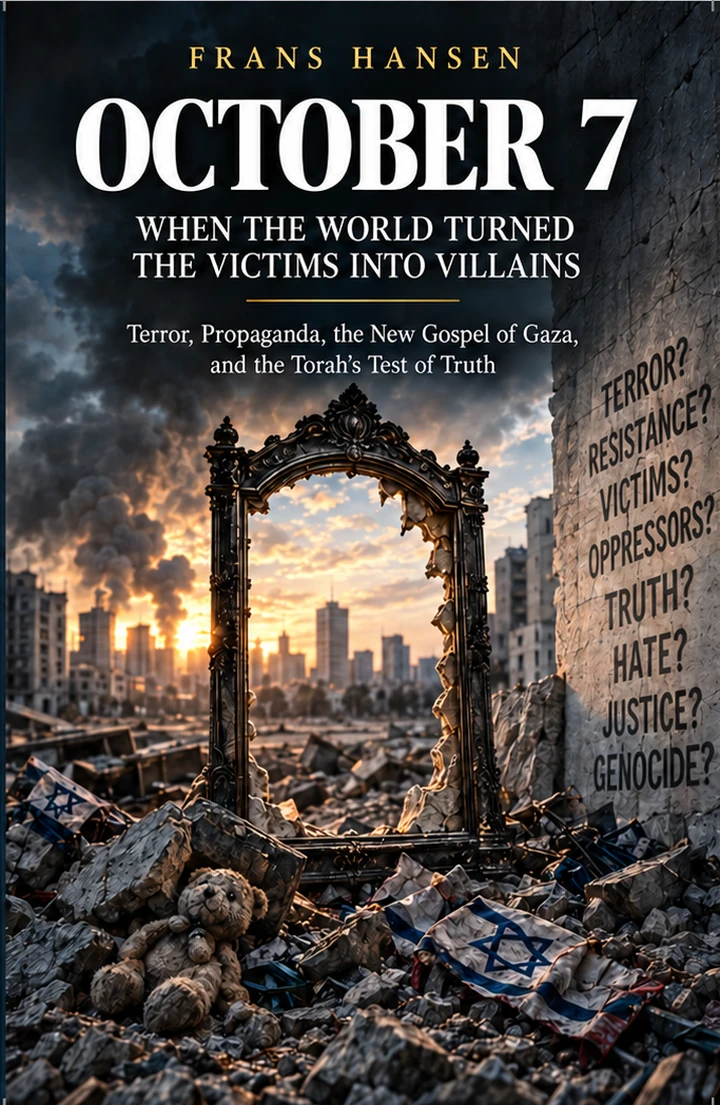
Frans Hansen
A Torah-first investigation of the October 7 Hamas attacks, the hostages, competing public narratives, antisemitism and moral responsibility. Documented events, disputed claims and the author's interpretations are kept distinct.
Available editions
Prices and availability are subject to retailer confirmation.
Inside the investigation
The book examines the attack and hostage-taking, conflicting public accounts and the ethics of collective blame. Its Torah-first perspective is explicit. Readers can inspect how opposing arguments are tested rather than simply dismissed.
From the manuscript
Excerpt from the revised manuscript, printed page 150, discussing competing accounts of the Muslim Brotherhood.
The defender's strongest argument deserves a direct answer. Repression can distort what an organisation says publicly, drive activity out of sight and produce wrongful accusations by political opponents. That possibility must be investigated where it bears upon the evidence. It also cannot excuse a proven assault on civilians. Victimisation and responsibility can belong to the same institution in different acts.
The critic's strongest answer is equally concrete. A movement that claims non-violence must answer authenticated endorsements, assistance or instructions that contradict the claim. It cannot demand that a declaration govern the verdict while conduct is excluded. The burden remains to authenticate the contradiction and identify the institution or person responsible.
Source: revised manuscript, p. 150. This passage illustrates the author's evidence-comparison method. It is not a standalone determination about a present-day organisation.
Frans Hansen writes from a Noahide commitment to the God of Israel and the authority of the Hebrew Scriptures, with respect for Orthodox Jewish learning. His work examines religious claims, antisemitism, Israel and moral responsibility. He does not claim rabbinic ordination or the authority to decide halakhah.
Publication: 2026 · Revised manuscript: 274 pages including front matter and appendices. Retail edition page counts can differ. Formats: Kindle, paperback and hardcover.
Evaluate claims concerning antisemitism, hostages and collective accusation.
Examine theological parallels and test them against the Hebrew Bible.
Study scriptural standards for judgment, evidence and accountability.
Follow the evidence ledger, objections and public-record comparisons.
Separate civilian suffering from the responsibility of individual perpetrators.
Challenge the thesis, including the strongest objections presented in Chapter 17.
Main parts: The event and hostages · Narratives · Networks and money · Imagery · Identity and institutions · Judgment and redemption · Evidence appendices.
Choose your edition
Buy directly from your preferred retailer. Prices and availability may change.