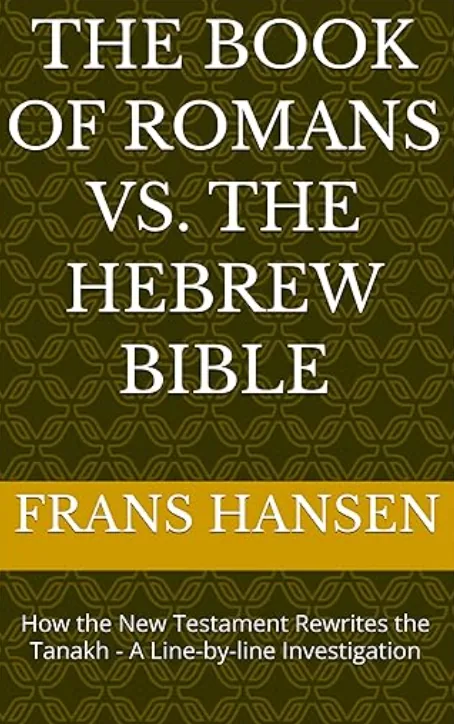
Author: Frans Hansen
What this book covers
Full detailed extended sales pitch from the sales-pitch workbook, column G.
THE BOOK OF ROMANS VS. THE HEBREW BIBLE
What if Christianity’s most important theological letter does not continue the Hebrew Bible — but replaces it?
Romans is not a side document.
It is the engine room of Christianity. Justification by faith. Original sin. Universal guilt. Law versus grace. Faith apart from works. The gospel as salvation. The alleged failure of Israel. The reinterpretation of Abraham. The claim that Torah cannot justify. The argument that Jews and Gentiles now stand on the same religious ground through Jesus. Much of Christianity runs through Romans. That is why this book matters. If Romans stands, Christian theology has its strongest foundation. If Romans falls, the whole system starts shaking. The Book of Romans vs. The Hebrew Bible places Paul’s most important letter on trial before the Scriptures Paul claims to explain. Not before church tradition. Not before Protestant doctrine. Not before missionary slogans. Not before emotional testimony. Not before “Paul said it, so it must be true.” Before the Hebrew Bible. Before Torah. Before Tanakh. Before covenant law. Before Jewish definitions of righteousness, repentance, sin, faith, justice, Israel, and salvation. This is not a devotional commentary. It is a forensic audit. A claim is made. The Hebrew Bible is opened. The original category is restored. Paul’s use of the text is tested. The legal and covenantal implications are exposed. A verdict is delivered.
Romans claims to explain Israel’s God.
This book asks:
Does it?
Romans claims to explain Israel’s Scriptures.
This book asks:
By whose rules?
Romans claims to reveal the gospel promised by the prophets.
This book asks:
Where exactly did the prophets say that?
Romans claims that righteousness comes through faith.
This book asks:
Is that what emunah means in the Hebrew Bible?
Romans claims that Torah cannot justify.
This book asks:
Why does the Torah itself call obedience life, righteousness, and blessing?
Romans claims universal guilt.
This book asks:
What about Ezekiel 18, Deuteronomy 30, Noah, Job, Daniel, Cornelius, repentance, and individual responsibility?
Romans claims Abraham supports Paul’s system.
This book asks:
Or did Paul tear Abraham out of his covenantal setting?
Romans claims Israel stumbled.
This book asks:
Or did Paul redefine success after the Christian claim failed under Tanakh standards? That is the central issue.
Romans does not merely interpret Judaism.
Romans rewrites its operating system.
In the Hebrew Bible, righteousness is covenant faithfulness. In Romans, righteousness is reframed through belief in Paul’s gospel. In the Hebrew Bible, repentance restores. In Romans, humanity is placed under a universal guilt problem that requires Paul’s solution. In the Hebrew Bible, Torah is life. In Romans, Torah becomes the instrument that exposes death. In the Hebrew Bible, Abraham is the father of covenant obedience. In Romans, Abraham is transformed into a prototype of faith apart from law. In the Hebrew Bible, Israel remains God’s covenant people. In Romans, Israel becomes a theological problem to be solved. In the Hebrew Bible, God judges each person by deeds. In Romans, Paul builds a system that later turns toward faith apart from works. That is not continuation. That is replacement. This book exposes the shift verse by verse. The manuscript walks through Romans 1–16 in detail, beginning with Paul’s self-authorization and ending with the final verdict of the Hebrew Bible. It does not skim. It does not cherry-pick. It does not attack one famous verse and pretend the job is done. It follows Paul through the entire argument. Romans 1 — Paul’s authority, his gospel claim, universal guilt, creation knowledge, idolatry, vice lists, and the foundation of Christian anthropology.
Romans 2 — judgment, works, Torah, Gentiles, circumcision, hypocrisy claims, and Paul’s attempt to collapse Jewish moral confidence.
Romans 3 — “none righteous,” law and sin, justification, faith apart from works, and Paul’s use of Psalms and prophetic language.
Romans 4 — Abraham, faith, circumcision, covenant timing, righteousness, and whether Paul’s Abraham is still the Abraham of Genesis.
Romans 5 — Adam, death, grace, original sin, substitution, and the foundation of inherited guilt theology.
Romans 6 — death to sin, baptismal identity, slavery language, and the replacement of Torah-obedience categories with union-with-Christ categories.
Romans 7 — Torah, sin, the “law of sin,” the divided self, and Paul’s most damaging psychological reframing of the commandments.
Romans 8 — Spirit, flesh, adoption, suffering, glory, predestination, and the replacement of covenant obedience with spiritual identity.
Romans 9 — Israel, election, Pharaoh, mercy, hardening, vessels of wrath, and Paul’s attempt to defend God while redefining covenant promise.
Romans 10 — zeal without knowledge, Christ as the alleged end or goal of Torah, confession, belief, and Paul’s reuse of Deuteronomy.
Romans 11 — Israel’s alleged stumbling, the remnant, the olive tree, Gentile arrogance, and Paul’s unstable attempt to preserve and relativize Israel at the same time.
Romans 12 — ethics, sacrifice language, transformation, humility, love, and whether Pauline ethics can replace Torah categories.
Romans 13 — governing authorities, Rome, obedience, love as fulfillment of law, and the political danger of Paul’s teaching.
Romans 14 — food, days, conscience, judgment, and Paul’s soft dismantling of Torah practice through “disputable matters.”
Romans 15 — Gentiles, hope, Scripture reuse, mission, and Paul’s final attempt to frame his work as Tanakh fulfillment.
Romans 16 — final greetings, warnings, authority networks, and the closing shape of Pauline Christianity.
This book is built for readers who want more than slogans. It is for Christians brave enough to test Paul without church protection. It is for Jews tired of hearing Romans quoted as if it settled the Hebrew Bible. It is for ex-Christians rebuilding from inherited guilt theology. It is for Noahides who want a clean path to the God of Israel without Pauline confusion. It is for anti-missionary educators who need structure, not scattered replies.
It is for anyone who has ever been told:
“Romans proves the law cannot save.” “Romans proves faith apart from works.” “Romans proves everyone is guilty.” “Romans proves Jesus is the only solution.” “Romans proves Israel missed the point.”
This book answers:
No.
Romans proves what happens when Hebrew categories are translated into a new religious system.
That is the problem. Paul does not simply quote the Hebrew Bible. He reprograms it. He takes emunah and moves it toward belief. He takes righteousness and moves it away from covenant obedience. He takes Torah and turns it into a diagnostic instrument for sin. He takes Abraham and detaches him from covenant law. He takes Adam and builds a universal guilt machine. He takes Israel’s election and turns it into a theological crisis. He takes Gentile inclusion and makes it depend on his gospel. He takes repentance and pushes it behind a larger salvation mechanism. He takes Scripture and makes it speak Paul. This book forces Romans to answer the question Christianity rarely permits: Did the Hebrew Bible actually teach this? The answer is not assumed. It is tested.
Each major claim is measured against:
The result is a book that does not merely criticize Paul. It exposes the architecture.
- Torah authority
- Tanakh context
- Hebrew meaning
- Jewish covenant logic
- individual responsibility
- repentance and teshuvah
- Noahide categories
- messianic expectations
- Abrahamic covenant structure
- the role of Israel
- works-based judgment
- Paul’s internal contradictions
- New Testament tensions
- later Christian doctrinal consequences
Romans is not treated as sacred fog.
It is treated as a legal argument. And legal arguments can be tested. If Paul claims authority, he must show authorization. If Paul claims prophecy, he must show the text. If Paul claims Abraham, he must preserve Abraham’s covenant. If Paul claims righteousness, he must use the Hebrew Bible’s definition. If Paul claims Torah cannot justify, he must explain why Torah calls obedience life. If Paul claims universal guilt, he must answer Ezekiel 18. If Paul claims faith apart from works, he must answer every passage where God judges by deeds. If Paul claims Israel failed, he must answer God’s eternal covenant promises. If Paul claims the gospel was promised beforehand, he must prove it from the prophets without importing the conclusion. That is why this book is dangerous to weak apologetics. It does not argue from anger. It argues from standards. It does not ask the reader to hate Paul. It asks the reader to test Paul. The distinction matters. Because the issue is not whether Paul was sincere. The issue is whether Paul was authorized. The issue is not whether Romans is powerful. The issue is whether Romans is true under the Hebrew Bible. The issue is not whether Christianity built doctrine from Romans. The issue is whether Romans had the right to rebuild the doctrine of Israel’s God in the first place. The Book of Romans vs. The Hebrew Bible gives readers a verse-by-verse weapon against confusion. It shows where Paul asserts instead of proves. Where he quotes without context. Where he shifts Hebrew meanings. Where he builds doctrine from Greek categories. Where he uses Israel’s Scriptures while changing Israel’s covenant logic. Where he contradicts Torah. Where he contradicts other New Testament voices. Where he creates the foundation for doctrines the Hebrew Bible never needed. The book is not short. It is not shallow. It is not a motivational essay. It is a full case file. It is designed for people who want to know exactly where the Pauline system breaks. Not vaguely. Not emotionally. Not with one clever line. But verse by verse. Claim by claim. Text by text. Verdict by verdict.
The central challenge is simple:
If Romans truly explains the Hebrew Bible, it should survive the Hebrew Bible. If Paul truly teaches Israel’s God, he should not need to redefine Israel’s Scriptures. If the gospel was truly promised by the prophets, the prophets should be able to say so in context. If Torah truly cannot justify, Moses should have said so. If faith apart from works is true, the Tanakh should not repeatedly teach judgment according to deeds. If universal guilt is true, Ezekiel 18 should not exist. If original sin is true, Deuteronomy 30 should not say life is near, doable, and chosen through obedience. If Christianity is continuation, Romans should not need replacement logic to work. That is the test. And once Romans is placed under that test, the result becomes unavoidable: Paul’s system does not continue the Hebrew Bible. It competes with it. It uses its language. It borrows its names. It quotes its verses. It claims its God. It invokes its prophets. It appeals to its patriarchs. But it changes the rules. And once the rules are changed, the covenant has been replaced. Because Romans is not merely one New Testament letter.
Romans is the theological bridge Christianity built between the Church and the Tanakh.
This book asks whether that bridge is real — or whether it was built on mistranslation, redefinition, and legal overreach. Read Romans with the Tanakh open. Test Paul’s authority. Test his gospel. Test his Abraham. Test his Adam. Test his faith. Test his law. Test his Israel. Test his salvation system. Test his use of Scripture.
Then ask the question Christianity has avoided for two thousand years:
Does Romans actually pass the Hebrew Bible?
Visual sales pitch
A quick visual case summary for this book.