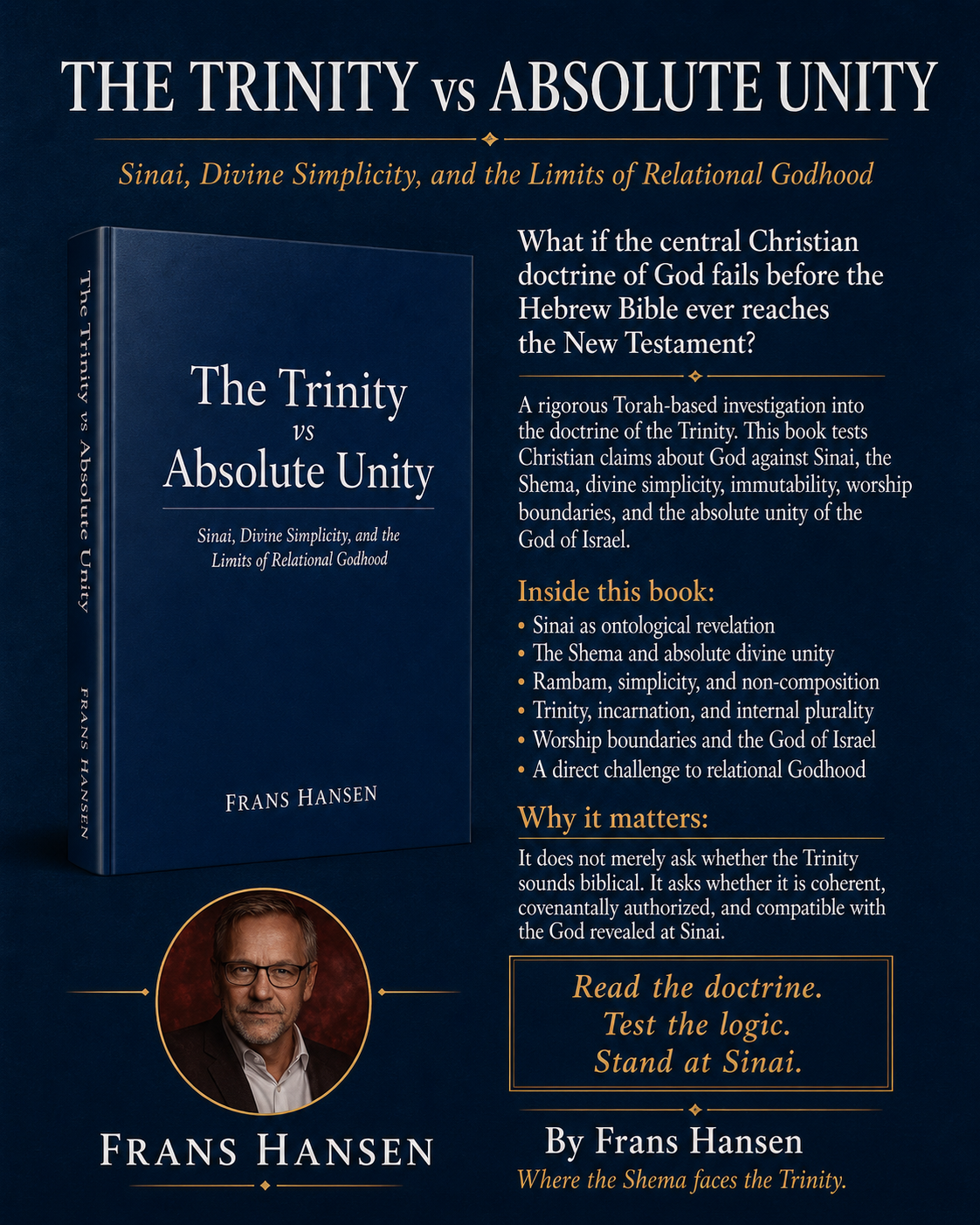
Author: Frans Hansen
What this book covers
Full detailed extended sales pitch from the sales-pitch workbook, column G.
THE TRINITY VS ABSOLUTE UNITY
What if the central Christian doctrine of God fails before the Hebrew Bible ever reaches the New Testament? Christianity says God is one. Judaism says God is one.
But the question is brutal:
Do they mean the same thing? The Trinity vs Absolute Unity is a serious theological and metaphysical investigation into the most important question in religion: What is God? Not what do people feel about God. Not what later councils declared. Not what inherited doctrine demands. Not what devotional language protects. But what the Hebrew Bible reveals, what Sinai permits, what reason can defend, and what worship may lawfully address. This book takes the Christian doctrine of the Trinity and tests it against the absolute unity of the God of Abraham, Isaac, and Jacob. The issue is not whether Trinitarian language sounds sophisticated. It does. The issue is whether it is compatible with divine unity as revealed at Sinai. That is the pressure point. Christian theology claims that God is one essence in three persons.
Judaism confesses something structurally different:
God is not composed. God is not internally divided. God is not a society of relations. God is not one being with three centers of personal distinction. God is not incarnated. God does not become. God does not enter history as a man. God does not share worship with another. God does not require philosophical repair to remain one. The God of Israel is absolute unity. Not a unity assembled from relations. Not a unity balanced between persons. Not a unity explained through mystery after contradiction appears. Absolute unity. This book asks whether Christian Trinitarianism can survive that standard. It does not mock the Trinity. That would be too easy.
It does something more dangerous:
It defines it carefully. Then it tests it. The Trinity vs Absolute Unity begins with the foundation: Sinai as ontological revelation. Sinai was not merely the giving of commandments. It was the public revelation of who God is. Israel did not receive a hidden plurality, an incarnational structure, or a divine family of persons. Israel received the God whose unity would become the boundary of worship.
From there, the book builds the case step by step:
The structure matters. This is not a random attack on Christian belief. It is a layered argument. First, the book establishes the Jewish and Torah-grounded concept of divine unity. Then it presents Christian doctrine in its strongest form.
- Sinai as ontological revelation
- covenant closure
- the Shema and divine unity
- Rambam and absolute simplicity
- negative theology
- necessary being and non-composition
- the Christian definitions of ousia and hypostasis
- eternal generation and procession
- contemporary analytic Trinity models
- incarnation and composite union
- kenosis and self-limitation
- Logos theology
- Psalm 110
- plural language in Torah
- the Angel of YHWH
- Two Powers in Heaven
- Wisdom, Memra, and personification
- Daniel 7
- resurrection and miracles
- Jeremiah 31 and the meaning of “new”
- prayer and divine address
- Arianism, Modalism, Tritheism
- the councils and the consolidation of Trinitarian language
- divine simplicity
- worship integrity
- final ontological synthesis
Then it asks the unavoidable question:
Can absolute unity contain internal personal distinction without becoming composite? That question is the blade. If God is necessary being, He cannot depend on internal parts that explain Him. If God is simple, He cannot be composed of essence plus relations plus persons. If God is immutable, He cannot become incarnate. If God is infinite, He cannot be contained in a finite body. If God alone is to be worshiped, no human figure may receive divine worship. If Sinai revealed God publicly, no later doctrine may redefine His identity through private interpretation, Greek metaphysics, or church councils. The Christian answer is usually “mystery.” This book refuses to let mystery do the work of coherence. Mystery can protect what is beyond human comprehension. It cannot rescue contradiction. That distinction is fatal. The Trinity vs Absolute Unity shows that the Trinity does not merely add complexity to Jewish monotheism. It changes the structure of God. It introduces internal relation. It introduces personhood distinctions. It introduces eternal generation. It introduces procession. It introduces incarnation. It introduces a divine-human composite. It introduces mediated worship. It introduces a Son who is not the Father, a Father who is not the Son, and a Spirit who is neither — while insisting this is still one God. That is not the Shema. That is a different ontology. And once ontology changes, worship changes. That is why this book matters. The debate over the Trinity is not an abstract puzzle for theologians. It determines who is being worshiped. If God is absolute unity, then Trinitarian worship crosses a boundary. If God is internally tri-personal, then Jewish worship is missing God’s inner identity. Both cannot be true in the same sense. Someone is redefining the word “one.” This book forces that issue into the open.
It examines the strongest Christian moves:
“Let us make man” in Genesis. “The Angel of the LORD.” “The Word became flesh.” “Before Abraham was, I am.” “Psalm 110 proves two divine figures.” “Daniel 7 shows a heavenly Son of Man.” “Isaiah 45 is applied to Jesus.” “Philippians 2 includes Jesus in divine identity.” “Wisdom and Logos show plurality in God.” “The Trinity is not three gods, but one essence.” “God can do anything, so incarnation is possible.” Each claim is tested. Not emotionally. Structurally. Can it fit the Hebrew Bible? Can it fit absolute simplicity? Can it fit necessary being? Can it fit immutability? Can it fit worship law? Can it fit Sinai? If not, the claim fails.
The book’s central argument is severe:
A God who must be explained through internal distinctions is not the same as the absolute One revealed to Israel. A God who becomes incarnate is not immutable. A God who is internally relational is not non-composite. A God whose worship includes a man has crossed the boundary of Torah monotheism. A theology that needs Greek categories to explain the God of Sinai is no longer simply reading Sinai. It is rebuilding God after Sinai. This book is for readers who are done with vague answers. It is for Jews who want a stronger defense of absolute unity. It is for Noahides who want to understand why the Trinity is not compatible with the God of Israel. It is for Christians brave enough to test their doctrine of God without hiding behind “mystery.” It is for ex-Christians rebuilding after Trinitarian confusion. It is for anti-missionary educators who need more than prooftext replies. It is for serious readers who know that the question “Who is God?” cannot be answered with slogans. The Trinity vs Absolute Unity does not merely ask whether the Trinity is biblical. It asks whether the Trinity is metaphysically coherent. Whether it is covenantally authorized. Whether it is compatible with Sinai. Whether it preserves divine simplicity. Whether it respects the worship boundary. Whether it can still honestly claim the God of Abraham, Isaac, and Jacob.
The answer this book gives is direct:
No. Not because Christians are stupid. Not because Trinitarian theologians are careless. Many are brilliant. That is precisely why the problem is so serious. The best Christian minds have spent centuries trying to explain how God can be one and three without becoming three gods, one mask, or a contradiction. The fact that the doctrine requires that level of conceptual machinery is already evidence that it does not arise naturally from the Hebrew Bible. The Shema does not require metaphysical rescue. Sinai does not require Nicene vocabulary. Moses does not need ousia and hypostasis to identify the One God. The God of Israel is not a theological equation waiting for Greek completion. He is One. This book brings the reader back to that. Not as a slogan. As ontology. As worship boundary. As covenant discipline. As intellectual restraint. As the foundation of true monotheism. The Trinity vs Absolute Unity is not a light devotional read. It is a serious argument for serious readers. It defines terms. It tests models. It exposes category mistakes. It challenges inherited assumptions. It refuses emotional shortcuts. It forces theology to answer to revelation, reason, and worship law.
And it leaves the reader with one unavoidable question:
If God is absolutely One, who gave Christianity permission to divide His identity into three? Where Sinai faces Nicaea. Where the Shema faces the Trinity. Where divine simplicity faces eternal relations. Where incarnation faces immutability. Where worship faces the boundary of Torah. Where the God of Abraham, Isaac, and Jacob is defended as absolute One. Not one essence in three persons. One. Without division. Without composition. Without incarnation. Without internal plurality. Without rival worship. Without theological expansion beyond Sinai. Read the doctrine. Test the logic. Open the Torah. Stand at Sinai. Then ask whether the Trinity survives absolute unity.
Visual sales pitch
A quick visual case summary for this book.