
Evidence bridge
by Frans Hansen Pharaoh: The First Christian Theologian: Pharaoh never says, “I don’t believe in your God.” He says something far more dangerous: • “Who exactly is going?
The reader wants a bounded verdict: what “by Frans Hansen Pharaoh: The First Christian Theologian: Pharaoh never says, “I don’t believe in your God.” He says something far more dangerous: • “Who exactly is going?” establishes, what remains possible, and what it does not authorize, using the controlling Tanakh passages, the exact Christian premise, covenant context, and the burden of proof for any added doctrine.
What this article established
The archived phrase “Pharaoh: the first Christian theologian” is polemical analogy, not history. Exodus does show something sharper: Pharaoh repeatedly acknowledges Hashem’s power yet negotiates obedience—who may leave, how far, and what property may go. Recognition without submission is not covenant faithfulness.
- Verified: Pharaoh and his court come to acknowledge Hashem’s power during the plague narrative.
- Verified: Pharaoh repeatedly negotiates the scope of Israel’s obedience.
- Verified: Moses refuses those negotiated reductions.
- Polemical analogy only: “Pharaoh was the first Christian theologian.”
- Legitimate methodological question: when a later religion changes Torah practice, what establishes divine authorization for the change?
The question that still remains
Beyond “by Frans Hansen Pharaoh: The First Christian Theologian: Pharaoh never says, “I don’t believe in your God.” He says something far more dangerous: • “Who exactly is going?”, can the larger claim be established across Two hundred focused questions requiring Christian claims to face the Hebrew Bible before the New Testament supplies the answer while the controlling Tanakh passages, the exact Christian premise, covenant context remains controlling?
Why this book is the next step
This assignment is justified by the unresolved evidence field, not by keyword overlap. The next task after Frans, Hansen, Pharaoh, First is Beyond “by Frans Hansen Pharaoh: The First Christian Theologian: Pharaoh never says, “I don’t believe in your God.” He says something far more dangerous: • “Who exactly is going?”, can the larger claim be established across Two hundred focused questions requiring Christian claims to face the Hebrew Bible before the New Testament supplies the answer while the controlling Tanakh passages, the exact Christian premise, covenant context remains controlling?; BEFORE YOU BELIEVE: 200 Questions Christianity Must Answer From the Hebrew Bible First covers Two hundred focused questions requiring Christian claims to face the Hebrew Bible before the New Testament supplies the answer. The assignment would fail if the remaining question were different; its fit depends on the exact move from Frans / Hansen / Pharaoh / First into Two hundred focused questions requiring Christian claims to face the Hebrew Bible before the New Testament supplies the answer. The worked hinge that makes this assignment specific is Frans / Hansen / Pharaoh / First / Theologian.
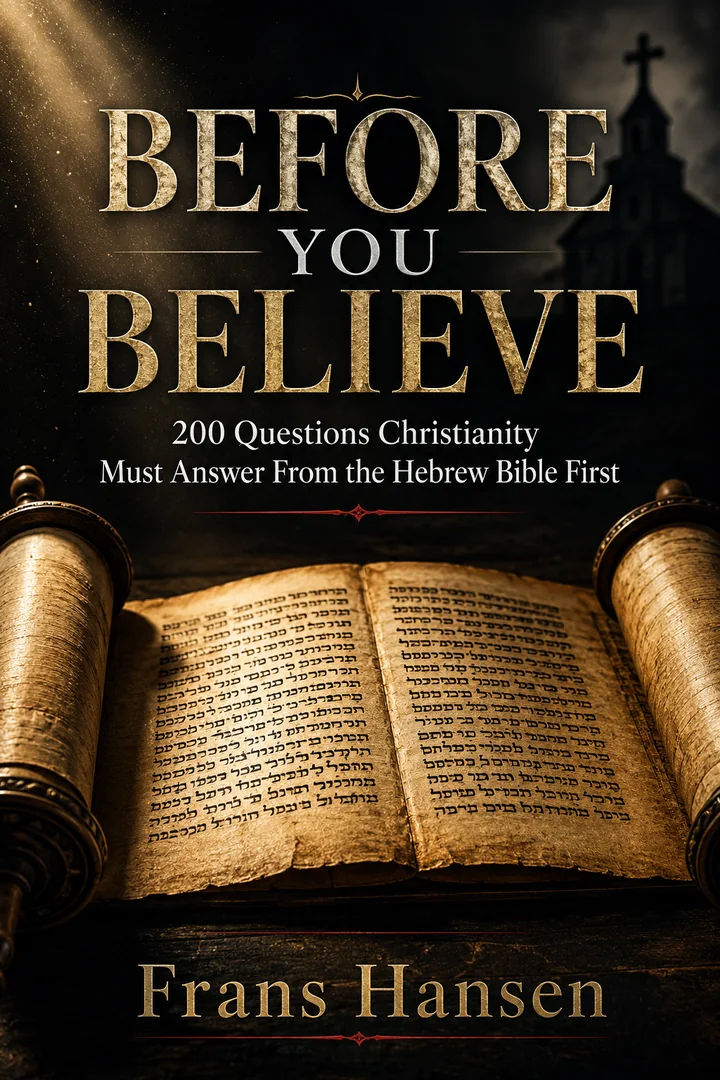
If the wider question after “by Frans Hansen Pharaoh: The First Christian Theologian: Pharaoh never says, “I don’t believe in your God.” He says something far more dangerous: • “Who exactly is going?” is genuinely Beyond “by Frans Hansen Pharaoh: The First Christian Theologian: Pharaoh never says, “I don’t believe in your God.” He says something far more dangerous: • “Who exactly is going?”, can the larger claim be established across Two hundred focused questions requiring Christian claims to face the Hebrew Bible before the New Testament supplies the answer while the controlling Tanakh passages, the exact Christian premise, covenant context remains controlling?, the next destination is BEFORE YOU BELIEVE: 200 Questions Christianity Must Answer From the Hebrew Bible First, because its scope is Two hundred focused questions requiring Christian claims to face the Hebrew Bible before the New Testament supplies the answer.