
Evidence bridge
Can a later application of a verse become a prophecy just because a later writer calls it fulfillment?
The reader wants to be able to explain “Can a later application of a verse become a prophecy just because a later writer calls it fulfillment?” from peshat, original speaker/audience, textual markers of futurity, literary category, and the later application without relying on denominational authority or counter-missionary slogans.
What this article established
A later writer can reapply an earlier text, build typology, or see a recurring pattern. What he cannot do merely by using the word “fulfilled” is change the earlier passage’s original speaker, audience, tense and literary function. Hosea 11:1 is a clear test: in Hosea it recalls Israel’s past Exodus; Matthew later reapplies it to Jesus.
- Verified: an earlier Tanakh passage has an original speaker, audience, literary category and historical horizon that exist before the New Testament's use of it.
- Verified: Hosea 11:1 refers in its own context to Israel and the Exodus.
- Possible: a later writer may reuse that verse typologically or homiletically to construct a new theological pattern.
- Disputed: whether a particular later application is theologically legitimate.
- Unsupported: the claim that the mere formula “this happened to fulfill” proves the earlier verse was originally a prediction of the later event.
The question that still remains
When “Can a later application of a verse become a prophecy just because a later writer calls it fulfillment?” is no longer left vague, can the surrounding argument still be sustained across A field manual for recurring missionary claims and prooftexts from peshat, original speaker/audience, textual markers of futurity, literary category?
Why this book is the next step
Christian Proof-Text Manual: 100 High-Frequency Missionary Claims Tested Against Torah, Hebrew, and Context is the narrowest catalogue match because its stated scope is A field manual for recurring missionary claims and prooftexts; that directly answers the remaining problem after application, verse, become, prophecy, whereas a general counter-missionary title would broaden too far. The book earns the bridge by expanding the evidence set while keeping the same burden of proof used at application / verse / become / prophecy. The worked hinge that makes this assignment specific is application / verse / become / prophecy / just.
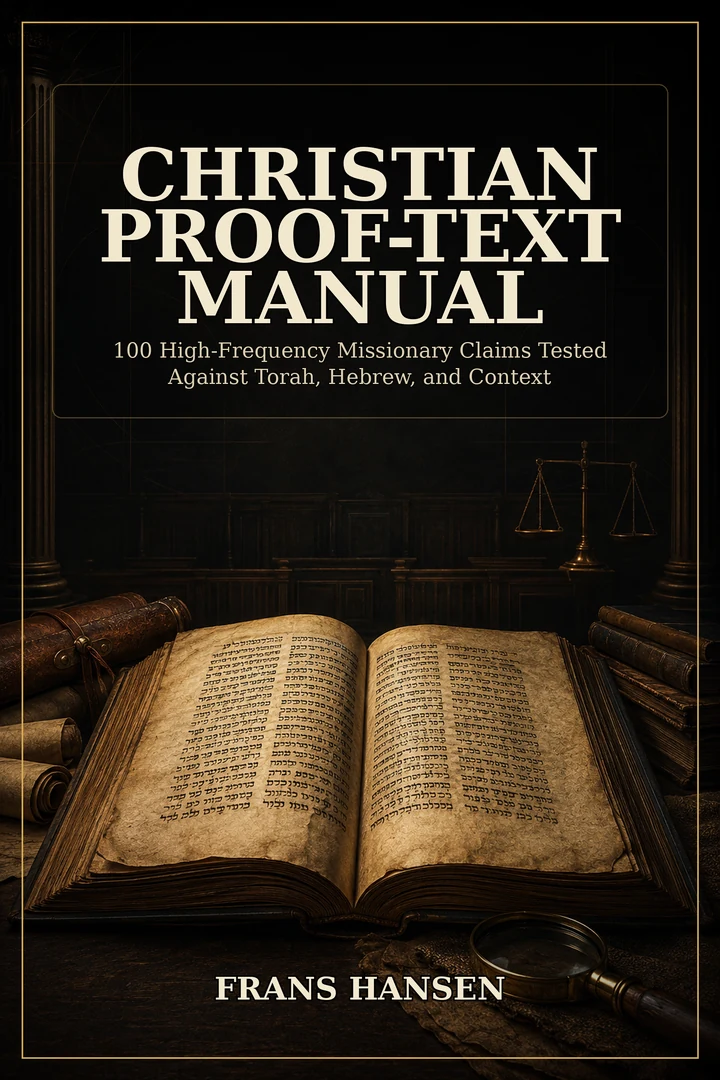
Only after the wider problem behind “Can a later application of a verse become a prophecy just because a later writer calls it fulfillment?” is clear should the book enter. Here that book is Christian Proof-Text Manual: 100 High-Frequency Missionary Claims Tested Against Torah, Hebrew, and Context, built to examine A field manual for recurring missionary claims and prooftexts.