
Evidence bridge
Does this claim survive a Torah-first reading: Can Exorcisms Prove that Christianity is the Truth? Part 2?
The reader wants a bounded verdict: what “Can Exorcisms Prove that Christianity is the Truth? Part 2” establishes, what remains possible, and what it does not authorize, using the Gospel report as hostile evidence, the controlling Torah rule, and any factual or textual issue in the narrative.
What this article established
The Gospel narratives treat exorcisms as signs of authority and the kingdom, but they also acknowledge exorcists outside Jesus’ immediate circle and warn that people may cast out demons in Jesus’ name without being accepted by him. Torah’s Deuteronomy 13 rule is even stricter: a sign can occur and still fail to prove a religious claimant true.
- Verified: the Gospel narratives present exorcisms as signs of authority and kingdom activity.
- Verified: the New Testament itself contains exorcism claims outside Jesus’ immediate circle and a warning that casting out demons in Jesus’ name does not guarantee approval.
- Verified: Deuteronomy 13 teaches that even a successful sign is insufficient to authenticate a religious claim that conflicts with covenant loyalty.
- Possible: an exorcism report may count as one data point inside a wider Christian cumulative case.
- Unsupported: the claim that exorcisms, by themselves, prove Christianity true.
- If “Does this claim survive a Torah-first reading: Can Exorcisms Prove that Christianity is the Truth? Part 2?” is settled from the sources, what survives when the inquiry expands to Method for testing religious claims by text, context, covenant, prophetic outcome and burden of proof under the Gospel report as hostile evidence, the controlling Torah rule, and any factual or textual issue in the narrative?
The question that still remains
If “Does this claim survive a Torah-first reading: Can Exorcisms Prove that Christianity is the Truth? Part 2?” is settled from the sources, what survives when the inquiry expands to Method for testing religious claims by text, context, covenant, prophetic outcome and burden of proof under the Gospel report as hostile evidence, the controlling Torah rule, and any factual or textual issue in the narrative?
Why this book is the next step
This assignment is justified by the unresolved evidence field, not by keyword overlap. The next task after Exorcisms, Prove, Truth, Part is If “Does this claim survive a Torah-first reading: Can Exorcisms Prove that Christianity is the Truth? Part 2?” is settled from the sources, what survives when the inquiry expands to Method for testing religious claims by text, context, covenant, prophetic outcome and burden of proof under the Gospel report as hostile evidence, the controlling Torah rule, and any factual or textual issue in the narrative?; The Frans Hansen Seven Gate Torah Verification System: A Torah-based procedure for testing any religious claim by text, context, covenant, prophetic outcome, and burden of proof. covers Method for testing religious claims by text, context, covenant, prophetic outcome and burden of proof. This keeps the sale downstream of the evidence: first Exorcisms / Prove / Truth / Part, then the larger Method for testing religious claims by text, context, covenant, prophetic outcome and burden of proof audit. The worked hinge that makes this assignment specific is Exorcisms / Prove / Truth / Part.
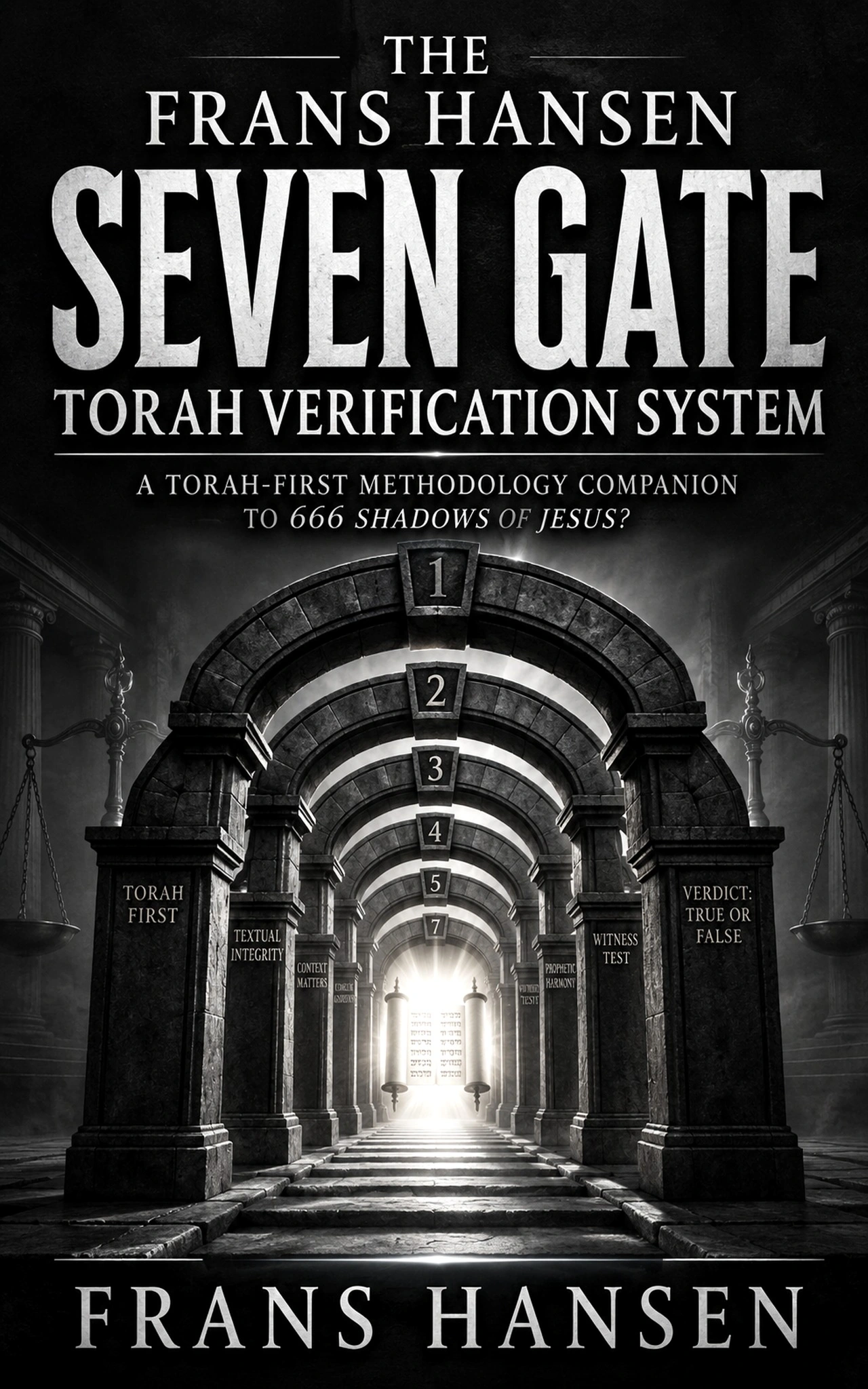
The source map beyond “Does this claim survive a Torah-first reading: Can Exorcisms Prove that Christianity is the Truth? Part 2?” points to one book-length continuation: The Frans Hansen Seven Gate Torah Verification System: A Torah-based procedure for testing any religious claim by text, context, covenant, prophetic outcome, and burden of proof., whose scope is Method for testing religious claims by text, context, covenant, prophetic outcome and burden of proof. Open the book page for the full treatment.