
Evidence bridge
Can Jewish agency explain honor given to Jesus without turning the agent into the Sender?
The reader wants to be able to explain “Can Jewish agency explain honor given to Jesus without turning the agent into the Sender?” from the lexical range of hishtachavah/proskuneō, the separate vocabulary of sacred service, and the action actually described in context without relying on denominational authority or counter-missionary slogans.
What this article established
Tanakh gives extraordinary authority to divine agents without collapsing them into Hashem. A messenger can speak for the Sender and receive honor as representative. That can explain some elevated language around Jesus, but it does not by itself prove Jesus is merely an agent—or that he is the Sender.
- Verified: Tanakh distinguishes Hashem from human and angelic agents while granting agents real authority.
- Verified: honor and representative speech do not by themselves turn an agent into the Sender.
- Possible: some New Testament honor toward Jesus can be understood through Jewish agency.
- Possible Christian argument: the cumulative New Testament portrayal goes beyond agency.
- Unsupported: “Jesus receives honor or speaks for God; therefore he must be God.”
- Equally unsupported: “agency exists; therefore every high Christological text is solved.”
The question that still remains
Beyond “Can Jewish agency explain honor given to Jesus without turning the agent into the Sender?”, can the larger claim be established across Missionary claims about Metatron, Angel of the Lord, Son of Man, divine agency and pre-incarnation while the lexical range of hishtachavah/proskuneō, the separate vocabulary of sacred service remains controlling?
Why this book is the next step
The reason for this book is structural, not topical coincidence: Jewish, agency, explain, honor opens into Beyond “Can Jewish agency explain honor given to Jesus without turning the agent into the Sender?”, can the larger claim be established across Missionary claims about Metatron, Angel of the Lord, Son of Man, divine agency and pre-incarnation while the lexical range of hishtachavah/proskuneō, the separate vocabulary of sacred service remains controlling? and the book is specifically organized around Missionary claims about Metatron, Angel of the Lord, Son of Man, divine agency and pre-incarnation. The book earns the bridge by expanding the evidence set while keeping the same burden of proof used at Jewish / agency / explain / honor. The worked hinge that makes this assignment specific is Jewish / agency / explain / honor / given.
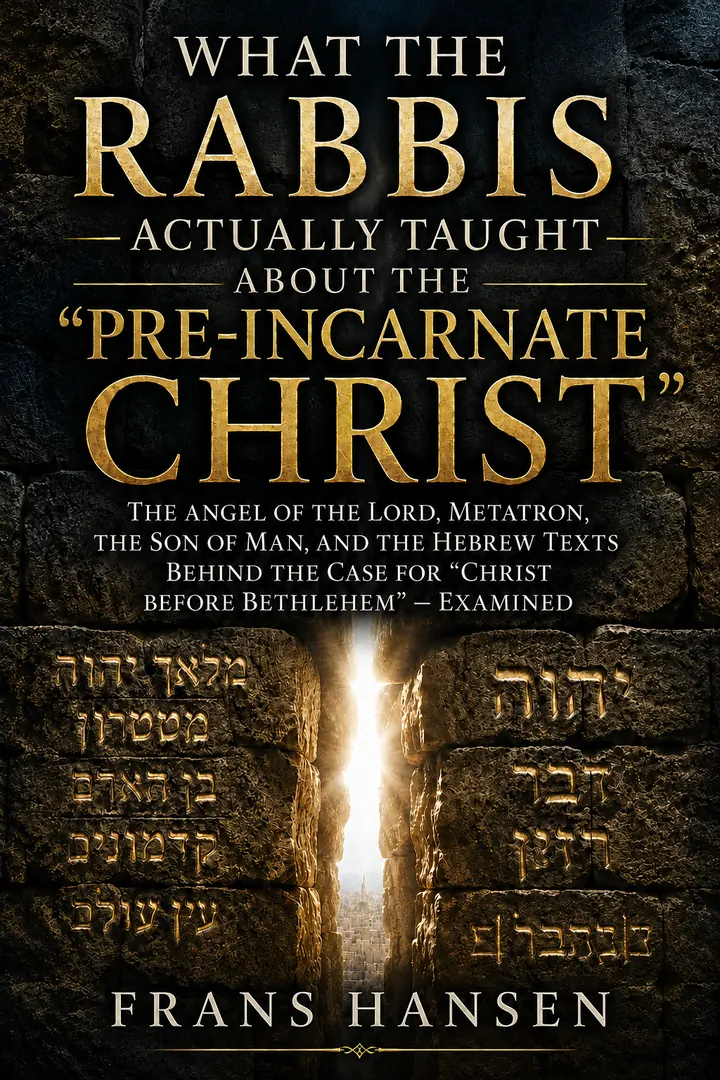
The landing page for “Can Jewish agency explain honor given to Jesus without turning the agent into the Sender?” has done its job when the reader can see why What the Rabbis Actually Taught About the “Pre-Incarnate Christ”: The Angel of the Lord, Metatron, the Son of Man, and the Hebrew Texts Behind the Case for “Christ Before Bethlehem” — Examined—not a generic anti-Christian title—continues this exact problem across Missionary claims about Metatron, Angel of the Lord, Son of Man, divine agency and pre-incarnation.