
Evidence bridge
Can Torah and the New Testament both be right if one says guilt stays with the sinner and the other makes substitution central?
The reader wants a bounded verdict: what “Can Torah and the New Testament both be right if one says guilt stays with the sinner and the other makes substitution central?” establishes, what remains possible, and what it does not authorize, using the controlling Torah/Prophetic statements about Hashem’s role, the human Davidic model, and the text claimed to transfer the prerogative.
What this article established
Deuteronomy and Ezekiel insist on personal moral responsibility, while Torah also contains sacrificial representation. The precise conflict is not “substitution versus no substitution,” but whether an innocent human can bear another person’s moral guilt as penal salvation.
- Verified: Torah and Ezekiel teach personal moral responsibility.
- Verified: Torah also contains sacrificial and representative forms of atonement.
- Too broad: “Torah has no substitution.”
- Still unproved by those sacrificial categories alone: penal transfer of human moral guilt to an innocent human savior.
The question that still remains
Once “Can Torah and the New Testament both be right if one says guilt stays with the sinner and the other makes substitution central?” is settled, what remains defensible across Better covenant, priesthood, covenant and atonement tested inside Torah rules when the test is controlled by the controlling Torah/Prophetic statements about Hashem’s role, the human Davidic model?
Why this book is the next step
The article's next legitimate scope matches this book's scope: Better covenant, priesthood, covenant and atonement tested inside Torah rules. That makes THE EPISTLE TO THE HEBREWS VS. THE HEBREW BIBLE: How the New Testament Rewrites the Tanakh - A Line-by-line Investigation a continuation of the same inquiry rather than an unrelated sale. The match is therefore between unresolved scope and book scope, not between repeated keywords. The worked hinge that makes this assignment specific is Testament / both / right / one / guilt.
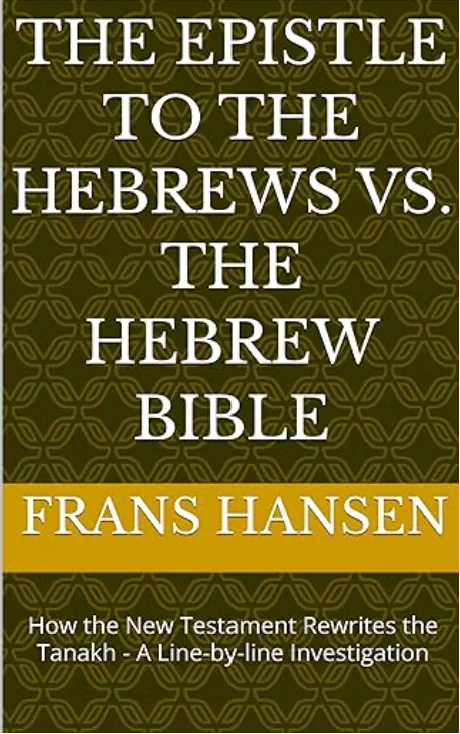
The source map beyond “Can Torah and the New Testament both be right if one says guilt stays with the sinner and the other makes substitution central?” points to one book-length continuation: THE EPISTLE TO THE HEBREWS VS. THE HEBREW BIBLE: How the New Testament Rewrites the Tanakh - A Line-by-line Investigation, whose scope is Better covenant, priesthood, covenant and atonement tested inside Torah rules. Open the book page for the full treatment.