
Evidence bridge
Did Matthew have a senior moment?
The goal is to know exactly where the evidence ends at “Did Matthew have a senior moment?”, so later theology cannot borrow certainty from a source that never supplied it.
What this article established
Matthew 27:9–10 names Jeremiah, while the clearest thirty-silver and potter material is in Zechariah 11:12–13. Jeremiah contributes potter and field themes. A composite-citation defense can explain the literary technique, but it does not turn the source material into a clean messianic prediction.
- Calling it a 'senior moment' is rhetoric, not analysis. The real issue is a composite attribution: Zechariah supplies the closest wording while Matthew names Jeremiah. Ancient composite citation may explain attribution technique, but fulfillment still has to be proved from the source contexts.
- If the same source-first method is carried into Matthew's quotations, fulfillment claims, and messianic arguments against the Hebrew text, does the larger claim still hold?
The question that still remains
What happens after “Did Matthew have a senior moment?” is resolved and the review widens to Matthew's quotations, fulfillment claims, and messianic arguments against the Hebrew text, with the Masoretic wording, the cited passage’s historical horizon, Matthew’s quotation form kept in view?
Why this book is the next step
The article's next legitimate scope matches this book's scope: Matthew's quotations, fulfillment claims, and messianic arguments against the Hebrew text. That makes THE GOSPEL OF MATTHEW UNDER THE TORAH TEST: Quotations, “Fulfillment,” and Messianism Tested Against the Hebrew Text a continuation of the same inquiry rather than an unrelated sale. That distinction matters here because Matthew's fulfillment claims, quotation practice, and Hebrew context requires more than another isolated response to Matthew / have / senior / moment. The worked hinge that makes this assignment specific is Matthew / have / senior / moment.
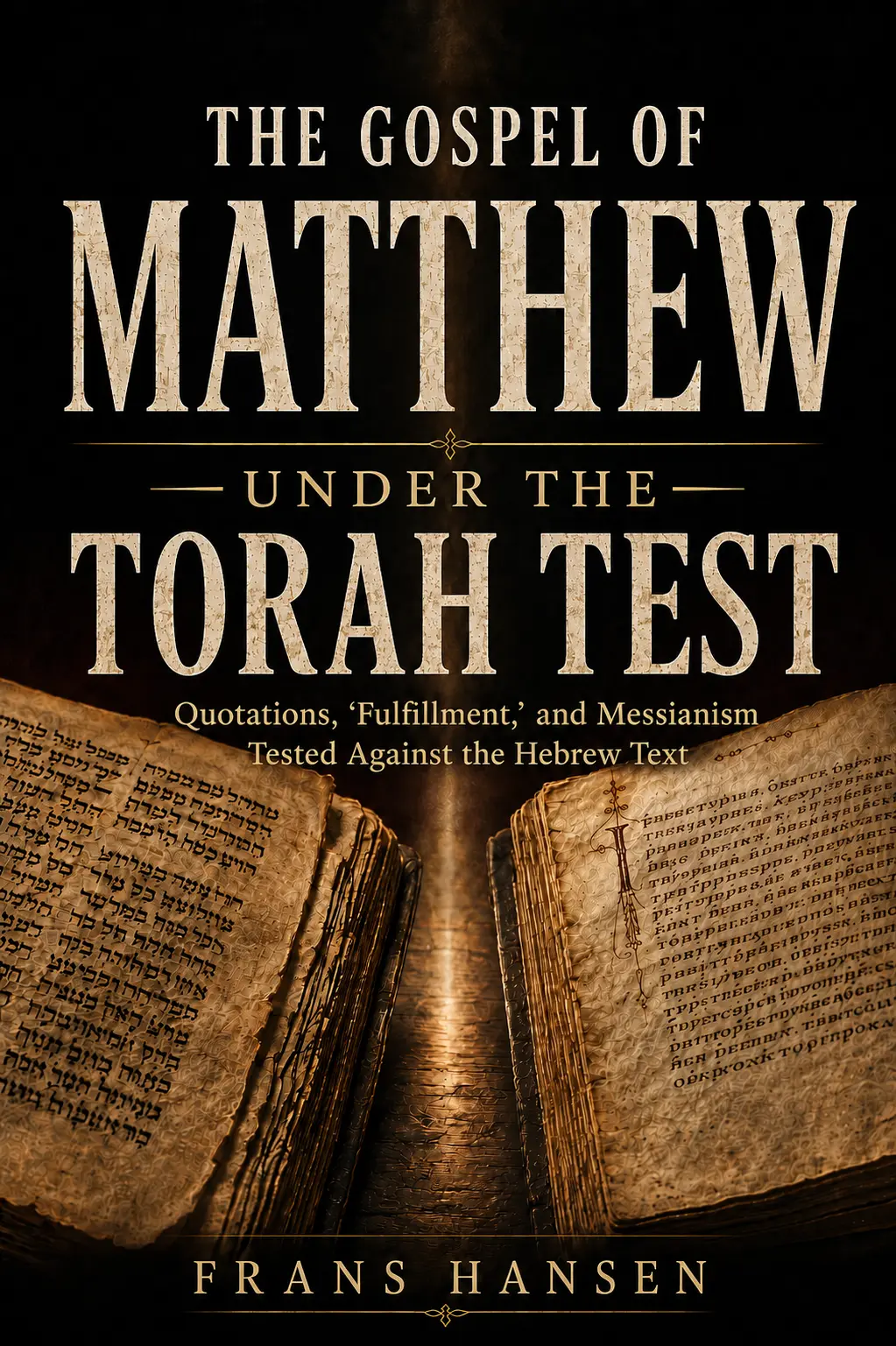
The landing page for “Did Matthew have a senior moment?” has done its job when the reader can see why THE GOSPEL OF MATTHEW UNDER THE TORAH TEST: Quotations, “Fulfillment,” and Messianism Tested Against the Hebrew Text—not a generic anti-Christian title—continues this exact problem across Matthew's quotations, fulfillment claims, and messianic arguments against the Hebrew text.