
Evidence bridge
Did the God who spoke at Sinai ever tell the world that His covenant, His commandments, and His way of returning to Him would one day be replaced by the death of a man?
The goal is to know exactly where the evidence ends at “Did the God who spoke at Sinai ever tell the world that His covenant, His commandments, and His way of returning to Him would one day be replaced by the death of a man?”, so later theology cannot borrow certainty from a source that never supplied it.
What this article established
Torah describes covenant, sin, repentance, sacrifice and return without announcing that the system will one day be replaced by a human death. Christians answer that Messiah fulfills rather than replaces Torah, but that fulfillment framework must be proved from the earlier revelation rather than assumed from later texts.
- Verified: Torah provides covenantal mechanisms for sin, repentance, sacrifice and return.
- Verified: Torah does not explicitly announce that a future Messiah’s death will replace those mechanisms.
- Possible Christian theology: Messiah fulfills and transforms Torah rather than abolishing it.
- Not established merely by calling it fulfillment: the authority for the transformation.
- Still requiring proof: the bridge from Sinai’s covenant rules to a permanent messianic death-centered system.
The question that still remains
If the evidence settles “Did the God who spoke at Sinai ever tell the world that His covenant, His commandments, and His way of returning to Him would one day be replaced by the death of a man?”, does Better covenant, priesthood, covenant and atonement tested inside Torah rules confirm the same conclusion once the controlling Tanakh passages, the exact Christian premise, covenant context is kept in control?
Why this book is the next step
This assignment is justified by the unresolved evidence field, not by keyword overlap. The next task after who, spoke, Sinai, ever is If the evidence settles “Did the God who spoke at Sinai ever tell the world that His covenant, His commandments, and His way of returning to Him would one day be replaced by the death of a man?”, does Better covenant, priesthood, covenant and atonement tested inside Torah rules confirm the same conclusion once the controlling Tanakh passages, the exact Christian premise, covenant context is kept in control?; THE EPISTLE TO THE HEBREWS VS. THE HEBREW BIBLE: How the New Testament Rewrites the Tanakh - A Line-by-line Investigation covers Better covenant, priesthood, covenant and atonement tested inside Torah rules. The match is therefore between unresolved scope and book scope, not between repeated keywords. The worked hinge that makes this assignment specific is who / spoke / Sinai / ever / tell.
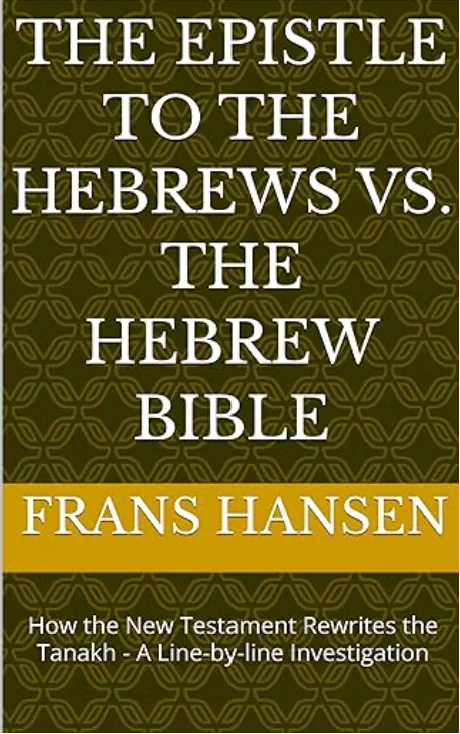
From the wider question raised by “Did the God who spoke at Sinai ever tell the world that His covenant, His commandments, and His way of returning to Him would one day be replaced by the death of a man?”, the book choice becomes specific: THE EPISTLE TO THE HEBREWS VS. THE HEBREW BIBLE: How the New Testament Rewrites the Tanakh - A Line-by-line Investigation carries the investigation into Better covenant, priesthood, covenant and atonement tested inside Torah rules.