
Evidence bridge
esurrection, rewrite Torah." It does not say, "If the experience feels real, the Shema is negotiable." It says: does this lead Israel toward worship Torah never commanded?
The reader wants to be able to explain “esurrection, rewrite Torah." It does not say, "If the experience feels real, the Shema is negotiable." It says: does this lead Israel toward worship Torah never commanded?” from the Hebrew source behind John’s claim, Torah’s categories for God, agency, worship, covenant, and any Greek term doing doctrinal work without relying on denominational authority or counter-missionary slogans.
What this article established
Even a claimed miracle does not receive authority to rewrite Sinai. Deuteronomy 13 explicitly tells Israel to test a wonder by the worship it promotes, so resurrection cannot be used as a self-authenticating exception to Torah’s boundaries.
- Verified: Deuteronomy 13 teaches that even a realized sign does not authorize Israel to follow prohibited worship.
- Verified: Torah establishes divine unity and worship boundaries before any later Gospel claim appears.
- Possible within Christian theology: the resurrection can be interpreted as God’s vindication of Jesus.
- Disputed: whether John’s high Christology should be read as identity, agency, unity of mission, or later doctrinal ontology in each individual passage.
- Unsupported by the resurrection claim alone: the legal conclusion that Israel must therefore worship Jesus or reinterpret Torah’s definition of God.
- If “esurrection, rewrite Torah.” It does not say, “If the experience feels real, the Shema is negotiable.” It says: does this lead Israel toward worship Torah never commanded?” is settled from the sources, what survives when the inquiry expands to Gospel authority claims tested under stable Torah jurisdiction, with jurisdiction first and evidence second under the Hebrew source behind John’s claim, Torah’s categories for God, agency, worship?
The question that still remains
If “esurrection, rewrite Torah." It does not say, "If the experience feels real, the Shema is negotiable." It says: does this lead Israel toward worship Torah never commanded?” is settled from the sources, what survives when the inquiry expands to Gospel authority claims tested under stable Torah jurisdiction, with jurisdiction first and evidence second under the Hebrew source behind John’s claim, Torah’s categories for God, agency, worship?
Why this book is the next step
Another book might discuss Christianity generally, but Court Case Jesus: A Torah-Jurisdiction Audit of Gospel Authority Claims follows the exact evidence family left open here—Gospel authority claims tested under stable Torah jurisdiction, with jurisdiction first and evidence second—so the transition does not manufacture a new problem. The match is therefore between unresolved scope and book scope, not between repeated keywords. The worked hinge that makes this assignment specific is esurrection / rewrite / not / experience / feels.
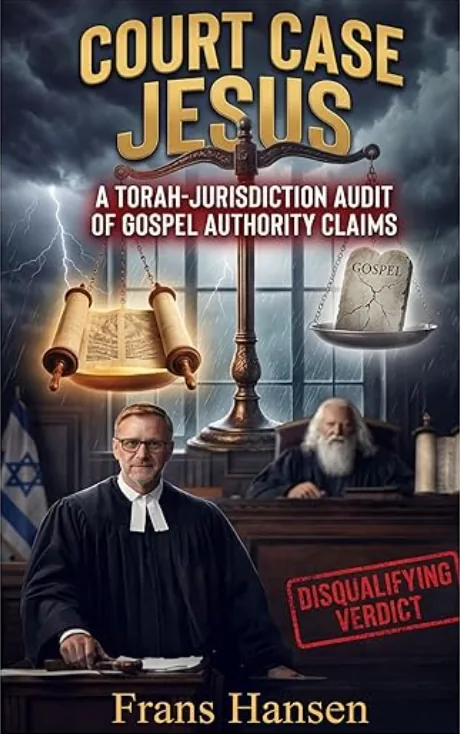
Only after the wider problem behind “esurrection, rewrite Torah." It does not say, "If the experience feels real, the Shema is negotiable." It says: does this lead Israel toward worship Torah never commanded?” is clear should the book enter. Here that book is Court Case Jesus: A Torah-Jurisdiction Audit of Gospel Authority Claims, built to examine Gospel authority claims tested under stable Torah jurisdiction, with jurisdiction first and evidence second.