
Evidence bridge
What does the controlling Tanakh evidence establish about this claim: Hebrews 1:6 and Greek Deuteronomy 32:43 absent MT wording?
The reader wants a bounded verdict: what “Hebrews 1:6 and Greek Deuteronomy 32:43 absent MT wording” establishes, what remains possible, and what it does not authorize, using Jeremiah 31, Torah’s priesthood and atonement rules, the named covenant partners, and Hebrews’ interpretive steps.
What this article established
Hebrews 1:6 draws on Greek wording associated with Deuteronomy 32:43 that is absent from the Masoretic wording. That textual difference is real and should not be dismissed as a Christian invention. But in Deuteronomy’s song the worship is directed to God; Hebrews supplies the transfer to the Son.
- Verified: Hebrews 1:6 contains the command, “Let all the angels of God worship him.”
- Verified: closely related angelic-worship wording exists in the ancient Greek form associated with Deuteronomy 32:43 and is absent from the Masoretic wording.
- Verified: in Deuteronomy 32 the controlling object of divine vindication and worship is Hashem.
- Possible: Hebrews is consciously using the Greek Deuteronomy tradition rather than fabricating a quotation.
- Disputed: the exact textual history behind the Greek and Hebrew forms.
- Unsupported by Deuteronomy 32 alone: the transfer of worship from Hashem to a distinct messianic Son.
The question that still remains
Does the method used to answer “What does the controlling Tanakh evidence establish about this claim: Hebrews 1:6 and Greek Deuteronomy 32:43 absent MT wording?” produce the same result across Better covenant, priesthood, covenant and atonement tested inside Torah rules when Jeremiah 31, Torah’s priesthood and atonement rules, the named covenant partners controls the test?
Why this book is the next step
THE EPISTLE TO THE HEBREWS VS. THE HEBREW BIBLE: How the New Testament Rewrites the Tanakh - A Line-by-line Investigation earns the slot because the reader's unresolved question moves from Hebrews, 1:6, Greek, Deuteronomy to Better covenant, priesthood, covenant and atonement tested inside Torah rules, precisely the domain this title was built to audit. The reader is not being moved sideways to a related product; the same unresolved covenant, priesthood, sacrifice, and obsolescence problem is being followed outward. The worked hinge that makes this assignment specific is Hebrews 1:6 / Hebrews / 1:6 / Greek / Deuteronomy.
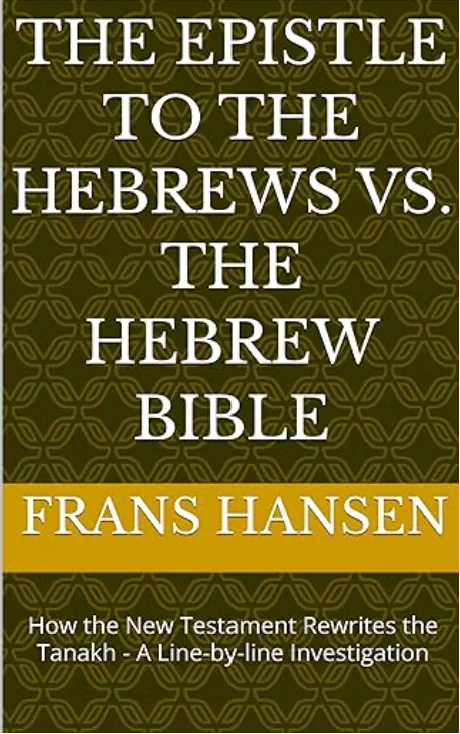
The source map beyond “What does the controlling Tanakh evidence establish about this claim: Hebrews 1:6 and Greek Deuteronomy 32:43 absent MT wording?” points to one book-length continuation: THE EPISTLE TO THE HEBREWS VS. THE HEBREW BIBLE: How the New Testament Rewrites the Tanakh - A Line-by-line Investigation, whose scope is Better covenant, priesthood, covenant and atonement tested inside Torah rules. Open the book page for the full treatment.