
Evidence bridge
What does the controlling Tanakh evidence establish about this claim: Hebrews 1 Psalm 102 Creator language applied to Son?
The desired certainty is not absolute certainty about every doctrine. It is enough precision to say why “Hebrews 1 Psalm 102 Creator language applied to Son” is Verified, Possible, Disputed, Unsupported, or Contradicted by the controlling source.
What this article established
Psalm 102 addresses Hashem as the eternal Creator whose years never end. Hebrews 1 quotes that passage in a sequence about the Son. This is genuine high Christology in Hebrews, but the Psalm itself never identifies its Creator as a future Messiah.
- Verified: Psalm 102 addresses Hashem as Creator and eternal ruler.
- Verified: Hebrews 1 applies that Creator-language quotation within its argument about the Son.
- Strong evidence: Hebrews’ author holds an extraordinarily exalted Christology.
- Possible within Christian inspiration claims: Hebrews authoritatively identifies the Son with the divine Creator language.
- Unsupported from Psalm 102 itself: that the Psalm originally predicts or identifies a future Messiah as Creator.
The question that still remains
After resolving “What does the controlling Tanakh evidence establish about this claim: Hebrews 1 Psalm 102 Creator language applied to Son?”, does the wider case across Better covenant, priesthood, covenant and atonement tested inside Torah rules survive the same test, especially Jeremiah 31, Torah’s priesthood and atonement rules, the named covenant partners?
Why this book is the next step
Keep the legal or literary category visible before importing theological analogy. 102 / Creator / language / applied: the problem has moved from one Hebrews 1 ruling into the exact scope of THE EPISTLE TO THE HEBREWS VS. THE HEBREW BIBLE: How the New Testament Rewrites the Tanakh - A Line-by-line Investigation. The conclusion stops where the controlling source stops. Verify the translation step before a second text is imported.
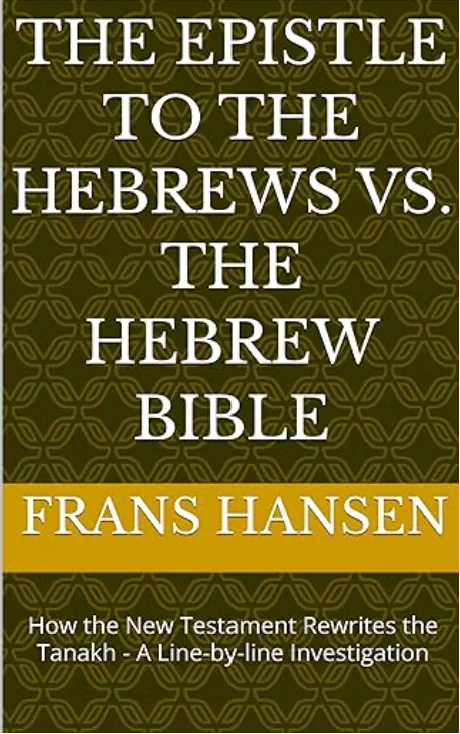
The landing page for “What does the controlling Tanakh evidence establish about this claim: Hebrews 1 Psalm 102 Creator language applied to Son?” has done its job when the reader can see why THE EPISTLE TO THE HEBREWS VS. THE HEBREW BIBLE: How the New Testament Rewrites the Tanakh - A Line-by-line Investigation—not a generic anti-Christian title—continues this exact problem across Better covenant, priesthood, covenant and atonement tested inside Torah rules.