
Evidence bridge
What does the controlling Tanakh evidence establish about this claim: Hebrews 9 covenant turned into last will requiring maker's death?
The desired certainty is not absolute certainty about every doctrine. It is enough precision to say why “Hebrews 9 covenant turned into last will requiring maker's death” is Verified, Possible, Disputed, Unsupported, or Contradicted by the controlling source.
What this article established
Hebrews 9 exploits the Greek word diathēkē, which can carry covenant and testament/will senses, to argue that death is required. Exodus 24 ratifies covenant with sacrificial blood, but the covenant Maker does not die. The will analogy is a later interpretive step, not Torah’s covenant rule.
- Verified: Greek *diathēkē* can function in covenant/testament semantic territory.
- Verified: Hebrews 9 uses death-of-the-testator logic.
- Verified: Exodus 24 ratifies covenant with sacrificial blood while Hashem, the covenant Maker, does not die.
- Verified: Jeremiah 31 does not state that the Maker of the new covenant must die.
- Possible within Christian theology: Hebrews’ wordplay and sacrifice pattern form a christological argument.
- Unsupported from Hebrew *berit* and Torah covenant law: “a covenant requires the death of its maker.”
The question that still remains
After resolving “What does the controlling Tanakh evidence establish about this claim: Hebrews 9 covenant turned into last will requiring maker's death?”, does the wider case across Better covenant, priesthood, covenant and atonement tested inside Torah rules survive the same test, especially Jeremiah 31, Torah’s priesthood and atonement rules, the named covenant partners?
Why this book is the next step
THE EPISTLE TO THE HEBREWS VS. THE HEBREW BIBLE: How the New Testament Rewrites the Tanakh - A Line-by-line Investigation earns the slot because the reader's unresolved question moves from Hebrews, covenant, turned, last to Better covenant, priesthood, covenant and atonement tested inside Torah rules, precisely the domain this title was built to audit. The reader is not being moved sideways to a related product; the same unresolved covenant, priesthood, sacrifice, and obsolescence problem is being followed outward. The worked hinge that makes this assignment specific is Hebrews 9 / Hebrews / covenant / turned / last.
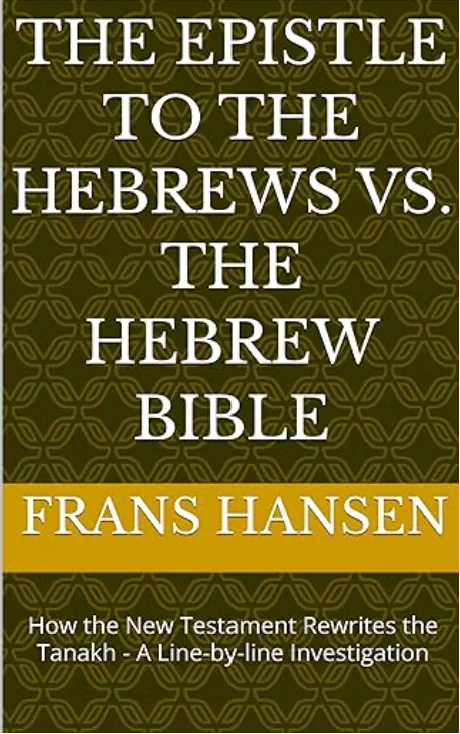
If the wider question after “What does the controlling Tanakh evidence establish about this claim: Hebrews 9 covenant turned into last will requiring maker's death?” is genuinely After resolving “What does the controlling Tanakh evidence establish about this claim: Hebrews 9 covenant turned into last will requiring maker's death?”, does the wider case across Better covenant, priesthood, covenant and atonement tested inside Torah rules survive the same test, especially Jeremiah 31, Torah’s priesthood and atonement rules, the named covenant partners?, the next destination is THE EPISTLE TO THE HEBREWS VS. THE HEBREW BIBLE: How the New Testament Rewrites the Tanakh - A Line-by-line Investigation, because its scope is Better covenant, priesthood, covenant and atonement tested inside Torah rules.