
Evidence bridge
If doctrine decides that a verse must have a second meaning, how could that interpretation ever be falsified?
The goal is to know exactly where the evidence ends at “If doctrine decides that a verse must have a second meaning, how could that interpretation ever be falsified?”, so later theology cannot borrow certainty from a source that never supplied it.
What this article established
A doctrine-driven “deeper meaning” can become unfalsifiable if every contrary context is dismissed as merely the first layer. A legitimate second meaning needs independent controls: textual markers, recurring structure, authorized interpretive rules, or a later authority established without relying on the disputed reading itself.
- Verified: doctrine can motivate a later reading without that reading being stated in the original text.
- Possible: Scripture can have typological, homiletic or fuller theological applications.
- Required for evidentiary force: a control independent of the doctrine the interpretation is meant to prove.
- Methodologically circular: “the verse must mean X because my doctrine requires X, and the verse then proves my doctrine.”
- Unfalsifiable: a second meaning protected from every possible textual counterevidence.
The question that still remains
Beyond “If doctrine decides that a verse must have a second meaning, how could that interpretation ever be falsified?”, can the larger claim be established across A field manual for recurring missionary claims and prooftexts while peshat, original speaker/audience, textual markers of futurity, literary category remains controlling?
Why this book is the next step
The fit is narrower than 'same biblical book' or 'same doctrine.' The unresolved test is Beyond “If doctrine decides that a verse must have a second meaning, how could that interpretation ever be falsified?”, can the larger claim be established across A field manual for recurring missionary claims and prooftexts while peshat, original speaker/audience, textual markers of futurity, literary category remains controlling?, and Christian Proof-Text Manual: 100 High-Frequency Missionary Claims Tested Against Torah, Hebrew, and Context supplies the broader treatment of A field manual for recurring missionary claims and prooftexts needed to run it. A broader title would dilute the doctrine / decides / verse / must evidence family; a narrower article would not reach the cross-text question. The worked hinge that makes this assignment specific is doctrine / decides / verse / must / have.
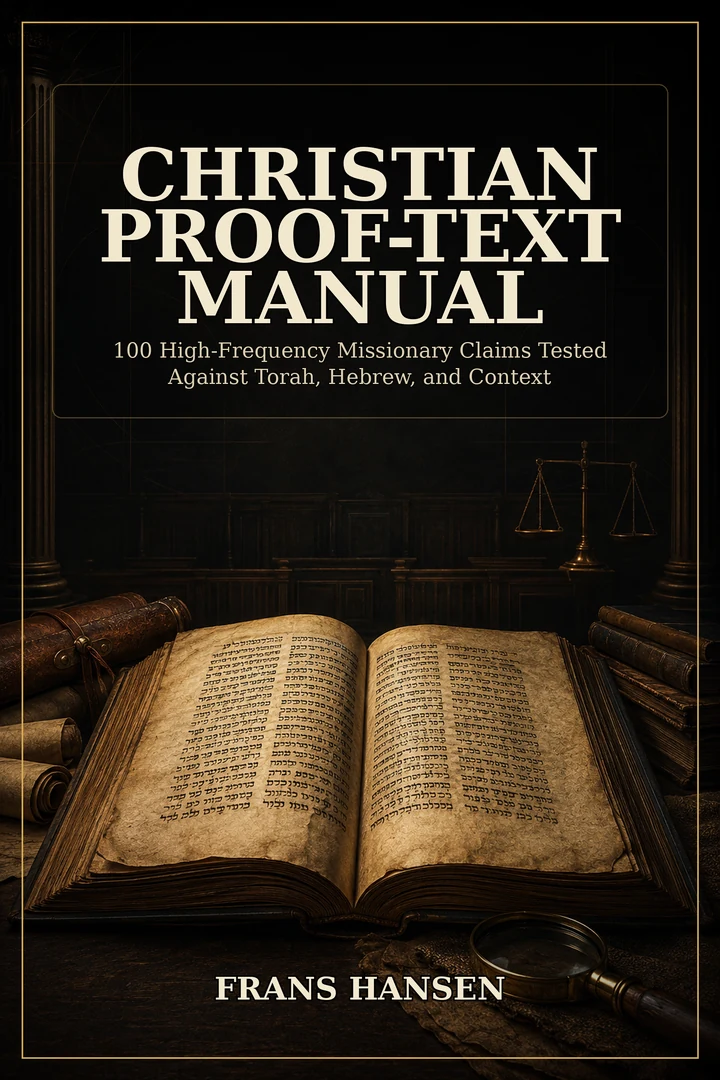
Only after the wider problem behind “If doctrine decides that a verse must have a second meaning, how could that interpretation ever be falsified?” is clear should the book enter. Here that book is Christian Proof-Text Manual: 100 High-Frequency Missionary Claims Tested Against Torah, Hebrew, and Context, built to examine A field manual for recurring missionary claims and prooftexts.