
Evidence bridge
If God forgives unknown sins in the Torah… why invent a savior for something HaShem already fixed?
The desired certainty is not absolute certainty about every doctrine. It is enough precision to say why “If God forgives unknown sins in the Torah… why invent a savior for something HaShem already fixed?” is Verified, Possible, Disputed, Unsupported, or Contradicted by the controlling source.
What this article established
Leviticus explicitly distinguishes inadvertent sin from deliberate rebellion and provides atonement when the offense becomes known. That does not erase sacrifice; it destroys the claim that Torah knows only one undifferentiated guilt category requiring a later savior.
- Verified: Torah distinguishes inadvertent sin from deliberate rebellion.
- Verified: Leviticus provides atonement procedures for inadvertent sins when they become known.
- Verified: sacrifice is genuinely part of those procedures in Leviticus.
- Unsupported: the claim that Torah teaches every unknown or unintentional sin leaves a person damned until a later savior appears.
- Still requiring proof: the Christian claim that Levitical atonement was designed as a temporary shadow of one final messianic sacrifice.
The question that still remains
Beyond “If God forgives unknown sins in the Torah… why invent a savior for something HaShem already fixed?”, can the larger claim be established across Better covenant, priesthood, covenant and atonement tested inside Torah rules while the controlling Tanakh passages, the exact Christian premise, covenant context remains controlling?
Why this book is the next step
The reason for this book is structural, not topical coincidence: forgives, unknown, sins, why opens into Beyond “If God forgives unknown sins in the Torah… why invent a savior for something HaShem already fixed?”, can the larger claim be established across Better covenant, priesthood, covenant and atonement tested inside Torah rules while the controlling Tanakh passages, the exact Christian premise, covenant context remains controlling? and the book is specifically organized around Better covenant, priesthood, covenant and atonement tested inside Torah rules. This keeps the sale downstream of the evidence: first forgives / unknown / sins / why, then the larger Better covenant, priesthood, covenant and atonement tested inside Torah rules audit. The worked hinge that makes this assignment specific is forgives / unknown / sins / why / invent.
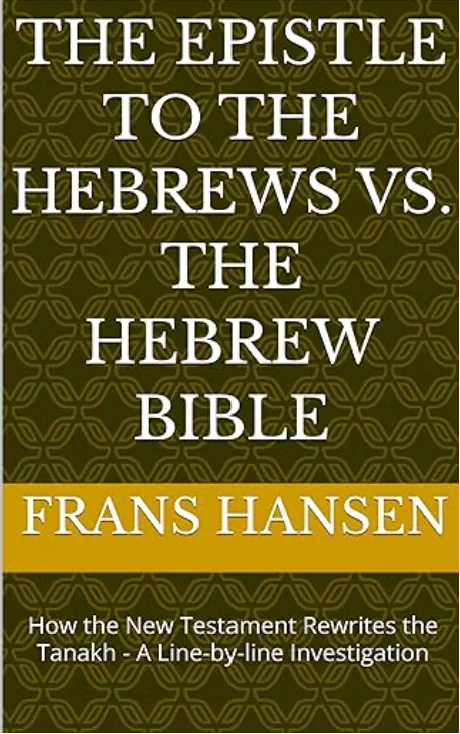
From the wider question raised by “If God forgives unknown sins in the Torah… why invent a savior for something HaShem already fixed?”, the book choice becomes specific: THE EPISTLE TO THE HEBREWS VS. THE HEBREW BIBLE: How the New Testament Rewrites the Tanakh - A Line-by-line Investigation carries the investigation into Better covenant, priesthood, covenant and atonement tested inside Torah rules.