
Evidence bridge
If ‘head knowledge’ is spiritually suspect, why does David pray, ‘Teach me good judgment and knowledge’?
The reader wants to be able to explain “If ‘head knowledge’ is spiritually suspect, why does David pray, ‘Teach me good judgment and knowledge’?” from Tanakh’s praise of wisdom, knowledge, testing, public revelation, and the difference between humble inquiry and rebellion without relying on denominational authority or counter-missionary slogans.
What this article established
Psalm 119:66 asks, “Teach me good judgment and knowledge.” Tanakh does not treat knowledge as the enemy of faith. It warns against pride and empty intellectualism, but wisdom, understanding and disciplined judgment are covenant virtues.
- Verified: Psalm 119 explicitly asks Hashem for good judgment and knowledge.
- Verified: Tanakh repeatedly praises wisdom, understanding and instruction.
- Verified: knowledge is expected to serve obedience rather than replace it.
- Possible legitimate warning: intellectual knowledge without humility or practice is incomplete.
- Unsupported: dismissing textual evidence because it is “only head knowledge.”
The question that still remains
When “If ‘head knowledge’ is spiritually suspect, why does David pray, ‘Teach me good judgment and knowledge’?” is no longer left vague, can the surrounding argument still be sustained across Two hundred focused questions requiring Christian claims to face the Hebrew Bible before the New Testament supplies the answer from Tanakh’s praise of wisdom, knowledge, testing, public revelation?
Why this book is the next step
The fit is narrower than 'same biblical book' or 'same doctrine.' The unresolved test is When “If ‘head knowledge’ is spiritually suspect, why does David pray, ‘Teach me good judgment and knowledge’?” is no longer left vague, can the surrounding argument still be sustained across Two hundred focused questions requiring Christian claims to face the Hebrew Bible before the New Testament supplies the answer from Tanakh’s praise of wisdom, knowledge, testing, public revelation?, and BEFORE YOU BELIEVE: 200 Questions Christianity Must Answer From the Hebrew Bible First supplies the broader treatment of Two hundred focused questions requiring Christian claims to face the Hebrew Bible before the New Testament supplies the answer needed to run it. The match is therefore between unresolved scope and book scope, not between repeated keywords. The worked hinge that makes this assignment specific is head / knowledge / spiritually / suspect / why.
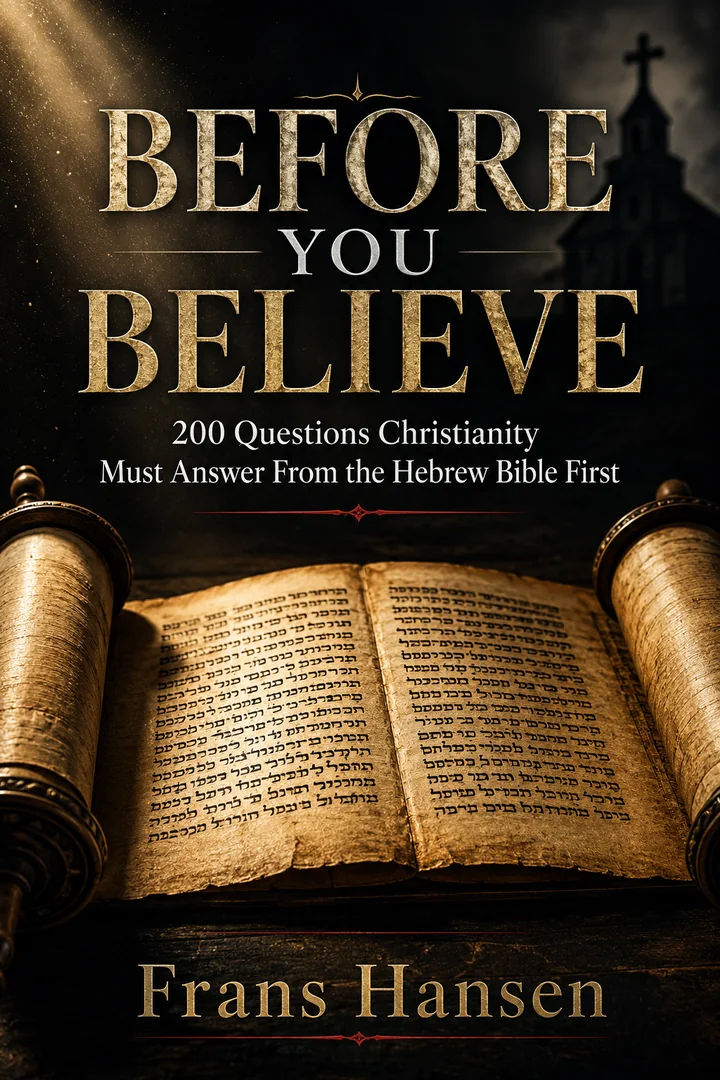
Only after the wider problem behind “If ‘head knowledge’ is spiritually suspect, why does David pray, ‘Teach me good judgment and knowledge’?” is clear should the book enter. Here that book is BEFORE YOU BELIEVE: 200 Questions Christianity Must Answer From the Hebrew Bible First, built to examine Two hundred focused questions requiring Christian claims to face the Hebrew Bible before the New Testament supplies the answer.