
Evidence bridge
If Matthew had never been placed in your head first, would you naturally read Isaiah 7 as a prophecy of a virgin birth seven centuries later?
The desired certainty is not absolute certainty about every doctrine. It is enough precision to say why “If Matthew had never been placed in your head first, would you naturally read Isaiah 7 as a prophecy of a virgin birth seven centuries later?” is Verified, Possible, Disputed, Unsupported, or Contradicted by the controlling source.
What this article established
No. Not from Isaiah 7 by itself. That does not mean a Christian is forbidden to read Matthew typologically. It means the Christian reading has to be identified for what it is: a later interpretation placed on an earlier text. The earlier text does not naturally announce a virgin conception seven centuries in the future.
- Verified: Isaiah 7 gives Ahaz a child-sign during the Syro-Ephraimite crisis.
- Verified: Matthew 1 applies the Greek form of Isaiah 7:14 to Jesus.
- Disputed: whether Matthew has divine authority to disclose a fuller meaning beyond Isaiah's immediate horizon.
- Unsupported by Isaiah 7 alone: the claim that a reader, before knowing Matthew, would naturally identify the passage as a prediction of a virgin conception seven centuries later.
The question that still remains
Once “If Matthew had never been placed in your head first, would you naturally read Isaiah 7 as a prophecy of a virgin birth seven centuries later?” is settled, what remains defensible across Matthew's quotations, fulfillment claims, and messianic arguments against the Hebrew text when the test is controlled by the Masoretic wording, the cited passage’s historical horizon, Matthew’s quotation form?
Why this book is the next step
The reason for this book is structural, not topical coincidence: Matthew, had, never, placed opens into Once “If Matthew had never been placed in your head first, would you naturally read Isaiah 7 as a prophecy of a virgin birth seven centuries later?” is settled, what remains defensible across Matthew's quotations, fulfillment claims, and messianic arguments against the Hebrew text when the test is controlled by the Masoretic wording, the cited passage’s historical horizon, Matthew’s quotation form? and the book is specifically organized around Matthew's quotations, fulfillment claims, and messianic arguments against the Hebrew text. A broader title would dilute the Matthew / had / never / placed evidence family; a narrower article would not reach the cross-text question. The worked hinge that makes this assignment specific is Isaiah 7 / Matthew / had / never / placed.
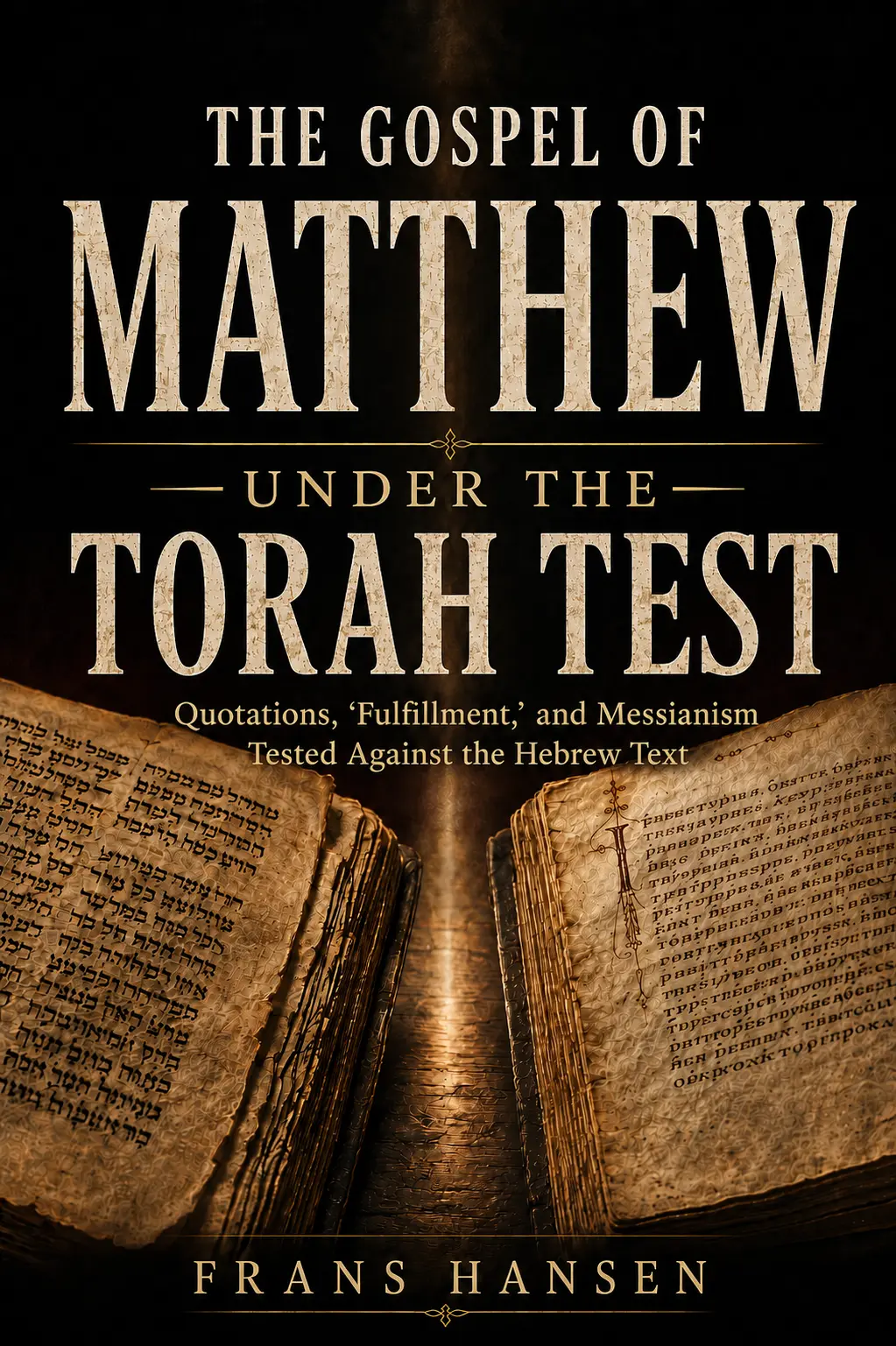
After the wider source map for “If Matthew had never been placed in your head first, would you naturally read Isaiah 7 as a prophecy of a virgin birth seven centuries later?”, the book fit becomes testable: THE GOSPEL OF MATTHEW UNDER THE TORAH TEST: Quotations, “Fulfillment,” and Messianism Tested Against the Hebrew Text is the book-length investigation for Matthew's quotations, fulfillment claims, and messianic arguments against the Hebrew text. Open the book page only if that is the field you still need examined.