
Evidence bridge
If miracles can prove a later religion, why does Deuteronomy 13 tell Israel to reject even a miracle-worker who redirects obedience?
The target state is evidentiary clarity: a fair Christian formulation, a controlled reading of “If miracles can prove a later religion, why does Deuteronomy 13 tell Israel to reject even a miracle-worker who redirects obedience?”, an explicit concession, and a narrow verdict.
What this article established
Deuteronomy 13 does not ask Israel to deny every reported miracle. It does something more damaging to miracle-based apologetics: it explicitly allows the sign to occur and still commands Israel to reject the claimant if the message redirects covenant loyalty. A wonder is evidence to evaluate, not authority to rewrite Sinai.
- Verified: Deuteronomy 13 explicitly contemplates a sign or wonder occurring without giving the claimant automatic religious authority.
- Verified: covenant loyalty remains controlling after the sign.
- Possible: a miracle can function as evidence within a larger case that already passes Torah's prior tests.
- Disputed: whether Christian claims about Jesus preserve or redirect the worship required by Sinai.
- Contradicted by controlling source: the generic rule “a genuine miracle proves the later religious message true.”
The question that still remains
After resolving “If miracles can prove a later religion, why does Deuteronomy 13 tell Israel to reject even a miracle-worker who redirects obedience?”, does the wider case across Method for testing religious claims by text, context, covenant, prophetic outcome and burden of proof survive the same test, especially Sinai’s public revelation, Torah’s prophet tests, covenant continuity?
Why this book is the next step
The Frans Hansen Seven Gate Torah Verification System: A Torah-based procedure for testing any religious claim by text, context, covenant, prophetic outcome, and burden of proof. earns the slot because the reader's unresolved question moves from miracles, prove, religion, why to Method for testing religious claims by text, context, covenant, prophetic outcome and burden of proof, precisely the domain this title was built to audit. This keeps the sale downstream of the evidence: first miracles / prove / religion / why, then the larger Method for testing religious claims by text, context, covenant, prophetic outcome and burden of proof audit. The worked hinge that makes this assignment specific is Deuteronomy 13 / miracles / prove / religion / why.
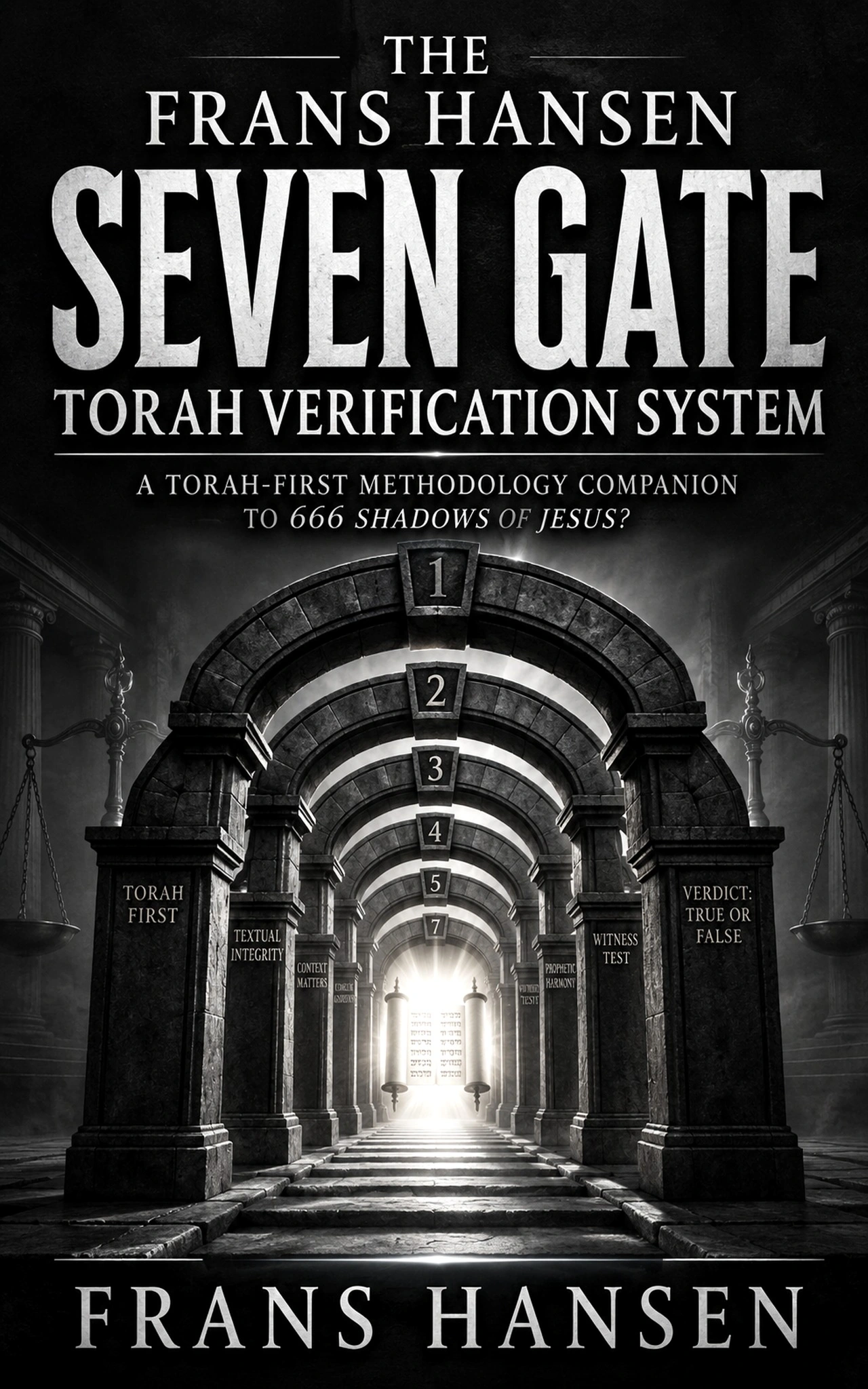
If the wider question after “If miracles can prove a later religion, why does Deuteronomy 13 tell Israel to reject even a miracle-worker who redirects obedience?” is genuinely After resolving “If miracles can prove a later religion, why does Deuteronomy 13 tell Israel to reject even a miracle-worker who redirects obedience?”, does the wider case across Method for testing religious claims by text, context, covenant, prophetic outcome and burden of proof survive the same test, especially Sinai’s public revelation, Torah’s prophet tests, covenant continuity?, the next destination is The Frans Hansen Seven Gate Torah Verification System: A Torah-based procedure for testing any religious claim by text, context, covenant, prophetic outcome, and burden of proof., because its scope is Method for testing religious claims by text, context, covenant, prophetic outcome and burden of proof.