
Evidence bridge
If obedience is irrelevant, then why does their own text ask, “Why do you call me, ‘Lord, Lord,’ and do not do what I say?
The reader wants a bounded verdict: what “If obedience is irrelevant, then why does their own text ask, “Why do you call me, ‘Lord, Lord,’ and do not do what I say?” establishes, what remains possible, and what it does not authorize, using Torah’s own descriptions of commandment, covenant duration, obedience, righteousness, repentance, and the Pauline passage under review.
What this article established
Luke 6:46 refutes the crude claim that obedience is irrelevant, but it does not by itself refute every Christian doctrine of justification by faith. The sharper Torah-first question is what obedience means and whether Paul’s law-and-faith framework preserves Torah’s own covenant categories.
- Verified: Luke 6:46 treats obedience as a necessary test of professed allegiance.
- Verified: Torah repeatedly describes obedience to God’s commandments as covenant faithfulness and can describe such obedience in the language of righteousness and life.
- Verified: Paul himself does not teach that conduct is irrelevant; he commands moral obedience and speaks of faith working through love.
- Contradicted by the controlling texts: the crude proposition that obedience is irrelevant to a person’s relationship with God.
- Possible within Christian theology: justification can be distinguished from the obedient life that follows it.
- Still disputed and requiring further proof: whether Paul’s specific law/faith structure preserves Torah’s covenant categories or replaces them.
- After resolving “If obedience is irrelevant, then why does their own text ask, “Why do you call me, ‘Lord, Lord,’ and do not do what I say?”, does the wider case across Paul's claims on law, faith, circumcision, Sinai, Jerusalem and Israel survive the same test, especially Torah’s own descriptions of commandment, covenant duration, obedience, righteousness?
The question that still remains
After resolving “If obedience is irrelevant, then why does their own text ask, “Why do you call me, ‘Lord, Lord,’ and do not do what I say?”, does the wider case across Paul's claims on law, faith, circumcision, Sinai, Jerusalem and Israel survive the same test, especially Torah’s own descriptions of commandment, covenant duration, obedience, righteousness?
Why this book is the next step
The article's next legitimate scope matches this book's scope: Paul's claims on law, faith, circumcision, Sinai, Jerusalem and Israel. That makes GALATIANS vs. THE HEBREW BIBLE: Paul’s War on Sinai a continuation of the same inquiry rather than an unrelated sale. The book earns the bridge by expanding the evidence set while keeping the same burden of proof used at obedience / irrelevant / then / why. The worked hinge that makes this assignment specific is obedience / irrelevant / then / why / their.
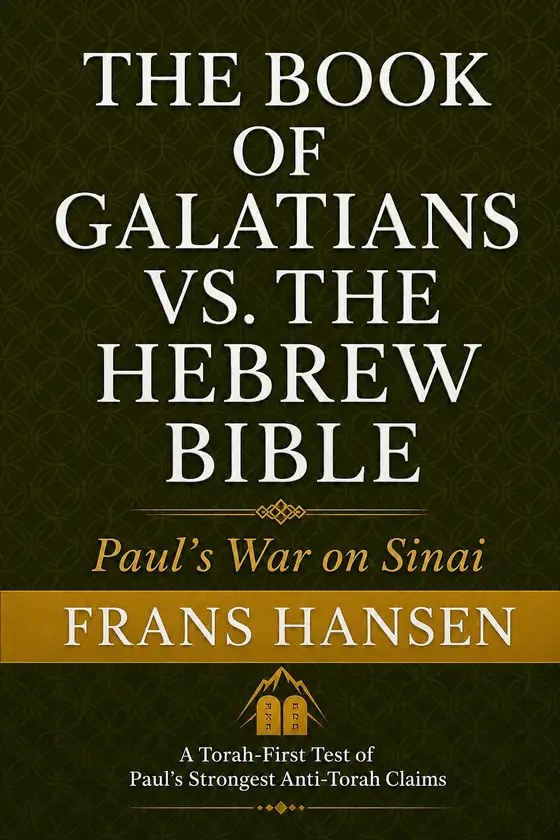
The source map beyond “If obedience is irrelevant, then why does their own text ask, “Why do you call me, ‘Lord, Lord,’ and do not do what I say?” points to one book-length continuation: GALATIANS vs. THE HEBREW BIBLE: Paul’s War on Sinai, whose scope is Paul's claims on law, faith, circumcision, Sinai, Jerusalem and Israel. Open the book page for the full treatment.