
Evidence bridge
If Ruth defined the path into Israel, why replace it with metaphor?
The reader wants a bounded verdict: what “If Ruth defined the path into Israel, why replace it with metaphor?” establishes, what remains possible, and what it does not authorize, using the covenant partners named in Torah and the Prophets, Israel’s continuing election, Gentile inclusion texts, and the alleged transfer mechanism.
What this article established
Ruth’s declaration binds peoplehood and God together: “Your people are my people, and your God is my God.” Her story then places her in Judah, under Israelite law, inside a Bethlehem family, and in David’s line. A later Christian metaphor can reuse Ruth, but it cannot reverse the direction of the story and turn attachment to Israel into replacement of Israel.
- Verified: Ruth 1:16 binds Ruth’s attachment to Naomi’s people with her attachment to Naomi’s God.
- Verified: the narrative places Ruth concretely inside Bethlehem, Israelite law, family redemption, and David’s ancestry.
- Possible: Christian readers may use Ruth as a typological picture of Gentile inclusion.
- Unsupported: the claim that Ruth itself turns Israel into a metaphor, authorizes a replacement people, or teaches Gentiles to claim Israel’s covenant identity while leaving Israel as the discarded subject.
- When “If Ruth defined the path into Israel, why replace it with metaphor?” is no longer left vague, can the surrounding argument still be sustained across Isaiah, nations, Zion, covenant and Christian reversal/replacement from the covenant partners named in Torah and the Prophets, Israel’s continuing election?
The question that still remains
When “If Ruth defined the path into Israel, why replace it with metaphor?” is no longer left vague, can the surrounding argument still be sustained across Isaiah, nations, Zion, covenant and Christian reversal/replacement from the covenant partners named in Torah and the Prophets, Israel’s continuing election?
Why this book is the next step
Test the claim under the same rule that would be accepted if the conclusion were reversed. path / Israel / replace / metaphor: the problem has moved from one Israel, Church and covenant replacement ruling into the exact scope of The Veil Over the Nations: Isaiah’s Witness, the Church’s Reversal, and the Return to Zion. Possibility is not promoted to proof by repetition. Isolate the textual horizon before later application is admitted. Constrain the stated covenant party under the Hebrew wording first; keep the concrete markers path, Israel, replace, metaphor, Church visible.
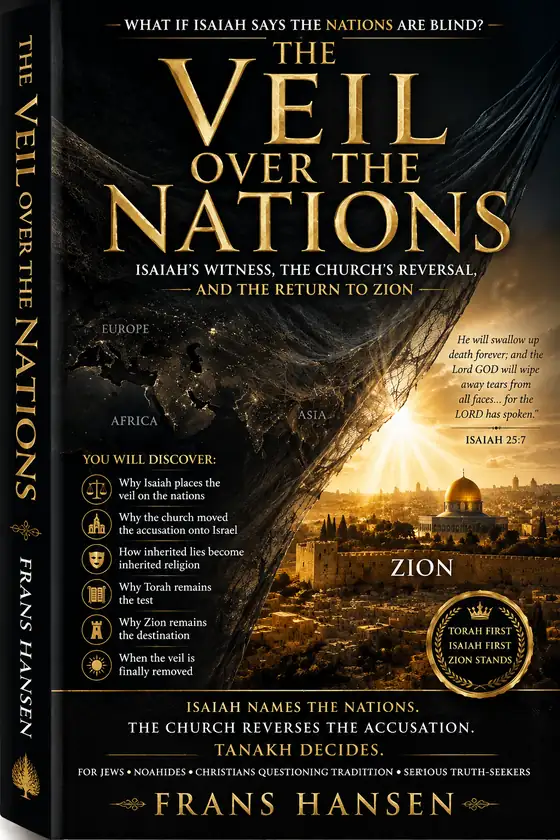
The landing page for “If Ruth defined the path into Israel, why replace it with metaphor?” has done its job when the reader can see why The Veil Over the Nations: Isaiah’s Witness, the Church’s Reversal, and the Return to Zion—not a generic anti-Christian title—continues this exact problem across Isaiah, nations, Zion, covenant and Christian reversal/replacement.