
Evidence bridge
If Torah provides sacrifices and repentance for unintentional sin, where did Christianity get the idea that unknown sin automatically damns you?
The target state is evidentiary clarity: a fair Christian formulation, a controlled reading of “If Torah provides sacrifices and repentance for unintentional sin, where did Christianity get the idea that unknown sin automatically damns you?”, an explicit concession, and a narrow verdict.
What this article established
Torah recognizes real guilt for inadvertent and even initially unknown violations, but it also provides defined sacrificial remedies, confession, repentance, and divine forgiveness. The stronger Christian claim that every unknown sin automatically produces eternal damnation is not a Torah category and should not be retrofitted onto Leviticus.
- Verified: Torah recognizes inadvertent and even initially unknown violations as real legal categories.
- Verified: Torah provides defined remedies for those categories rather than treating them as automatic eternal damnation.
- Verified: Tanakh presents repentance, return, prayer, justice, and divine mercy as genuine parts of forgiveness.
- Possible: Christian theology may build a wider universal-sin and atonement system from multiple later premises.
- Unsupported: the claim that Torah itself teaches every unknown sin automatically damns the person eternally.
- What happens after “If Torah provides sacrifices and repentance for unintentional sin, where did Christianity get the idea that unknown sin automatically damns you?” is resolved and the review widens to Testing Christian prooftexts, leaving church authority and returning to the One God, with Torah’s sacrificial categories, prophetic repentance texts, examples of forgiveness without blood kept in view?
The question that still remains
What happens after “If Torah provides sacrifices and repentance for unintentional sin, where did Christianity get the idea that unknown sin automatically damns you?” is resolved and the review widens to Testing Christian prooftexts, leaving church authority and returning to the One God, with Torah’s sacrificial categories, prophetic repentance texts, examples of forgiveness without blood kept in view?
Why this book is the next step
The reason for this book is structural, not topical coincidence: provides, sacrifices, repentance, unintentional opens into What happens after “If Torah provides sacrifices and repentance for unintentional sin, where did Christianity get the idea that unknown sin automatically damns you?” is resolved and the review widens to Testing Christian prooftexts, leaving church authority and returning to the One God, with Torah’s sacrificial categories, prophetic repentance texts, examples of forgiveness without blood kept in view? and the book is specifically organized around Testing Christian prooftexts, leaving church authority and returning to the One God. The match is therefore between unresolved scope and book scope, not between repeated keywords. The worked hinge that makes this assignment specific is provides / sacrifices / repentance / unintentional / sin.
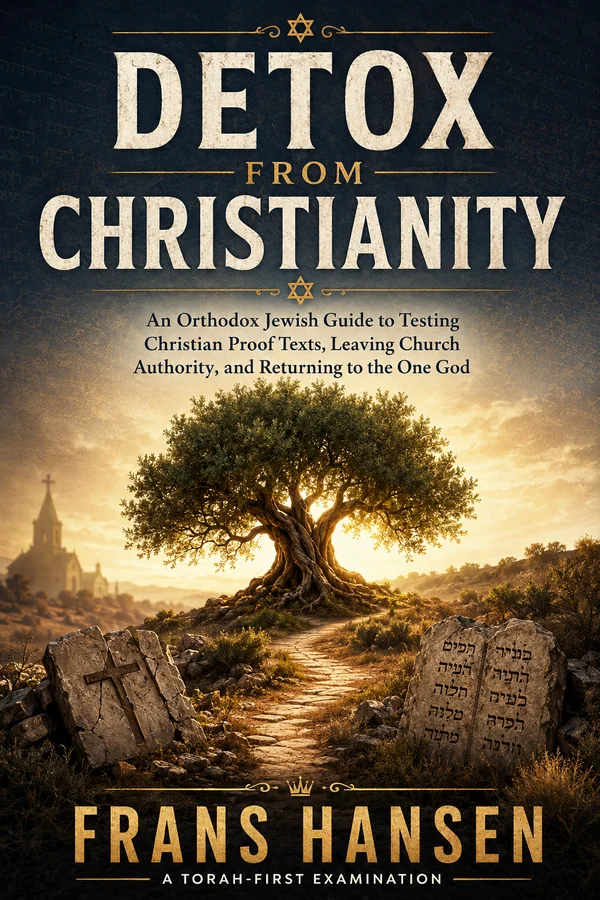
From the wider question raised by “If Torah provides sacrifices and repentance for unintentional sin, where did Christianity get the idea that unknown sin automatically damns you?”, the book choice becomes specific: DETOX FROM CHRISTIANITY: An Orthodox Jewish Guide to Testing Christian Proof Texts, Leaving Church Authority, and Returning to the One God carries the investigation into Testing Christian prooftexts, leaving church authority and returning to the One God.