
Evidence bridge
If unauthorized worship was dangerous inside the Mishkan, why assume unauthorized mediation is harmless outside it?
The target state is evidentiary clarity: a fair Christian formulation, a controlled reading of “If unauthorized worship was dangerous inside the Mishkan, why assume unauthorized mediation is harmless outside it?”, an explicit concession, and a narrow verdict.
What this article established
Nadav and Avihu prove that sacred innovation can fail even near the sanctuary, but Leviticus 10 does not directly name Christianity. The sharper Torah question is whether a later mediator has jurisdiction the earlier covenant actually authorizes.
- Verified: Leviticus 10 condemns an unauthorized sacred act as “strange fire.”
- Verified: Torah contains authorized mediators and regulated offices.
- Supported principle: sacred sincerity or status does not substitute for divine authorization.
- Not proved by Leviticus 10 alone: that Christianity’s mediation claims are false.
- Still required: a Torah-level warrant for any mediator claimed to revise priesthood, sacrifice, covenant or access to God.
The question that still remains
If the evidence settles “If unauthorized worship was dangerous inside the Mishkan, why assume unauthorized mediation is harmless outside it?”, does Gospel authority claims tested under stable Torah jurisdiction, with jurisdiction first and evidence second confirm the same conclusion once Torah’s rules for authorized worship, the Nadav/Avihu pattern where relevant is kept in control?
Why this book is the next step
Court Case Jesus: A Torah-Jurisdiction Audit of Gospel Authority Claims is the narrowest catalogue match because its stated scope is Gospel authority claims tested under stable Torah jurisdiction, with jurisdiction first and evidence second; that directly answers the remaining problem after unauthorized, worship, dangerous, inside, whereas a general counter-missionary title would broaden too far. The reader is not being moved sideways to a related product; the same unresolved who may receive worship and on what Torah authority problem is being followed outward. The worked hinge that makes this assignment specific is unauthorized / worship / dangerous / inside / Mishkan.
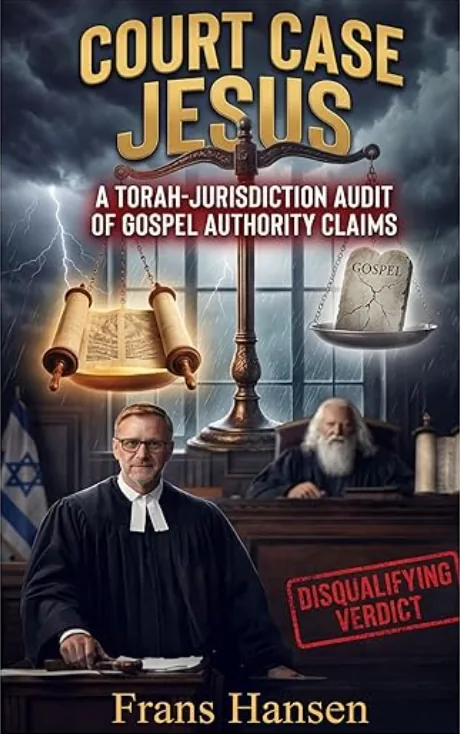
If the wider question after “If unauthorized worship was dangerous inside the Mishkan, why assume unauthorized mediation is harmless outside it?” is genuinely If the evidence settles “If unauthorized worship was dangerous inside the Mishkan, why assume unauthorized mediation is harmless outside it?”, does Gospel authority claims tested under stable Torah jurisdiction, with jurisdiction first and evidence second confirm the same conclusion once Torah’s rules for authorized worship, the Nadav/Avihu pattern where relevant is kept in control?, the next destination is Court Case Jesus: A Torah-Jurisdiction Audit of Gospel Authority Claims, because its scope is Gospel authority claims tested under stable Torah jurisdiction, with jurisdiction first and evidence second.