
Evidence bridge
What does the controlling Tanakh evidence establish about this claim: Matthew 23 Moses' seat authority versus displacement?
The reader wants a bounded verdict: what “Matthew 23 Moses' seat authority versus displacement” establishes, what remains possible, and what it does not authorize, using the Masoretic wording, the cited passage’s historical horizon, Matthew’s quotation form, and any material Septuagint difference.
What this article established
Matthew 23:2–3 presents the scribes and Pharisees as sitting in Moses’ seat and tells listeners to do what they teach while condemning failure to practice it. That is evidence of recognized teaching authority inside Matthew, not a simple story of Jesus abolishing Jewish authority.
- Verified: Matthew 23:2–3 says the scribes and Pharisees sit in Moses’ seat.
- Verified: Jesus tells the audience to do and observe what they teach while condemning their failure to practice it.
- Verified: the immediate criticism is hypocrisy, not an explicit abolition of Moses’ seat.
- Possible Christian theology: this authority was transitional and later displaced by apostolic authority.
- Unsupported by Matthew 23 itself: claiming the text announces that Jewish teaching authority has ended.
The question that still remains
Beyond “What does the controlling Tanakh evidence establish about this claim: Matthew 23 Moses' seat authority versus displacement?”, can the larger claim be established across Matthew's quotations, fulfillment claims, and messianic arguments against the Hebrew text while the Masoretic wording, the cited passage’s historical horizon, Matthew’s quotation form remains controlling?
Why this book is the next step
The fit is narrower than 'same biblical book' or 'same doctrine.' The unresolved test is Beyond “What does the controlling Tanakh evidence establish about this claim: Matthew 23 Moses' seat authority versus displacement?”, can the larger claim be established across Matthew's quotations, fulfillment claims, and messianic arguments against the Hebrew text while the Masoretic wording, the cited passage’s historical horizon, Matthew’s quotation form remains controlling?, and THE GOSPEL OF MATTHEW UNDER THE TORAH TEST: Quotations, “Fulfillment,” and Messianism Tested Against the Hebrew Text supplies the broader treatment of Matthew's quotations, fulfillment claims, and messianic arguments against the Hebrew text needed to run it. The reader is not being moved sideways to a related product; the same unresolved Matthew's fulfillment claims, quotation practice, and Hebrew context problem is being followed outward. The worked hinge that makes this assignment specific is Matthew 23 / Matthew / Moses / seat / authority.
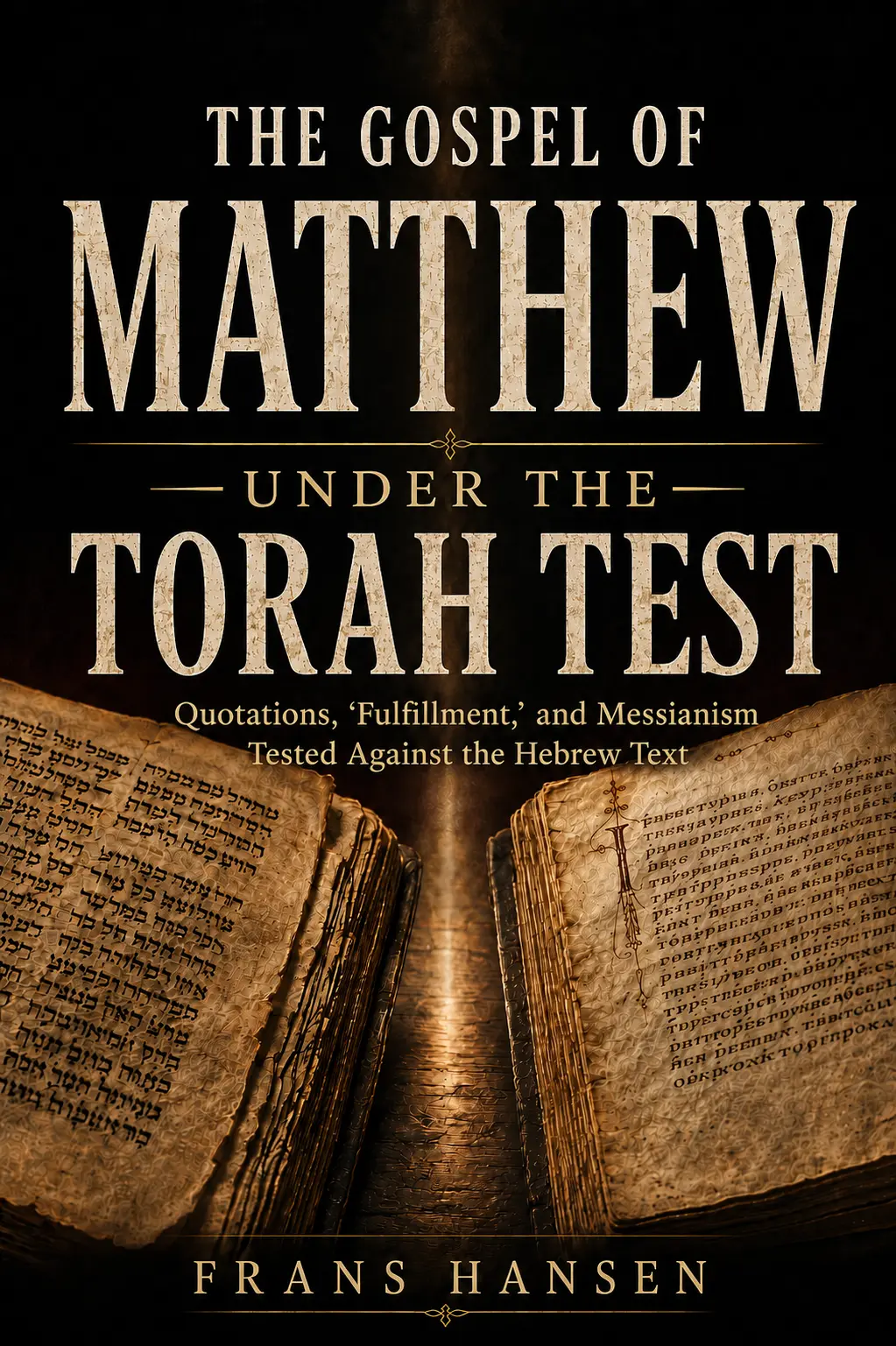
If the wider question after “What does the controlling Tanakh evidence establish about this claim: Matthew 23 Moses' seat authority versus displacement?” is genuinely Beyond “What does the controlling Tanakh evidence establish about this claim: Matthew 23 Moses' seat authority versus displacement?”, can the larger claim be established across Matthew's quotations, fulfillment claims, and messianic arguments against the Hebrew text while the Masoretic wording, the cited passage’s historical horizon, Matthew’s quotation form remains controlling?, the next destination is THE GOSPEL OF MATTHEW UNDER THE TORAH TEST: Quotations, “Fulfillment,” and Messianism Tested Against the Hebrew Text, because its scope is Matthew's quotations, fulfillment claims, and messianic arguments against the Hebrew text.