
Evidence bridge
Does this claim survive a Torah-first reading: Most Christians were never told to test Christianity from the Hebrew Bible first?
The goal is to know exactly where the evidence ends at “Most Christians were never told to test Christianity from the Hebrew Bible first”, so later theology cannot borrow certainty from a source that never supplied it.
What this article established
The dataset does not prove the sociological claim that “most Christians” were never taught to test Christianity from the Hebrew Bible. But the methodological challenge survives: whenever Christianity claims Moses or the Prophets as proof, the earlier text must control its own wording, context, category, and burden of proof.
- Unsupported: this dataset does not establish that most Christians were never taught to test Christianity from the Hebrew Bible first.
- Verified: Christianity and Christian missionary arguments repeatedly appeal to Tanakh as prior scriptural authority.
- Verified: when a claim is made about what a Tanakh passage means, its Hebrew wording, context, literary category, speaker, audience, and historical horizon are controlling evidence.
- Possible: a Christian may defend later canonical or typological rereading as part of Christian theology.
- Unsupported: treating that later rereading as proof that the earlier Hebrew text plainly taught the later doctrine without first demonstrating it from the earlier text.
The question that still remains
Beyond “Does this claim survive a Torah-first reading: Most Christians were never told to test Christianity from the Hebrew Bible first?”, can the larger claim be established across A field manual for recurring missionary claims and prooftexts while the exact Tanakh wording, immediate context, literary category, and the premise added by the Christian argument remains controlling?
Why this book is the next step
The article's next legitimate scope matches this book's scope: A field manual for recurring missionary claims and prooftexts. That makes Christian Proof-Text Manual: 100 High-Frequency Missionary Claims Tested Against Torah, Hebrew, and Context a continuation of the same inquiry rather than an unrelated sale. The reason is methodological continuity: the book applies the same source controls beyond the single Most / Christians / never / told hinge. The worked hinge that makes this assignment specific is Most / Christians / never / told / first.
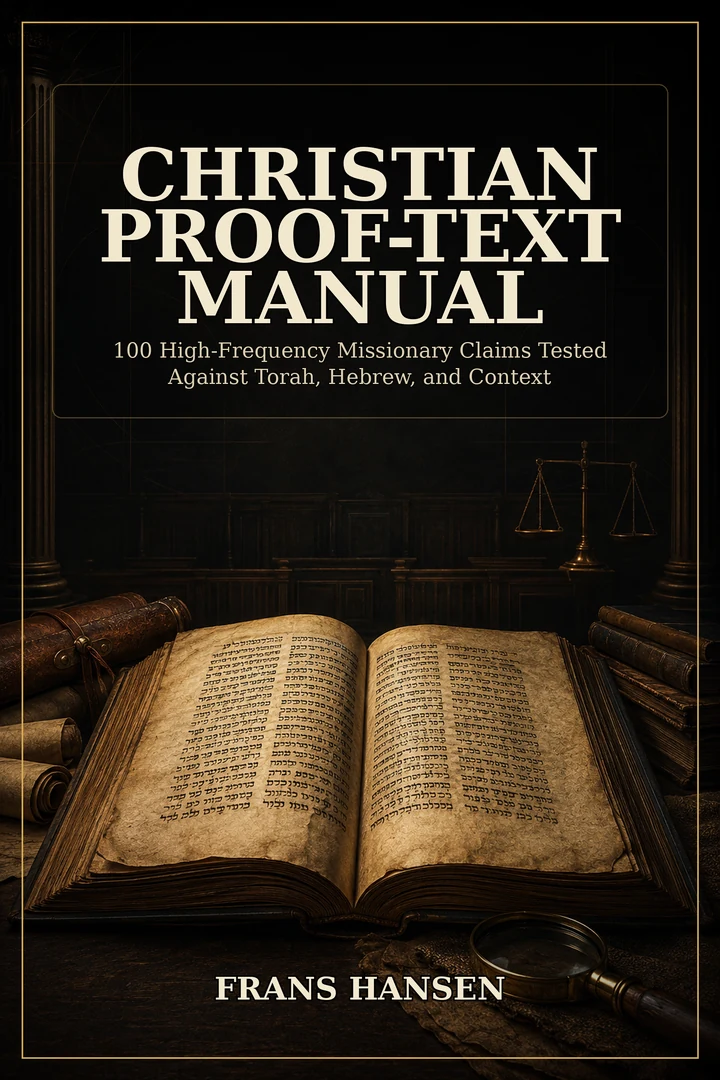
Only after the wider problem behind “Does this claim survive a Torah-first reading: Most Christians were never told to test Christianity from the Hebrew Bible first?” is clear should the book enter. Here that book is Christian Proof-Text Manual: 100 High-Frequency Missionary Claims Tested Against Torah, Hebrew, and Context, built to examine A field manual for recurring missionary claims and prooftexts.