
Evidence bridge
Or does the doctrine require a later Christian filter?
The desired certainty is not absolute certainty about every doctrine. It is enough precision to say why “Or does the doctrine require a later Christian filter?” is Verified, Possible, Disputed, Unsupported, or Contradicted by the controlling source.
What this article established
Later revelation is not disqualified merely because it is later; Tanakh itself contains later prophets. But a later religious claim cannot prove its own right to rewrite an earlier covenant. Torah supplies non-addition, worship, and prophet tests that must remain controlling before later doctrine becomes the interpretive lens.
- Verified: Torah anticipates later religious and prophetic claims and supplies tests for them.
- Verified: later revelation is not disqualified merely because it is later.
- Verified: Torah’s non-addition, worship, and prophet-test rules prevent a later claimant from creating authority merely by claiming divine revelation.
- Possible within Christian theology: later New Testament revelation can be understood as legitimate fulfillment and fuller disclosure.
- Unsupported as a method: allowing the New Testament to define what Torah “must have meant” before the New Testament’s authority has itself been tested under Torah’s categories.
- If “Or does the doctrine require a later Christian filter?” is settled from the sources, what survives when the inquiry expands to Method for testing religious claims by text, context, covenant, prophetic outcome and burden of proof under Sinai’s public covenant, Torah’s non-addition/non-subtraction rules, prophet tests?
The question that still remains
If “Or does the doctrine require a later Christian filter?” is settled from the sources, what survives when the inquiry expands to Method for testing religious claims by text, context, covenant, prophetic outcome and burden of proof under Sinai’s public covenant, Torah’s non-addition/non-subtraction rules, prophet tests?
Why this book is the next step
The Frans Hansen Seven Gate Torah Verification System: A Torah-based procedure for testing any religious claim by text, context, covenant, prophetic outcome, and burden of proof. is the narrowest catalogue match because its stated scope is Method for testing religious claims by text, context, covenant, prophetic outcome and burden of proof; that directly answers the remaining problem after doctrine, require, filter, whereas a general counter-missionary title would broaden too far. The reason is methodological continuity: the book applies the same source controls beyond the single doctrine / require / filter hinge. The worked hinge that makes this assignment specific is doctrine / require / filter.
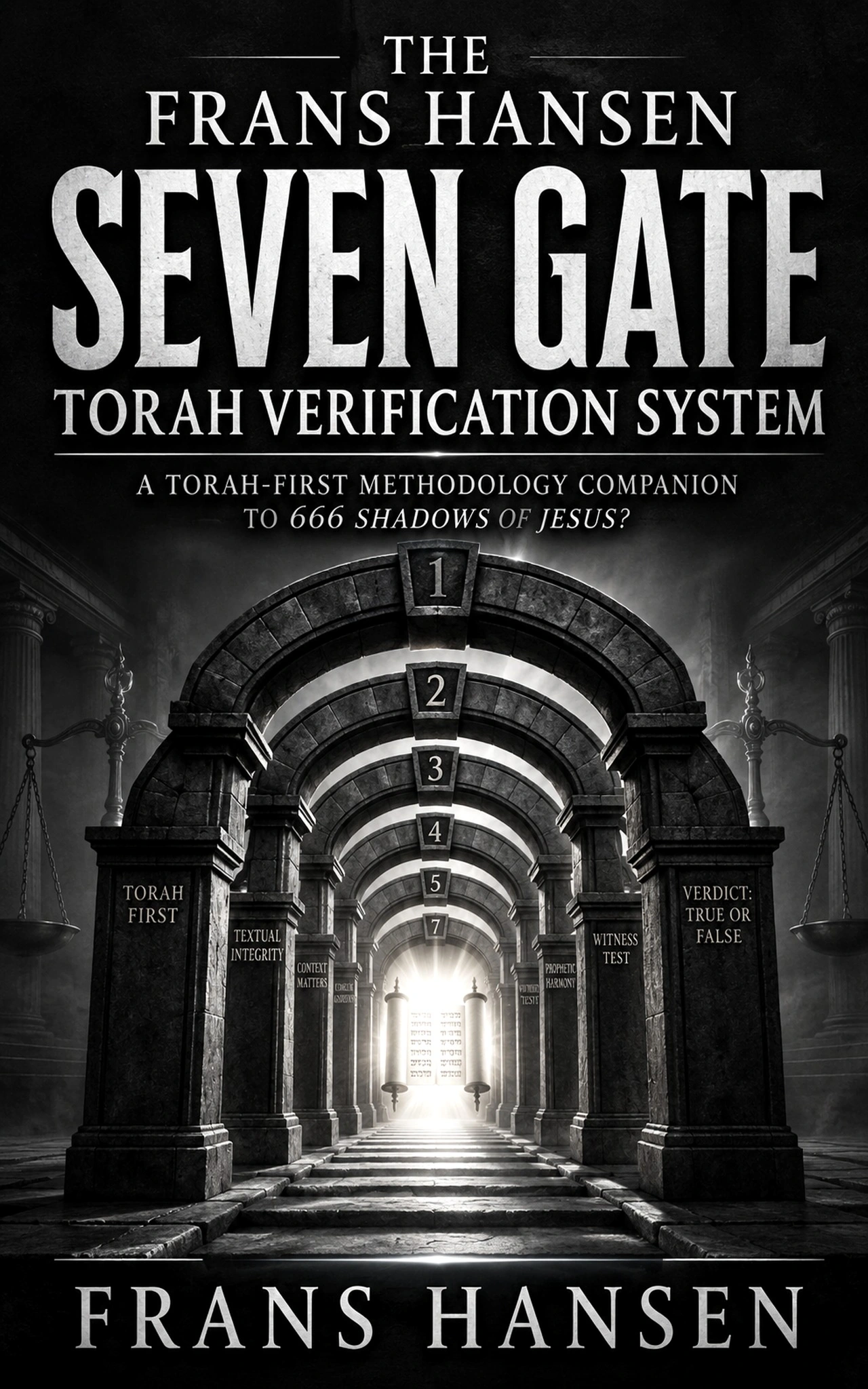
From the wider question raised by “Or does the doctrine require a later Christian filter?”, the book choice becomes specific: The Frans Hansen Seven Gate Torah Verification System: A Torah-based procedure for testing any religious claim by text, context, covenant, prophetic outcome, and burden of proof. carries the investigation into Method for testing religious claims by text, context, covenant, prophetic outcome and burden of proof.