
Evidence bridge
The first question is: Who was commanded?
The target state is evidentiary clarity: a fair Christian formulation, a controlled reading of “The first question is: Who was commanded?”, an explicit concession, and a narrow verdict.
What this article established
The Omer count is commanded to Israel inside Israel’s festival and land/Temple framework. That does not prove a non-Jew commits idolatry by voluntarily counting days, but it does block the claim that covenant ownership can be created by imitation.
- Verified: the Omer count belongs to Israel’s commanded festival framework.
- Verified: Torah identifies the commanded audience.
- Possible: a non-Jew may imitate or study a practice without claiming the command legally applies to him.
- Unsupported: deriving Israelite covenant status merely from voluntarily performing Israel’s command.
- Unsupported: treating the command as a Christian symbol before its stated Torah purpose is controlled.
The question that still remains
What happens after “The first question is: Who was commanded?” is resolved and the review widens to Christian hints, types, shadows, parallels, codes and prooftexts under Torah rules, with the original narrative, its stated purpose, any textual signal of future reference kept in view?
Why this book is the next step
Locate the precise burden shift before allowing the argument to widen. symbolic / original / narrative / stated: the problem has moved from one Types, shadows, feasts and symbolic Jesus claims ruling into the exact scope of 666 Shadows of Jesus?: Christian “Hints, Types & Shadows” in the Hebrew Bible Tested Under Torah. The same rule must govern the next text as governed this one. Distinguish the named parties while preserving the strongest concession. Partition the source chronology under the Hebrew wording first; keep the concrete markers commanded, Types, shadows, feasts, symbolic visible.
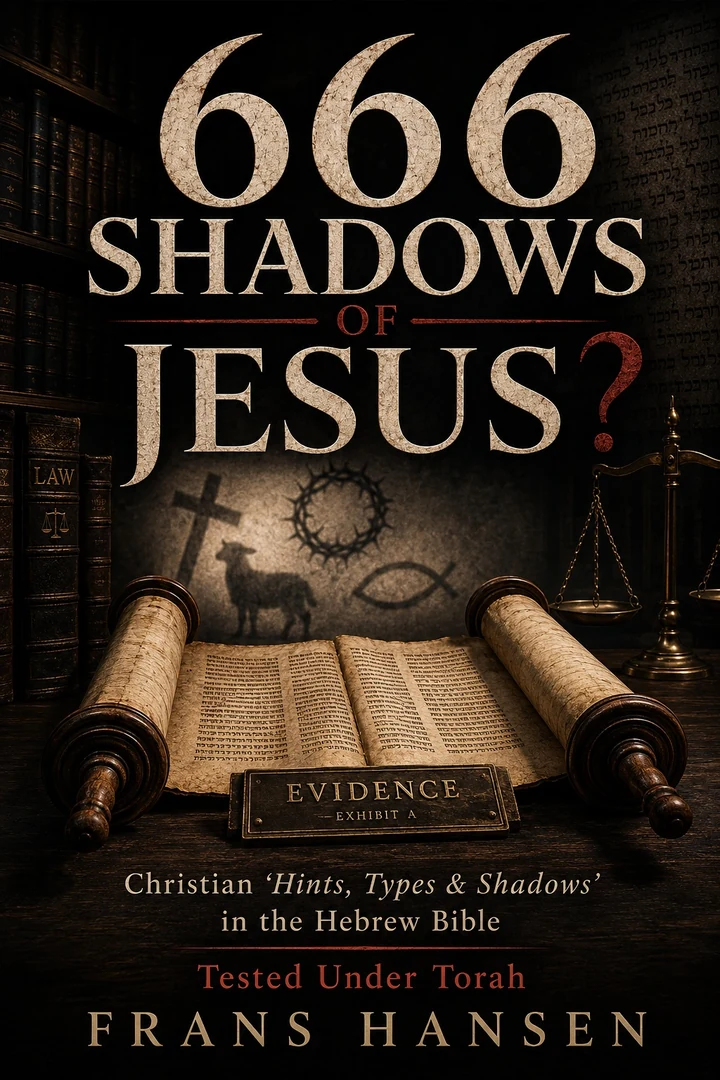
The source map beyond “The first question is: Who was commanded?” points to one book-length continuation: 666 Shadows of Jesus?: Christian “Hints, Types & Shadows” in the Hebrew Bible Tested Under Torah, whose scope is Christian hints, types, shadows, parallels, codes and prooftexts under Torah rules. Open the book page for the full treatment.