
Evidence bridge
What does ‘which He had not commanded them’ do to religious practices defended only by sincerity or symbolism?
The target state is evidentiary clarity: a fair Christian formulation, a controlled reading of “What does ‘which He had not commanded them’ do to religious practices defended only by sincerity or symbolism?”, an explicit concession, and a narrow verdict.
What this article established
Leviticus 10 condemns Nadav and Avihu for bringing foreign fire “which He had not commanded them.” The principle is severe inside the Mishkan’s sacred service. It cannot honestly be expanded into a blanket claim that every religious practice without an explicit verse is forbidden.
- Verified: Nadav and Avihu brought unauthorized fire in priestly sacred service.
- Verified: Torah identifies “which He had not commanded them” as part of the offense.
- Supported principle: sincerity does not independently authorize changes inside regulated worship.
- Unsupported overreach: every uncommanded religious custom in all contexts is therefore forbidden.
- Still requiring proof: any later ritual that claims authority to alter or replace Torah-defined sacred service.
The question that still remains
Beyond “What does ‘which He had not commanded them’ do to religious practices defended only by sincerity or symbolism?”, can the larger claim be established across Method for testing religious claims by text, context, covenant, prophetic outcome and burden of proof while Torah’s rules for authorized worship, the Nadav/Avihu pattern where relevant remains controlling?
Why this book is the next step
This assignment is justified by the unresolved evidence field, not by keyword overlap. The next task after which, had, not, commanded is Beyond “What does ‘which He had not commanded them’ do to religious practices defended only by sincerity or symbolism?”, can the larger claim be established across Method for testing religious claims by text, context, covenant, prophetic outcome and burden of proof while Torah’s rules for authorized worship, the Nadav/Avihu pattern where relevant remains controlling?; The Frans Hansen Seven Gate Torah Verification System: A Torah-based procedure for testing any religious claim by text, context, covenant, prophetic outcome, and burden of proof. covers Method for testing religious claims by text, context, covenant, prophetic outcome and burden of proof. The match is therefore between unresolved scope and book scope, not between repeated keywords. The worked hinge that makes this assignment specific is which / had / not / commanded / them.
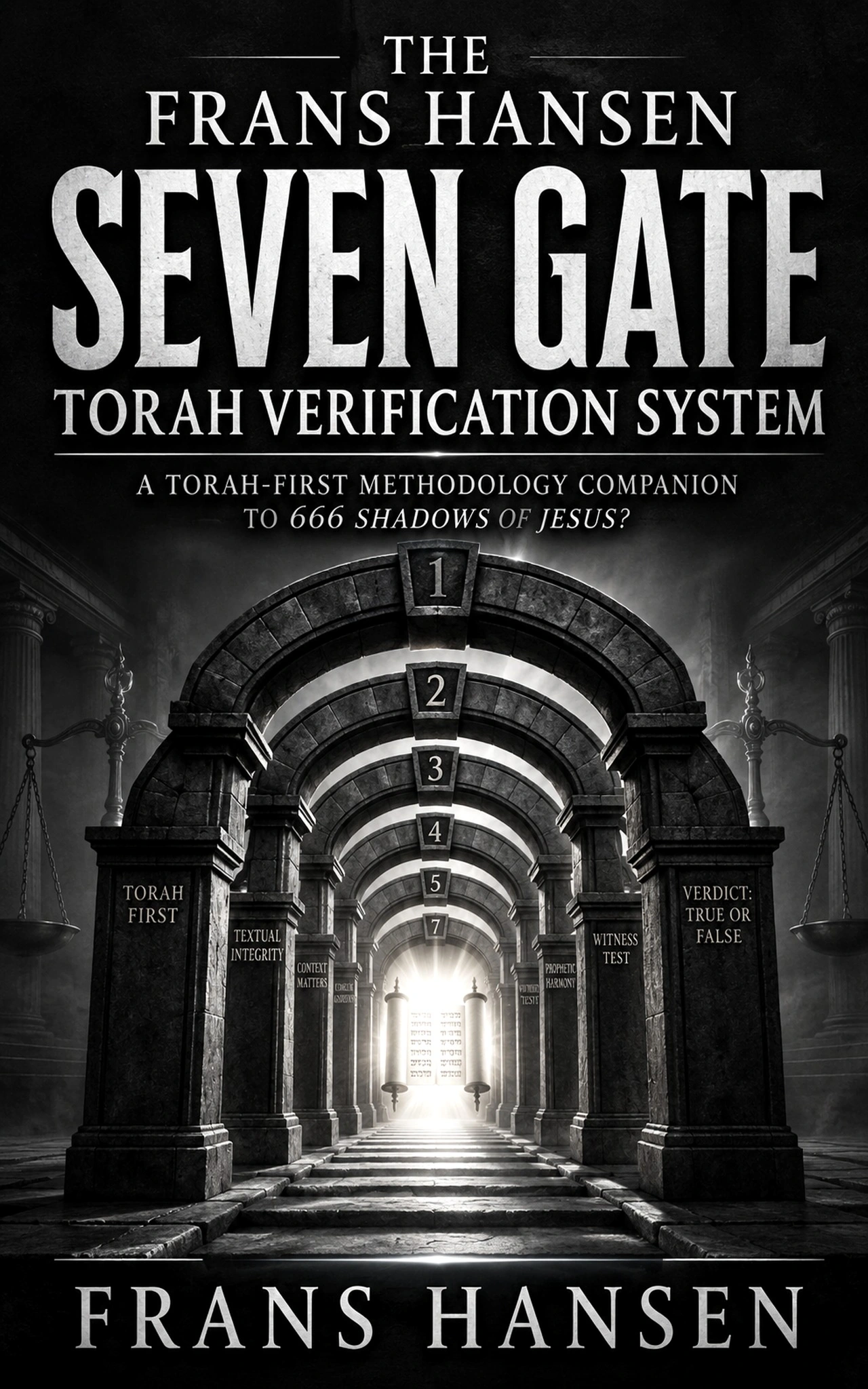
The source map beyond “What does ‘which He had not commanded them’ do to religious practices defended only by sincerity or symbolism?” points to one book-length continuation: The Frans Hansen Seven Gate Torah Verification System: A Torah-based procedure for testing any religious claim by text, context, covenant, prophetic outcome, and burden of proof., whose scope is Method for testing religious claims by text, context, covenant, prophetic outcome and burden of proof. Open the book page for the full treatment.