
Evidence bridge
What is the difference between applying an old text to a new situation and claiming that the old text predicted it?
The reader wants a bounded verdict: what “What is the difference between applying an old text to a new situation and claiming that the old text predicted it?” establishes, what remains possible, and what it does not authorize, using peshat, original speaker/audience, textual markers of futurity, literary category, and the later application.
What this article established
An older verse can be applied to a new event without having predicted that event. Prediction requires a future-directed textual bridge; application requires only a meaningful analogy. Confusing those categories lets later doctrine manufacture prophecy after the fact.
- Verified: later application and original prediction are different interpretive categories.
- Verified: peshat is controlled by grammar, audience, literary setting and historical horizon.
- Possible: a later event can meaningfully reuse or typologically echo an earlier text.
- Required for a verified prediction: textual or independently authorized evidence that the earlier passage points forward.
- Unsupported: “The later writer applied the verse, therefore the earlier verse predicted the later event.”
The question that still remains
Once “What is the difference between applying an old text to a new situation and claiming that the old text predicted it?” is settled, what remains defensible across A field manual for recurring missionary claims and prooftexts when the test is controlled by peshat, original speaker/audience, textual markers of futurity, literary category?
Why this book is the next step
Christian Proof-Text Manual: 100 High-Frequency Missionary Claims Tested Against Torah, Hebrew, and Context earns the slot because the reader's unresolved question moves from difference, between, applying, text to A field manual for recurring missionary claims and prooftexts, precisely the domain this title was built to audit. The book earns the bridge by expanding the evidence set while keeping the same burden of proof used at difference / between / applying / text. The worked hinge that makes this assignment specific is difference / between / applying / text / situation.
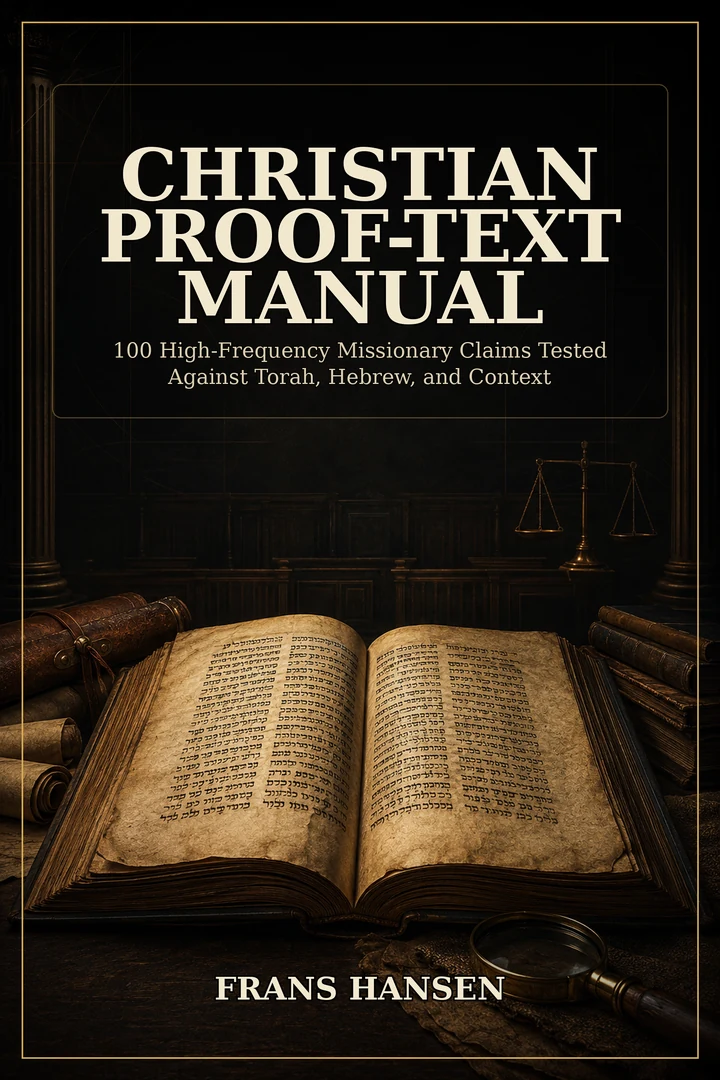
If the wider question after “What is the difference between applying an old text to a new situation and claiming that the old text predicted it?” is genuinely Once “What is the difference between applying an old text to a new situation and claiming that the old text predicted it?” is settled, what remains defensible across A field manual for recurring missionary claims and prooftexts when the test is controlled by peshat, original speaker/audience, textual markers of futurity, literary category?, the next destination is Christian Proof-Text Manual: 100 High-Frequency Missionary Claims Tested Against Torah, Hebrew, and Context, because its scope is A field manual for recurring missionary claims and prooftexts.