
Evidence bridge
What kind of truth needs people to fear the act of examining it?
The reader wants a bounded verdict: what “What kind of truth needs people to fear the act of examining it?” establishes, what remains possible, and what it does not authorize, using Tanakh’s praise of wisdom, knowledge, testing, public revelation, and the difference between humble inquiry and rebellion.
What this article established
Tanakh does not praise suspicion for its own sake. It praises wisdom and gives tests for religious claims. A truth claim should survive honest examination, while the examiner must also accept evidence, context and covenant controls rather than turning skepticism itself into an untouchable creed.
- Verified: Torah provides tests for religious and prophetic claims.
- Verified: Tanakh praises wisdom, knowledge and correction.
- Verified: foundational revelation is presented publicly rather than as inaccessible private experience.
- Possible: faith and trust can coexist with disciplined examination.
- Methodologically invalid: a system in which no evidence can count against the doctrine.
- Equally invalid: skepticism that refuses to let any answer count.
The question that still remains
If “What kind of truth needs people to fear the act of examining it?” is settled from the sources, what survives when the inquiry expands to Method for testing religious claims by text, context, covenant, prophetic outcome and burden of proof under Tanakh’s praise of wisdom, knowledge, testing, public revelation?
Why this book is the next step
The Frans Hansen Seven Gate Torah Verification System: A Torah-based procedure for testing any religious claim by text, context, covenant, prophetic outcome, and burden of proof. earns the slot because the reader's unresolved question moves from kind, truth, needs, people to Method for testing religious claims by text, context, covenant, prophetic outcome and burden of proof, precisely the domain this title was built to audit. The assignment would fail if the remaining question were different; its fit depends on the exact move from kind / truth / needs / people into Method for testing religious claims by text, context, covenant, prophetic outcome and burden of proof. The worked hinge that makes this assignment specific is kind / truth / needs / people / fear.
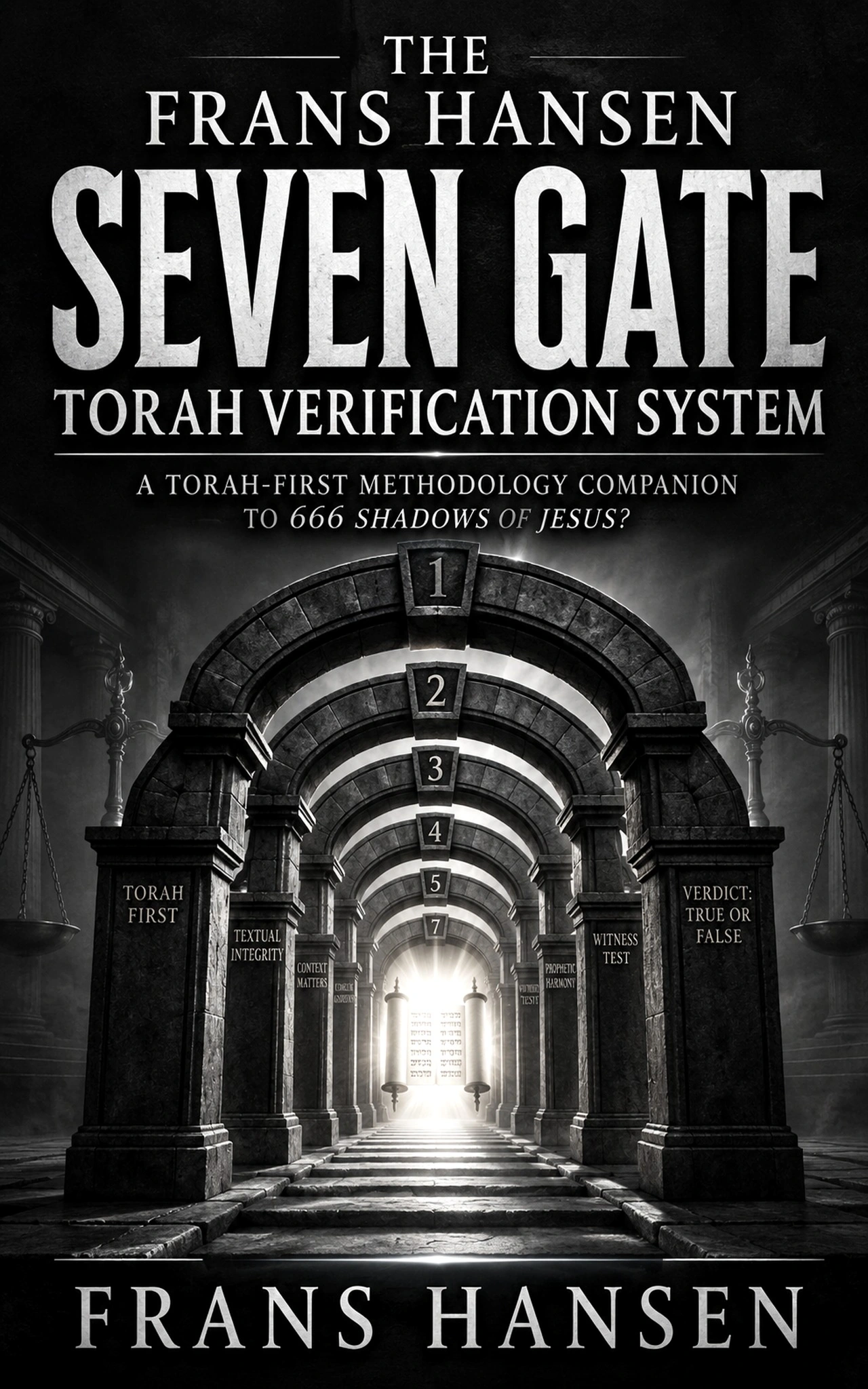
From the wider question raised by “What kind of truth needs people to fear the act of examining it?”, the book choice becomes specific: The Frans Hansen Seven Gate Torah Verification System: A Torah-based procedure for testing any religious claim by text, context, covenant, prophetic outcome, and burden of proof. carries the investigation into Method for testing religious claims by text, context, covenant, prophetic outcome and burden of proof.