
Evidence bridge
Where does Deuteronomy 4:2 create an exception called ‘fulfillment’ that allows commandments to become obsolete?
The desired certainty is not absolute certainty about every doctrine. It is enough precision to say why “Where does Deuteronomy 4:2 create an exception called ‘fulfillment’ that allows commandments to become obsolete?” is Verified, Possible, Disputed, Unsupported, or Contradicted by the controlling source.
What this article established
Deuteronomy 4:2 forbids adding to and subtracting from what Moses commands. A later theology may argue that some commandments reached a new covenantal stage, but the word “fulfillment” is not an exception written into Moses’ rule.
- Verified: Deuteronomy 4:2 forbids adding to and subtracting from Moses’ commandments.
- Verified: the verse does not contain an exception named “fulfillment.”
- Possible as later Christian theology: a claim that fulfillment changes the covenantal administration of commandments.
- Unsupported by Deuteronomy 4:2 itself: using “fulfillment” as an automatic legal escape clause from the non-subtraction rule.
The question that still remains
After resolving “Where does Deuteronomy 4:2 create an exception called ‘fulfillment’ that allows commandments to become obsolete?”, does the wider case across Method for testing religious claims by text, context, covenant, prophetic outcome and burden of proof survive the same test, especially the named Torah or prophetic control text, its legal or covenant function?
Why this book is the next step
The article's next legitimate scope matches this book's scope: Method for testing religious claims by text, context, covenant, prophetic outcome and burden of proof. That makes The Frans Hansen Seven Gate Torah Verification System: A Torah-based procedure for testing any religious claim by text, context, covenant, prophetic outcome, and burden of proof. a continuation of the same inquiry rather than an unrelated sale. The reason is methodological continuity: the book applies the same source controls beyond the single Where / Deuteronomy / 4:2 / create hinge. The worked hinge that makes this assignment specific is Deuteronomy 4:2 / Where / Deuteronomy / 4:2 / create.
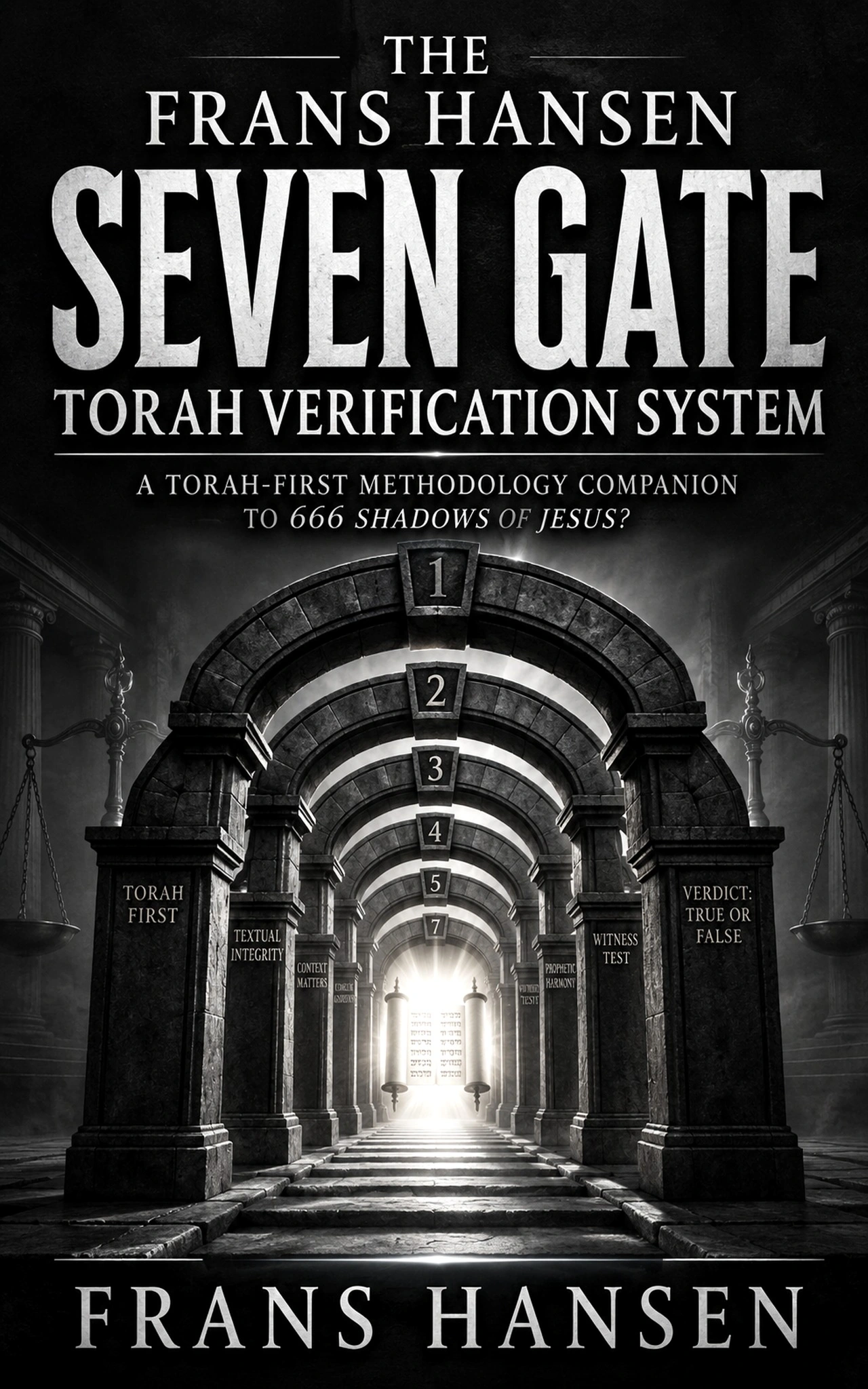
After the wider source map for “Where does Deuteronomy 4:2 create an exception called ‘fulfillment’ that allows commandments to become obsolete?”, the book fit becomes testable: The Frans Hansen Seven Gate Torah Verification System: A Torah-based procedure for testing any religious claim by text, context, covenant, prophetic outcome, and burden of proof. is the book-length investigation for Method for testing religious claims by text, context, covenant, prophetic outcome and burden of proof. Open the book page only if that is the field you still need examined.