
Evidence bridge
Why does Isaiah 7 suddenly jump seven centuries?
The desired certainty is not absolute certainty about every doctrine. It is enough precision to say why “Why does Isaiah 7 suddenly jump seven centuries?” is Verified, Possible, Disputed, Unsupported, or Contradicted by the controlling source.
What this article established
It does not. The seven-century jump happens when Matthew's application is placed back into Isaiah and then treated as if Isaiah himself announced it.
- Verified: the sign is given in Ahaz's crisis.
- Verified: Isaiah 7:16 ties the child's development to the removal of the two kings Ahaz fears.
- Verified: Isaiah 8 repeats a child-as-clock pattern for near-term events.
- Possible as later Christian interpretation: an additional typological fulfillment in Jesus.
- Unsupported: erasing the immediate timeline and treating the seven-century application as though it were the only horizon Isaiah supplied.
The question that still remains
If “Why does Isaiah 7 suddenly jump seven centuries?” is settled from the sources, what survives when the inquiry expands to Matthew's quotations, fulfillment claims, and messianic arguments against the Hebrew text under the Masoretic wording, the cited passage’s historical horizon, Matthew’s quotation form?
Why this book is the next step
passage’s / Isaiah / 7 / suddenly: the problem has moved from one Isaiah 7 ruling into the exact scope of THE GOSPEL OF MATTHEW UNDER THE TORAH TEST: Quotations, “Fulfillment,” and Messianism Tested Against the Hebrew Text. A wider verdict needs a fresh source. Keep the legal or literary category visible before importing theological analogy. Locate the lexical move while preserving the strongest concession.
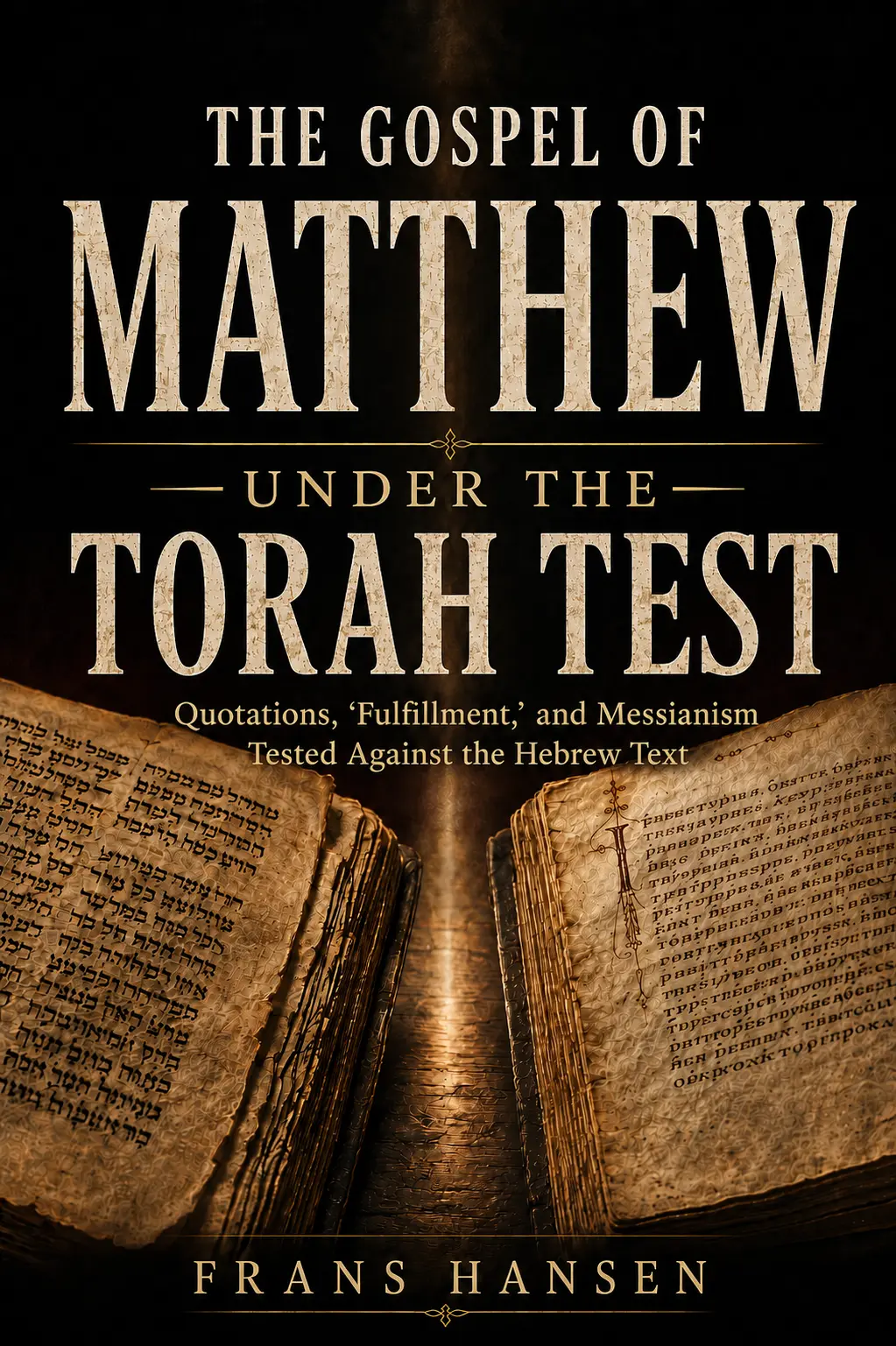
If the wider question after “Why does Isaiah 7 suddenly jump seven centuries?” is genuinely What happens to the larger case when Matthew's quotations, fulfillment claims, and messianic arguments against the Hebrew text is tested instead of inferred from this single result?, the next destination is THE GOSPEL OF MATTHEW UNDER THE TORAH TEST: Quotations, “Fulfillment,” and Messianism Tested Against the Hebrew Text, because its scope is Matthew's quotations, fulfillment claims, and messianic arguments against the Hebrew text.