
Evidence bridge
You are My servant, Israel.” So who is exalted?
The goal is to know exactly where the evidence ends at “You are My servant, Israel.” So who is exalted?”, so later theology cannot borrow certainty from a source that never supplied it.
What this article established
Isaiah 49:3 calls the servant Israel; Daniel 7 repeatedly gives the kingdom to the holy ones and their people. Both texts allow representative language. An individual messianic figure is possible, but an exclusive Jesus-only reading cannot erase the corporate recipients named by Daniel.
- Verified: Isaiah 49:3 explicitly calls the servant “Israel,” showing that Tanakh can use singular representative language for a corporate identity.
- Verified: Daniel 7’s beasts represent kingdoms, establishing a corporate-symbolic structure inside the vision.
- Verified: Daniel 7:18, 22, and 27 repeatedly give the final kingdom to the holy ones and to the people of the holy ones of the Most High.
- Possible: the “one like a human being” may be an individual representative, including a messianic king, who embodies the holy people.
- Unsupported by Daniel 7 alone: an exclusive identification of the figure with Jesus that makes the holy people secondary or dispensable to the interpretation.
- Unsupported by the source line alone: using Isaiah’s “servant Israel” phrase as if it were a quotation from Daniel.
- If “You are My servant, Israel.” So who is exalted?” is settled from the sources, what survives when the inquiry expands to Daniel 2, 7, 9, 12, Son of Man, seventy weeks, resurrection and prophecy charts under the relevant Daniel passage in full, its Hebrew/Aramaic terms, chronology, symbolic identifications?
The question that still remains
If “You are My servant, Israel.” So who is exalted?” is settled from the sources, what survives when the inquiry expands to Daniel 2, 7, 9, 12, Son of Man, seventy weeks, resurrection and prophecy charts under the relevant Daniel passage in full, its Hebrew/Aramaic terms, chronology, symbolic identifications?
Why this book is the next step
The reason for this book is structural, not topical coincidence: You, servant, Israel, who opens into If “You are My servant, Israel.” So who is exalted?” is settled from the sources, what survives when the inquiry expands to Daniel 2, 7, 9, 12, Son of Man, seventy weeks, resurrection and prophecy charts under the relevant Daniel passage in full, its Hebrew/Aramaic terms, chronology, symbolic identifications? and the book is specifically organized around Daniel 2, 7, 9, 12, Son of Man, seventy weeks, resurrection and prophecy charts. A broader title would dilute the You / servant / Israel / who evidence family; a narrower article would not reach the cross-text question. The worked hinge that makes this assignment specific is You / servant / Israel / who / exalted.
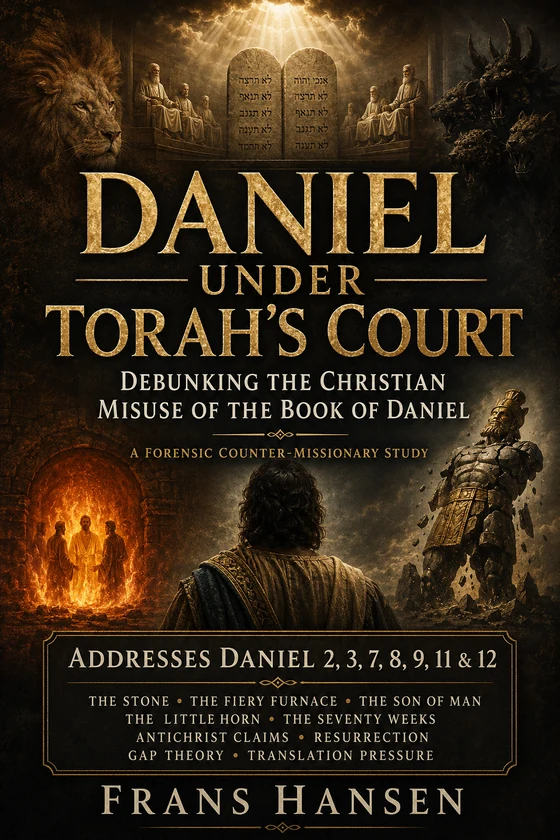
If the wider question after “You are My servant, Israel.” So who is exalted?” is genuinely If “You are My servant, Israel.” So who is exalted?” is settled from the sources, what survives when the inquiry expands to Daniel 2, 7, 9, 12, Son of Man, seventy weeks, resurrection and prophecy charts under the relevant Daniel passage in full, its Hebrew/Aramaic terms, chronology, symbolic identifications?, the next destination is Daniel Under Torah's Court: Debunking the Christian misuse of the Book of Daniel, because its scope is Daniel 2, 7, 9, 12, Son of Man, seventy weeks, resurrection and prophecy charts.