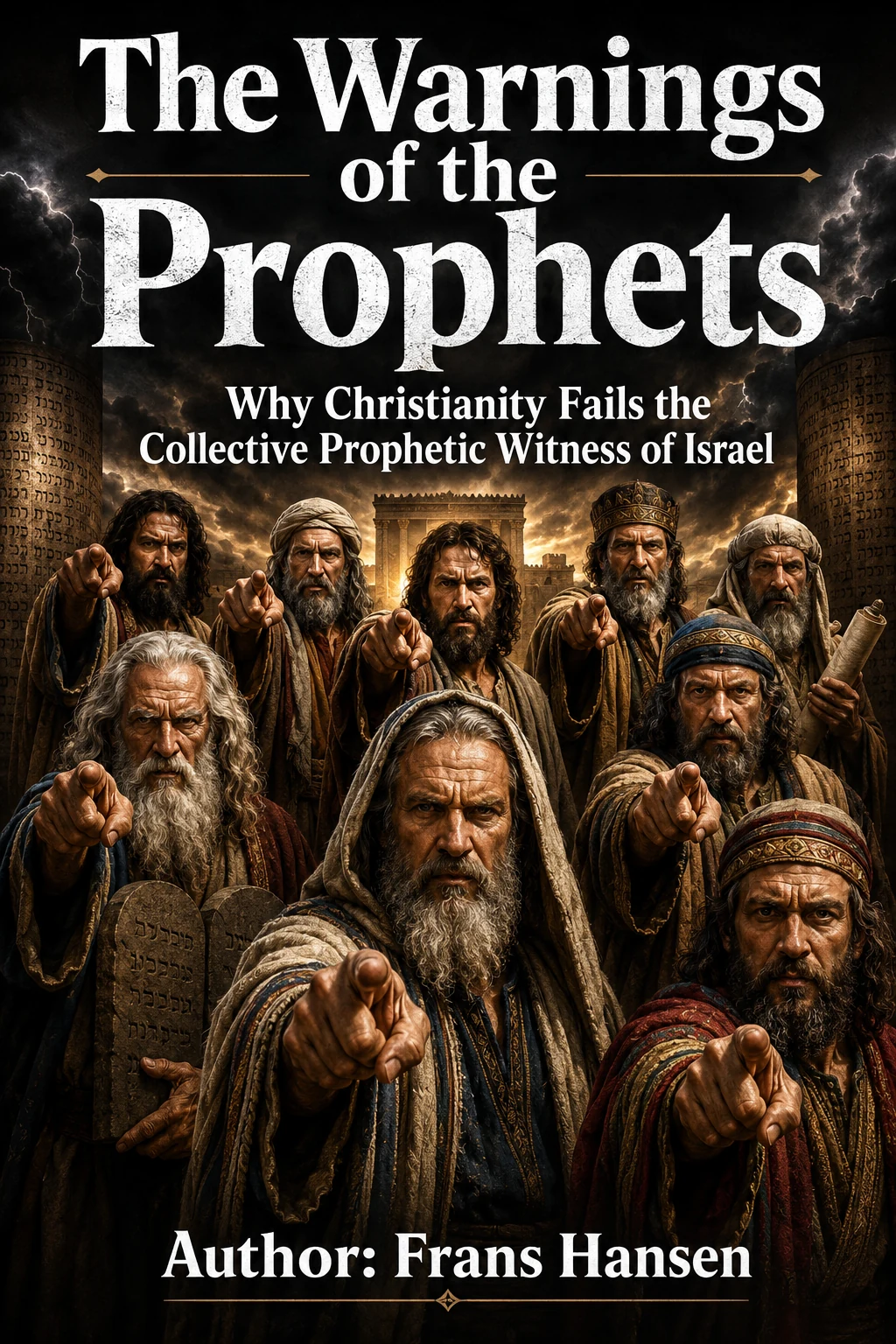
Why read The Warnings of the Prophets: Why Christianity Fails the Collective Prophetic Witness of Israel? A Torah-first reader’s guide
This guide explains what the book actually examines, why that examination matters, and how to read it critically. It is not a substitute for the evidence in the book. It gives you the map before you enter the argument.
A Torah-first courtroom case testing Christianity against Moses and the collective prophetic witness of Israel.
A Torah-first courtroom case against Christian claims. Moses controls the jurisdiction, the prophets testify together, and Christianity must survive Tanakh’s covenant categories before the New Testament is allowed to speak.
This is not a loose pile of objections. It is a forensic test of Christian theology under Israel’s covenant evidence. Christianity quotes the Hebrew Bible constantly, but quoting a court record is not the same as surviving its judgment.
Use this book when the debate moves from isolated prooftexts to the collective witness of Moses and the Prophets. It forces incarnation, cross-atonement, fulfilled Torah, Church authority, miracle claims, and typology to stand beneath Tanakh’s own covenant controls.
The central issue is authority. A Christian conclusion cannot prove itself merely by quoting an earlier Hebrew text. The wording, speaker, audience, covenant setting, and public outcome still control what the earlier text can support.
The controlling method
The book uses a Torah-first test: begin with the Hebrew Bible in its own literary and covenant setting, state the strongest Christian reading fairly, then ask whether the later claim preserves the original subject, meaning, and authority.
Who should read it
Jewish readers can use the book to identify where missionary arguments cross from quotation into reinterpretation. Noahides and questioning Christians can use it to separate reverence for Scripture from automatic acceptance of New Testament conclusions. Teachers and debaters can use its structure to keep the burden of proof visible.
What this guide does not claim
A forceful verdict is not a licence to skip sources. This guide does not turn every disagreement into dishonesty, and it does not make possible interpretations proven. The book succeeds only where its textual comparisons, context, and burden-of-proof analysis can be independently checked.
FAQ
What this book tests: The Warnings of the Prophets: Why Christianity Fails the Collective Prophetic Witness of Israel?
A Torah-first courtroom case testing Christianity against Moses and the collective prophetic witness of Israel. The central issue is authority. A Christian conclusion cannot prove itself merely by quoting an earlier Hebrew text. The wording, speaker, audience, covenant setting, and public outcome still control what the earlier text can support.
The controlling method: The Warnings of the Prophets: Why Christianity Fails the Collective Prophetic Witness of Israel?
The book uses a Torah-first test: begin with the Hebrew Bible in its own literary and covenant setting, state the strongest Christian reading fairly, then ask whether the later claim preserves the original subject, meaning, and authority.
Who should read it: The Warnings of the Prophets: Why Christianity Fails the Collective Prophetic Witness of Israel?
Jewish readers can use the book to identify where missionary arguments cross from quotation into reinterpretation. Noahides and questioning Christians can use it to separate reverence for Scripture from automatic acceptance of New Testament conclusions. Teachers and debaters can use its structure to keep the burden of proof visible.