franshansen.com
Book

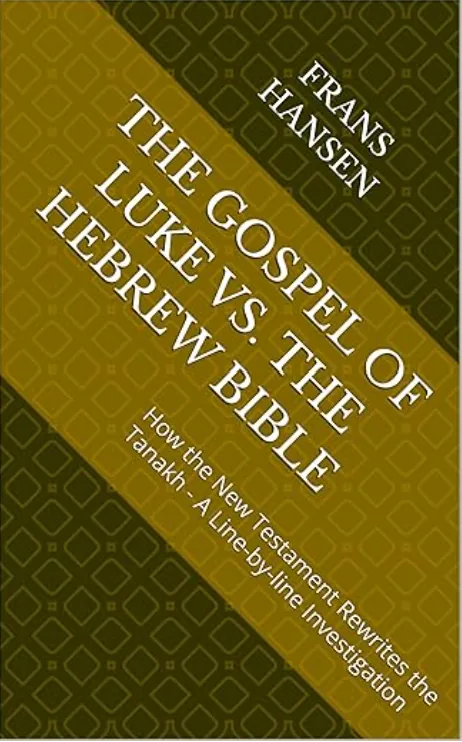
THE GOSPEL OF LUKE VS. THE HEBREW BIBLE

A line-by-line audit: where Luke rewrites Tanakh frames, reshapes terms, and relocates meanings.

Author: Frans Hansen

What this book covers

Full detailed extended sales pitch from the sales-pitch workbook, column G.

THE GOSPEL OF LUKE VS. THE HEBREW BIBLE

What if the most polished Gospel is also the most carefully disguised replacement of the Hebrew Bible?

Luke is often treated as the gentle Gospel.

The Gospel of compassion. The Gospel of the poor. The Gospel of women. The Gospel of sinners. The Gospel of the outsider.

But beneath that smooth surface lies a harder question:

Does Luke actually continue the Hebrew Bible — or does he rewrite it? This book places the Gospel of Luke on trial before the God of Israel. Not through church tradition. Not through devotional reading. Not through missionary slogans. Not through emotional attachment. Through Torah. Through Tanakh. Through Hebrew context. Through covenant law. Through the standards Luke claims to inherit. The Gospel of Luke vs. The Hebrew Bible is a forensic, chapter-by-chapter audit of Luke’s claims, stories, prophecies, miracles, speeches, genealogy, authority claims, and use of Israel’s Scriptures. The result is devastating.

Luke does not merely tell a story about Jesus.

Luke builds a new religious narrative dressed in Jewish language.

Priests appear — but covenant authority disappears. Angels speak — but Torah standards are bypassed. Prophecies are quoted — but their Hebrew context is rewritten. Miracles occur — but miracles cannot override Torah. Jesus is called Davidic — but the genealogy collapses under Jewish lineage law. The kingdom is announced — but Israel is not restored. Forgiveness is proclaimed — but Torah categories are replaced. Jewish resistance is reframed — but the objections are never fairly judged by Sinai. That is the problem.

Luke sounds biblical because it borrows biblical atmosphere.

But atmosphere is not authorization. This book shows how Luke repeatedly uses the sound, imagery, rhythm, and emotional force of the Hebrew Bible while shifting the meaning away from Israel’s covenant and toward a Jesus-centered religious system.

Inside, you will see Luke tested across the major pressure points:

The attached manuscript does not offer vague criticism. It proceeds section by section, with chapter summaries, pericope analysis, final verdicts, and an appendix mapping Luke’s passages to the Hebrew Bible references in view. :contentReference[oaicite:1]{index=1} This is not a devotional commentary. It is a structured case file. A claim is made. The Hebrew Bible is opened. The context is restored. The Torah standard is applied. The verdict is delivered.

  • the self-authored Gospel opening
  • Zechariah and Elizabeth as borrowed Tanakh birth-patterns
  • Gabriel’s announcement and the virgin-birth problem
  • John the Baptist forced into Elijah’s prophecy
  • Mary’s Magnificat as Hannah-pattern imitation
  • the census and Bethlehem problem
  • Jesus’ genealogy through Joseph while denying Joseph’s fatherhood
  • the Nathan-line problem versus Davidic kingship through Solomon
  • baptism for repentance as a substitute ritual
  • Isaiah 40 and Isaiah 61 redirected away from national restoration
  • wilderness temptation and foreign cosmology
  • synagogue authority claims
  • forgiveness of sins transferred to Jesus
  • Sabbath controversy
  • demons, exorcisms, healings, and miracle-based authority
  • the centurion narrative and Roman moral inversion
  • the Good Samaritan as ethical drama detached from covenant context
  • the “kingdom of God” redefined away from David, Jerusalem, land, Temple, and national restoration
  • the Pharisee/tax collector contrast
  • the rich ruler
  • the entry into Jerusalem
  • the wicked tenants
  • Caesar, resurrection, and authority conflict

Luke wants the reader to believe that Jesus fulfills Israel’s story.

This book asks the question Luke does not want tested:

What if the Hebrew Bible never authorized that story?

The central discovery is simple:

Luke does not merely quote Tanakh.

Luke imitates Tanakh.

He borrows the forms:

miraculous births, angelic announcements, prophetic songs, Temple scenes, wilderness testing, Elijah imagery, Isaiah language, Davidic promises, kingdom vocabulary, and repentance language. But he detaches them from their original covenant purpose. In the Hebrew Bible, redemption means Israel restored. Jerusalem rebuilt. Exiles gathered. Torah honored. Davidic kingship established. Oppression ended. The nations turning to the God of Israel. In Luke, the kingdom becomes personal, spiritual, symbolic, and Jesus-centered. No restored Davidic throne. No national redemption. No ingathering of exiles. No rebuilt Jerusalem. No Torah-centered messianic age. No visible fulfillment of the prophets. That is not continuation. That is replacement.

This book is for:

  • Christians brave enough to test Luke without church protection
  • Jews tired of seeing their Scriptures used against them
  • Noahides seeking a Torah-consistent reading
  • ex-Christians rebuilding from inherited theology
  • anti-missionary educators who need structured answers
  • students of Jewish–Christian debate
  • readers who want evidence, not religious theater
  • anyone who has ever asked: “Did Luke really get this from the Hebrew Bible?”

The answer this book gives is blunt:

No. Luke’s Gospel is beautiful. Luke’s Gospel is literary. Luke’s Gospel is emotionally powerful. But beauty is not truth. Literary skill is not prophecy. Emotion is not covenant authority. And a story does not become biblical because it dresses itself in biblical clothing. If Luke truly continues the Hebrew Bible, it should survive the Hebrew Bible. If Jesus truly fulfills the prophets, the prophets should not have to be redefined. If the kingdom truly arrived, Israel’s promised restoration should not be missing. If the genealogy proves Davidic legitimacy, it should not collapse under the fatherhood problem. If miracles prove authority, Deuteronomy 13 should not be standing in the way. If Luke’s claims are true, they should pass Torah. This book applies that test. And once Luke is read under Torah’s light, the pattern becomes impossible to ignore: Hebrew language is borrowed. Greek theology is inserted. Jewish expectation is redirected. National promises are spiritualized. Torah authority is bypassed. Jesus becomes the new center. Israel’s covenant is quietly displaced. That is why this book matters. It does not merely attack Luke. It exposes the mechanism. The Gospel of Luke vs. The Hebrew Bible gives readers the tools to see how New Testament theology can sound Jewish while moving away from Judaism; how prophecy can be quoted while context is removed; how compassion language can hide covenant replacement; and how a Gospel can appear faithful to the Hebrew Bible while rewriting its meaning from the inside. Read Luke with the Tanakh open. Test the genealogy. Test the prophecies. Test the kingdom. Test the miracles. Test the authority claims. Test the use of Isaiah. Test the covenant logic.

Then ask the question Christianity avoids:

Does Luke actually pass Sinai? Where the polished Gospel faces the Hebrew text. Where beautiful narrative meets Torah law. Where borrowed prophecy meets original context. Where Luke stands trial before the God of Israel.

Visual sales pitch

A quick visual case summary for this book.

Visual sales pitch for THE GOSPEL OF LUKE VS. THE HEBREW BIBLE

Related reading