franshansen.com
Book

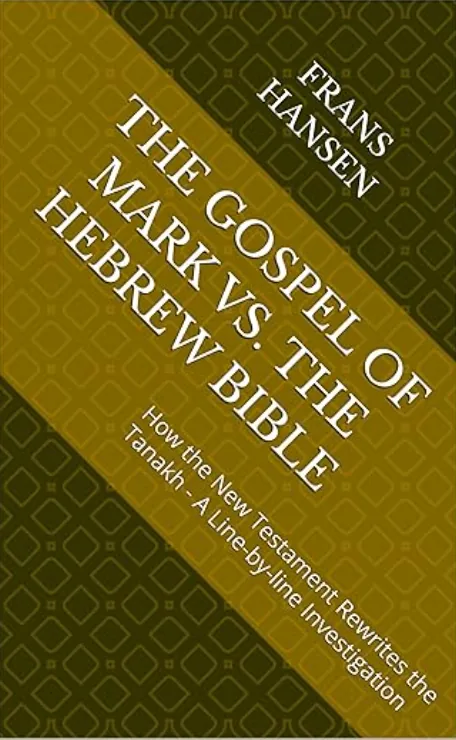
THE GOSPEL OF MARK VS. THE HEBREW BIBLE

Tracks interpretive moves: selective quoting, re-framing, and meaning carried by translation choices.

Author: Frans Hansen

What this book covers

Full detailed extended sales pitch from the sales-pitch workbook, column G.

FEATURES OF THE BOOK

The Gospel of Mark vs. The Hebrew Bible is not a devotional commentary. It is a full Torah-forensic audit of the Gospel of Mark — built to test every major claim, quotation, allusion, miracle, authority claim, and “fulfillment” argument against the Hebrew Bible. The manuscript runs to approximately 360 source pages, ending with a glossary. The main chapter-by-chapter audit covers Mark 1–16, followed by master tables, final assessment, concluding synthesis, Torah-verdict closing chapter, appendices, a prophecy-definition section, and final summary. Final KDP page count may change with formatting, but the structure is already that of a serious reference work, not a pamphlet.

BOOK STRUCTURE

The book contains:

  • A preface and personal author trajectory
  • A clear explanation of what the book is and is not
  • A reader guide on how to use the book
  • A book introduction
  • A methodology section
  • Rules for comparing the Greek New Testament to the Hebrew Tanakh
  • A section on the Septuagint and the Hebrew Bible
  • 16 chapter-by-chapter audits of the Gospel of Mark
  • Dozens of focused pericope sections
  • Chapter summaries
  • Tanakh verdicts
  • A master summary table
  • A master table of Mark’s OT use vs. the Masoretic Text
  • Final assessment of how Mark uses and misuses Scripture
  • Final narrative summary
  • Concluding interpretive synthesis
  • Full Torah-verdict closing chapter
  • Appendix A: Hebrew Bible references in view
  • Appendix B: NT claims vs. Tanakh context vs. MT verdict
  • A section on how the Hebrew Bible defines prophecy
  • Hebrew Bible prophetic model summary
  • Final summary and conclusion
  • A word about the future
  • Glossary of terms

Why this matters:

The book does not rely on one attack line. It documents a pattern.

The reader is taken step by step through:

  • why Mark is usually read through Christian assumptions
  • why those assumptions must be tested, not protected
  • why the Hebrew Bible controls the meaning of its own texts
  • why Mark’s use of prophecy often depends on Greek, not Hebrew
  • why context breaks many Christian fulfillment claims
  • why miracles cannot override Torah
  • why Mark’s Jesus fails Deuteronomy 13 and Deuteronomy 18 tests
  • why “kingdom,” “son,” “servant,” “Son of Man,” and “messiah” are redefined
  • why Mark’s passion narrative borrows Tanakh language without fulfilling Tanakh prophecy
  • why the longer ending of Mark functions as a later Christian patch
  • why the Gospel of Mark does not complete the Hebrew Bible but rewrites it

STYLE

The style is forensic, direct, readable, and confrontational. Not devotional. Not apologetic. Not academic fog. Not polite religious cushioning. It reads like a case file.

The book uses:

  • short chapter introductions
  • focused pericope sections
  • Christian claim summaries
  • Tanakh-grounded counteranalysis
  • Hebrew Bible control texts
  • Deuteronomy 13 and 18 testing
  • direct verdicts
  • chapter-level summaries
  • master tables
  • final Torah rulings
  • practical debate framing

Why this matters:

Most readers do not need another vague book saying “context matters.” They need to see exactly where Mark breaks context, shifts meaning, changes categories, and borrows authority from the Hebrew Bible while moving away from it. This book gives them structure, ammunition, and a repeatable method.

CORE SECTIONS

PREFACE — FROM BELIEF TO CLARITY

Explains the author’s movement from trusting New Testament quotations to testing them against the Hebrew Bible. Core point: The New Testament does not fulfill the Hebrew Bible when the Hebrew Bible is allowed to speak for itself.

A PERSONAL TRAJECTORY YOU CANNOT DISMISS AS “IGNORANCE”

Shows the author’s background inside Christianity, missionary work, charismatic practice, Messianic circles, Bible teaching, Israel activism, and later return to the Hebrew text. Core point: This is not an outsider’s cheap attack. It is a former insider’s forensic audit.

WHAT THIS BOOK ACTUALLY IS

Defines the book as a forensic audit of Mark’s use of the Tanakh. Core point: Every citation, allusion, fulfillment claim, theological leap, and narrative borrowing is tested by the Hebrew source.

WHAT THIS BOOK IS NOT

Rejects the idea that the book is anti-religion, emotional deconstruction, or a strawman. Core point: The target is distortion, not faith.

WHO THIS BOOK IS FOR

Names the reader clearly:

Core point: This is a tool for people who want verification, not slogans.

  • scholars
  • Torah students
  • questioning Christians
  • former missionaries
  • anti-missionary educators
  • truth-seekers
  • readers tired of inherited claims

HOW TO USE THIS BOOK

Explains how to read the book:

Core point: The book can be read as a full argument or used as a reference system.

  • sequentially
  • thematically
  • comparatively
  • diagnostically

BOOK INTRODUCTION

Frames Mark as the earliest Gospel and the foundation for later Gospel claims. Core point: Mark begins not with proof, lineage, covenant, or continuity, but with a claim.

HOW TO READ MARK HONESTLY

Strips away inherited Christian assumptions:

Core point: These are not demonstrated. They are assumed.

  • that Mark reports history
  • that Mark understands Judaism
  • that Mark fulfills prophecy
  • that Mark continues the Tanakh

METHODOLOGY

Establishes the governing principle:

The Hebrew Bible is the authority. The New Testament is the claim. Claims must submit to the authority they quote. Core point: Christianity reverses the order. This book restores it.

RULES FOR COMPARING THE GREEK NEW TESTAMENT TO THE HEBREW TANAKH

Gives the reader the testing rules:

Core point: Once these rules are applied, Mark’s fulfillments begin to collapse.

  • Hebrew controls meaning
  • LXX does not override Hebrew
  • midrash is not prediction
  • similarity is not fulfillment
  • no retroactive doctrines
  • national prophecy cannot be reduced to one man

THE SEPTUAGINT AND THE HEBREW BIBLE

Explains how Greek translation, paraphrase, and interpretive shifts shaped Mark’s use of Scripture. Core point: Many Christian claims work in Greek because they do not survive in Hebrew.

MARK 1 — THE LAUNCH OF A NEW RELIGION

Tests Mark’s opening prophecy claim, John’s baptism, Jesus’ baptism, wilderness temptation, kingdom announcement, exorcisms, healings, and cleansing of the leper. Core point: Mark’s first chapter already misuses prophecy, imports foreign cosmology, redefines forgiveness, and shifts authority toward Jesus.

MARK 2 — JESUS ABOVE TORAH STRUCTURE

Tests forgiveness of sins, eating with sinners, fasting, new wine, and the Sabbath grain incident. Core point: Mark 2 relocates authority from God and Torah to Jesus personally.

MARK 3 — THEOLOGICAL BREAKPOINT

Tests Sabbath healing, appointment of the Twelve, Beelzebul accusation, unforgivable sin, and Jesus’ “true family.” Core point: Mark 3 replaces Torah categories with Jesus-centered categories: Sabbath, authority, family, blasphemy, leadership, and covenant identity.

MARK 4 — SECRECY, PARABLES, AND DIVINE PREROGATIVES

Tests the Sower, Isaiah 6 misuse, hiddenness sayings, kingdom parables, and calming the storm. Core point: Mark redefines revelation as insider mystery and assigns God-only authority over creation to Jesus.

MARK 5 — DEMONOLOGY, IMPURITY, AND RESURRECTION SYMBOLISM

Tests the Gerasene demoniac, pig destruction, hemorrhaging woman, and Jairus’ daughter. Core point: Mark’s miracle logic operates in categories foreign to Torah and uses spectacle where the Hebrew Bible requires covenant verification.

MARK 6 — FAILED RECOGNITION AND MISSION STRUCTURE

Tests rejection at Nazareth, sending of the Twelve, Herod and John, feeding miracle, walking on water, and mass healings. Core point: Mark builds authority through mission, miracle, and mythic symbolism rather than Tanakh messianic criteria.

MARK 7 — PURITY, TRADITION, AND FOOD LAW

Tests handwashing controversy, Korban argument, “all foods clean,” Syrophoenician woman, and healing of the deaf-mute. Core point: Mark 7 is one of the clearest Torah-collision chapters because it reframes purity and kashrut around Jesus’ authority.

MARK 8 — SIGNS, BLINDNESS, AND THE TURN TO THE CROSS

Tests feeding of the four thousand, demand for a sign, leaven warning, two-stage healing, Peter’s confession, passion prediction, and “take up your cross.” Core point: Mark shifts messiahship away from Tanakh outcomes and toward suffering, secrecy, and loyalty to Jesus.

MARK 9 — TRANSFIGURATION, ELIJAH, EXORCISM, AND GEHENNA

Tests the transfiguration, Elijah claim, failed exorcism, passion prediction, greatness dispute, outsider exorcist, and stumbling sayings. Core point: Mark uses spectacle, heavenly figures, and fear language to support claims that still do not meet Torah verification.

MARK 10 — DIVORCE, CHILDREN, WEALTH, RANSOM, AND BLINDNESS

Tests divorce teaching, children and kingdom, rich man, third passion prediction, ransom saying, and Bartimaeus. Core point: Mark modifies Torah categories and introduces ransom theology without Tanakh authorization.

MARK 11 — ENTRY, FIG TREE, TEMPLE, AND AUTHORITY

Tests the Jerusalem entry, cursed fig tree, Temple action, faith that moves mountains, and authority challenge. Core point: Mark weaponizes symbolism against Temple and Israel while failing to deliver the restoration the prophets actually describe.

MARK 12 — TENANTS, CAESAR, RESURRECTION, SHEMA, PSALM 110, SCRIBES, WIDOW

Tests the wicked tenants, tax question, Sadducees, greatest commandments, Psalm 110, warning against scribes, and widow’s offering. Core point: Mark borrows Jewish categories while redirecting authority away from Israel’s covenant structures toward Jesus.

MARK 13 — APOCALYPSE AND FAILED TIMING

Tests Temple destruction, false messiahs, wars, abomination, tribulation, fig tree, “this generation,” and unknown hour. Core point: Mark 13 contains time-linked apocalyptic claims that fail Deuteronomy 18 standards when read plainly.

MARK 14 — PASSOVER, BLOOD COVENANT, ARREST, TRIAL, DANIEL 7, PSALM 110

Tests anointing, Last Supper, “blood of the covenant,” Zechariah 13, Gethsemane, arrest, Scripture fulfillment claim, trial, Daniel 7, Psalm 110, and Peter’s denial. Core point: Mark 14 recasts Passover, covenant blood, and messianic identity into a Jesus-centered system not authorized by Torah.

MARK 15 — CRUCIFIXION AND PASSION PROOFTEXTING

Tests Pilate, Roman mockery, crucifixion, Psalm 22, darkness, veil torn, centurion confession, and burial. Core point: Mark turns lament texts and symbolic details into a passion script, but the Hebrew contexts do not predict Jesus.

MARK 16 — EMPTY TOMB AND LATER PATCH

Tests the women at the tomb, young man in white, fear and silence, original ending, and longer ending. Core point: Mark ends without public vindication; the later ending supplies missing Christian theology but does not solve the Tanakh problem.

MASTER SUMMARY TABLE

Organizes Mark’s major Tanakh uses into a visual audit. Core point: The reader can see the pattern rather than merely hear it asserted.

MASTER TABLE — MARK’S OT USE VS MT

Compares Mark’s claims with the Hebrew Bible context and Masoretic Text verdict. Core point: This is one of the book’s strongest practical tools because it makes the misuse visible.

FINAL ASSESSMENT

Explains Mark’s method:

Core point: Mark’s use of Tanakh is not random. It is systematic reassignment.

  • identity transfer
  • lament recast as prophecy
  • midrash without boundaries
  • LXX tension
  • covenant displacement
  • unmet prophetic criteria
  • replacement of Israel’s mission

FULL TORAH-VERDICT CLOSING CHAPTER

Applies Torah standards to Mark’s claims and Christology. Core point: Mark’s Jesus fails prophetic authority, messianic qualification, covenant permanence, and national redemption standards.

APPENDICES AND REFERENCE TOOLS

The appendices are not filler. They turn the book into a verification system.

APPENDIX A — HEBREW BIBLE REFERENCES IN VIEW

Maps Mark’s verse clusters to the Hebrew Bible passages being quoted, echoed, borrowed, or misused. Why it matters: Readers can locate the actual Tanakh passages behind Mark’s claims quickly.

APPENDIX B — NT CLAIMS VS TANAKH CONTEXT VS MT VERDICT

Places New Testament claims beside their Hebrew Bible context and verdict. Why it matters: This creates a direct side-by-side tool for debate, study, and missionary response.

HOW THE HEBREW BIBLE DEFINES PROPHECY

Explains the actual prophetic model of the Tanakh. Why it matters: The reader learns the rules before judging the claim.

THE HEBREW BIBLE’S PROPHETIC MODEL — SUMMARY

Condenses prophecy into testable criteria. Why it matters: It prevents Christian arguments from moving the goalposts.

GLOSSARY OF TERMS

Defines key terms and concepts used throughout the book. Why it matters: Readers are not left dependent on Christian vocabulary or missionary framing.

WHY THE TABLES MATTER

Without the master tables, the book is a chapter-by-chapter critique. With them, it becomes a reference weapon.

They help readers:

The tables turn the book from something to read into something to use.

  • verify every Mark-to-Tanakh claim
  • see patterns across the whole Gospel
  • compare New Testament claims with Masoretic Text context
  • identify mistranslation, miscontext, and theological reassignment
  • prepare debate answers
  • write articles
  • create posts and videos
  • teach others
  • stop being intimidated by “fulfilled prophecy” claims

WHY THE METHOD MATTERS

The book does not ask the reader to dislike Christianity. It asks the reader to test Mark.

The method is simple:

That is why the book is dangerous to weak apologetics. It does not argue from emotion. It argues from control texts.

  • restore the Hebrew
  • restore the context
  • restore the covenant
  • restore the prophetic criteria
  • restore the messianic job description
  • then ask whether Mark survives

COMPACT SALES DESCRIPTION

The Gospel of Mark vs. The Hebrew Bible is a full Torah-forensic audit of the earliest Gospel. Across approximately 360 source pages, the book examines Mark 1–16 line by line, testing every quotation, allusion, miracle, authority claim, fulfillment argument, and theological leap against the Hebrew Bible. It is not a devotional commentary. It is a structured case file. The book begins by stripping away inherited assumptions about Mark, then establishes the rules: Hebrew controls Greek, context controls prooftexting, Torah controls later claims, Deuteronomy 13 controls miracle-workers, Deuteronomy 18 controls prophecy, and the Tanakh controls the definition of messiah. It then walks through the entire Gospel of Mark chapter by chapter: the fabricated prophecy opening, John’s baptism, Jesus’ baptism, exorcisms, Sabbath controversies, food-law conflict, parables, secrecy, miracle narratives, Temple symbolism, apocalyptic claims, passion story, Psalm misuse, Daniel 7 and Psalm 110 claims, the crucifixion narrative, the empty tomb, and the later longer ending. The study shows a repeated pattern: Mark does not simply quote the Hebrew Bible. He reassigns it. National texts become individual claims. Israel’s story becomes Jesus’ biography. Lament becomes prophecy. Torah becomes flexible. Miracles become validation. Covenant becomes Christology. The Hebrew Bible is made to serve a conclusion it never authorized. The final sections turn the book into a practical reference system, with a master summary table, a Mark OT-use-vs-MT table, final assessment, Torah-verdict closing chapter, Hebrew Bible reference appendix, NT-claims-vs-Tanakh-context matrix, prophecy-definition section, final summary, and glossary. The result is a book that does more than criticize Mark. It equips the reader. It gives context to the confused. Structure to the debater. Language to the ex-Christian. Weapons to the anti-missionary educator. Clarity to Jews and Noahides tired of seeing the Hebrew Bible quoted against itself.

And one clear challenge to anyone who still claims Mark proves Jesus:

Put Mark beside the Hebrew Bible. Read the Hebrew. Restore the context. Apply Torah’s own standards. Then see if the Gospel survives.

Visual sales pitch

A quick visual case summary for this book.

Visual sales pitch for THE GOSPEL OF MARK VS. THE HEBREW BIBLE

Related reading