
Evidence bridge
Can covenant faithfulness be credited to you without covenant obedience ever becoming yours?
The target state is evidentiary clarity: a fair Christian formulation, a controlled reading of “Can covenant faithfulness be credited to you without covenant obedience ever becoming yours?”, an explicit concession, and a narrow verdict.
What this article established
Christian imputation has an internal logic: Christ’s covenant faithfulness is credited to the believer, who is then called to obey. Torah and Ezekiel, however, keep righteousness and wickedness personally attributable. The transfer mechanism itself must be proved.
- Verified: Torah and Ezekiel preserve personal responsibility for righteousness and wickedness.
- Verified: repentance can change the sinner’s standing.
- Verified: Genesis 15 credits Abraham’s own faith as righteousness.
- Possible within Christian theology: representational union in which Christ’s righteousness is imputed and obedience follows.
- Unsupported from the controlling Torah texts: transfer of one human’s covenant obedience as another human’s legal righteousness.
The question that still remains
When “Can covenant faithfulness be credited to you without covenant obedience ever becoming yours?” is no longer left vague, can the surrounding argument still be sustained across Romans tested under stable Torah categories and legal terms from Torah’s rules of personal responsibility, repentance, sacrifice, and texts invoked for vicarious guilt or righteousness?
Why this book is the next step
The reason for this book is structural, not topical coincidence: covenant, faithfulness, credited, you opens into When “Can covenant faithfulness be credited to you without covenant obedience ever becoming yours?” is no longer left vague, can the surrounding argument still be sustained across Romans tested under stable Torah categories and legal terms from Torah’s rules of personal responsibility, repentance, sacrifice, and texts invoked for vicarious guilt or righteousness? and the book is specifically organized around Romans tested under stable Torah categories and legal terms. This keeps the sale downstream of the evidence: first covenant / faithfulness / credited / you, then the larger Romans tested under stable Torah categories and legal terms audit. The worked hinge that makes this assignment specific is covenant / faithfulness / credited / you / obedience.
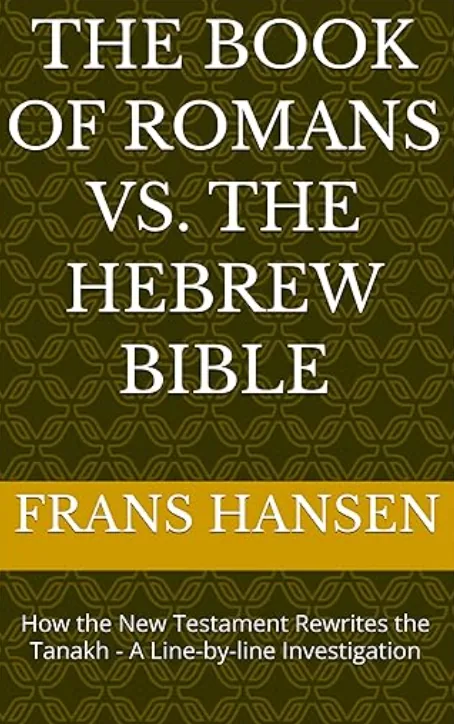
From the wider question raised by “Can covenant faithfulness be credited to you without covenant obedience ever becoming yours?”, the book choice becomes specific: THE BOOK OF ROMANS VS. THE HEBREW BIBLE: How the New Testament Rewrites the Tanakh - A Line-by-line Investigation carries the investigation into Romans tested under stable Torah categories and legal terms.