
Evidence bridge
ctly sinless • completely righteous • spotless before God But also claims: • he was made sin • he bore the guilt of others • he stood condemned in their place Which is it?
The goal is to know exactly where the evidence ends at “ctly sinless • completely righteous • spotless before God But also claims: • he was made sin • he bore the guilt of others • he stood condemned in their place Which is it?”, so later theology cannot borrow certainty from a source that never supplied it.
What this article established
Christian theology can distinguish Jesus’ personal sinlessness from Paul’s claim that he was “made sin” for others, so the two statements are not automatically contradictory. The harder Torah question is whether moral guilt and condemnation may be transferred to an innocent human substitute.
- Verified: New Testament theology can distinguish Jesus’ personal sinlessness from a representative “made sin” role.
- Unsupported: claiming that “sinless” and “made sin” must logically contradict each other.
- Verified: Torah contains divinely commanded sacrificial and symbolic burden-bearing rites.
- Verified: Torah and Ezekiel also protect personal moral responsibility.
- Disputed: whether Christian human substitution is a legitimate fulfillment of those sacrificial categories.
- Not established by the personal-responsibility texts themselves: that an innocent human may become legally guilty for the sins of others.
The question that still remains
What happens after “ctly sinless • completely righteous • spotless before God But also claims: • he was made sin • he bore the guilt of others • he stood condemned in their place Which is it?” is resolved and the review widens to Romans tested under stable Torah categories and legal terms, with the Torah or prophetic passage Paul invokes, its original legal/covenantal function kept in view?
Why this book is the next step
THE BOOK OF ROMANS VS. THE HEBREW BIBLE: How the New Testament Rewrites the Tanakh - A Line-by-line Investigation is the narrowest catalogue match because its stated scope is Romans tested under stable Torah categories and legal terms; that directly answers the remaining problem after ctly, sinless, completely, righteous, whereas a general counter-missionary title would broaden too far. This keeps the sale downstream of the evidence: first ctly / sinless / completely / righteous, then the larger Romans tested under stable Torah categories and legal terms audit. The worked hinge that makes this assignment specific is ctly / sinless / completely / righteous / spotless.
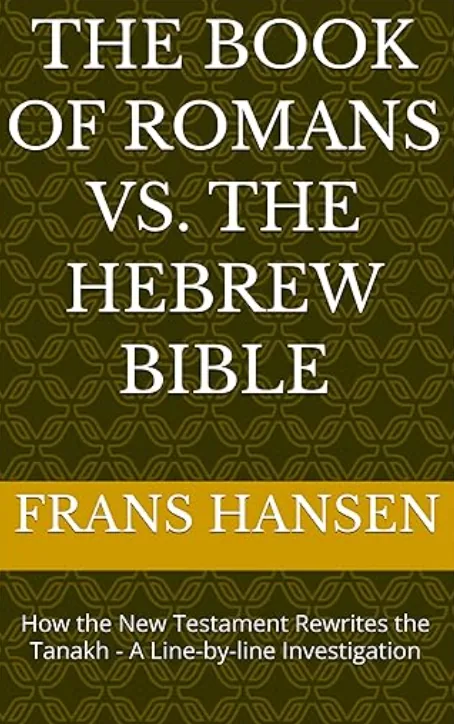
The source map beyond “ctly sinless • completely righteous • spotless before God But also claims: • he was made sin • he bore the guilt of others • he stood condemned in their place Which is it?” points to one book-length continuation: THE BOOK OF ROMANS VS. THE HEBREW BIBLE: How the New Testament Rewrites the Tanakh - A Line-by-line Investigation, whose scope is Romans tested under stable Torah categories and legal terms. Open the book page for the full treatment.