
Evidence bridge
FINAL CHALLENGE If righteous Gentiles already stood accepted before God, why declare them unsaved?
The target state is evidentiary clarity: a fair Christian formulation, a controlled reading of “FINAL CHALLENGE If righteous Gentiles already stood accepted before God, why declare them unsaved?”, an explicit concession, and a narrow verdict.
What this article established
Tanakh knows righteous non-Israelites, accepts Gentile repentance, and never states that every non-Jew outside Israel’s covenant was damned until a Christian saving mechanism arrived. Christianity can define salvation through Christ inside its own theology, but it cannot claim Torah required that conclusion without showing the rule.
- Verified: Tanakh recognizes righteous or repentant non-Israelites and depicts God responding favorably to them.
- Verified: Torah distinguishes Israel’s covenant obligations from the status of the nations.
- Verified with chronological caution: later rabbinic Judaism explicitly develops a righteous-Gentile/Noahide framework, but the fully formulated seven-law system should not simply be read backward into every earlier period.
- Possible within Christian theology: Christians may say all final salvation is through Christ, including people who lived before Jesus.
- Unsupported by the controlling Torah/Tanakh texts: the claim that righteous Gentiles were categorically unsaved before God unless a later Christological mechanism is supplied.
The question that still remains
After resolving “FINAL CHALLENGE If righteous Gentiles already stood accepted before God, why declare them unsaved?”, does the wider case across Romans tested under stable Torah categories and legal terms survive the same test, especially the Torah or prophetic passage Paul invokes, its original legal/covenantal function?
Why this book is the next step
The commercial bridge is valid only because the evidence bridge is valid: from the local FINAL, CHALLENGE, righteous, Gentiles verdict to the wider Romans tested under stable Torah categories and legal terms audit handled by THE BOOK OF ROMANS VS. THE HEBREW BIBLE: How the New Testament Rewrites the Tanakh - A Line-by-line Investigation. The match is therefore between unresolved scope and book scope, not between repeated keywords. The worked hinge that makes this assignment specific is FINAL / CHALLENGE / righteous / Gentiles / already.
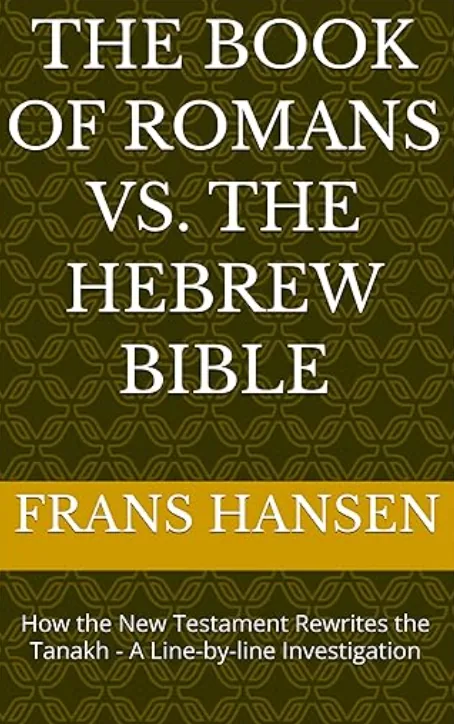
If the wider question after “FINAL CHALLENGE If righteous Gentiles already stood accepted before God, why declare them unsaved?” is genuinely After resolving “FINAL CHALLENGE If righteous Gentiles already stood accepted before God, why declare them unsaved?”, does the wider case across Romans tested under stable Torah categories and legal terms survive the same test, especially the Torah or prophetic passage Paul invokes, its original legal/covenantal function?, the next destination is THE BOOK OF ROMANS VS. THE HEBREW BIBLE: How the New Testament Rewrites the Tanakh - A Line-by-line Investigation, because its scope is Romans tested under stable Torah categories and legal terms.