
Evidence bridge
ousness for us, if we are careful to observe all these commandments before the Lord our God, as He has commanded us.’ Why would God magnify something you no longer needed?
The reader wants to be able to explain “ousness for us, if we are careful to observe all these commandments before the Lord our God, as He has commanded us.’ Why would God magnify something you no longer needed?” from the Torah or prophetic passage Paul invokes, its original legal/covenantal function, and the exact logical step Romans adds without relying on denominational authority or counter-missionary slogans.
What this article established
The locked subject for this record is visibly truncated, but its archive source and control fields are clear: Deuteronomy 6:25 explicitly calls careful commandment-observance “righteousness for us,” while Romans 3:21 speaks of a righteousness of God “apart from law.” The texts use righteousness in different argumentative settings; Paul cannot erase Torah’s positive covenant category by assertion.
- Verified: Deuteronomy 6:25 explicitly uses “righteousness” for Israel's careful observance of God's commandment.
- Verified: Romans 3:21 speaks of a righteousness of God “apart from law” and broadly claims the Law and Prophets as witnesses without naming a direct quotation in that verse.
- Possible: Paul can use “righteousness” in a different theological sense from Deuteronomy 6:25.
- Disputed: whether Paul's larger synthesis of law and justification correctly represents the Torah and Prophets.
- Unsupported by the controlling Torah text: the claim that Torah itself teaches obedient covenant righteousness was merely useless, impossible or no longer needed.
The question that still remains
What happens after “ousness for us, if we are careful to observe all these commandments before the Lord our God, as He has commanded us.’ Why would God magnify something you no longer needed?” is resolved and the review widens to Romans tested under stable Torah categories and legal terms, with the Torah or prophetic passage Paul invokes, its original legal/covenantal function kept in view?
Why this book is the next step
This assignment is justified by the unresolved evidence field, not by keyword overlap. The next task after ousness, careful, observe, all is What happens after “ousness for us, if we are careful to observe all these commandments before the Lord our God, as He has commanded us.’ Why would God magnify something you no longer needed?” is resolved and the review widens to Romans tested under stable Torah categories and legal terms, with the Torah or prophetic passage Paul invokes, its original legal/covenantal function kept in view?; THE BOOK OF ROMANS VS. THE HEBREW BIBLE: How the New Testament Rewrites the Tanakh - A Line-by-line Investigation covers Romans tested under stable Torah categories and legal terms. The match is therefore between unresolved scope and book scope, not between repeated keywords. The worked hinge that makes this assignment specific is ousness / careful / observe / all / commandments.
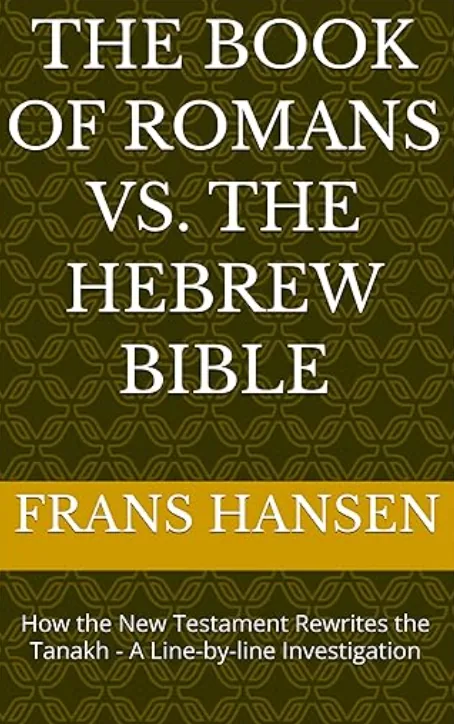
The landing page for “ousness for us, if we are careful to observe all these commandments before the Lord our God, as He has commanded us.’ Why would God magnify something you no longer needed?” has done its job when the reader can see why THE BOOK OF ROMANS VS. THE HEBREW BIBLE: How the New Testament Rewrites the Tanakh - A Line-by-line Investigation—not a generic anti-Christian title—continues this exact problem across Romans tested under stable Torah categories and legal terms.