
Evidence bridge
Does this claim survive a Torah-first reading: The Gospels on Trial: LXX vs MT: Every Major Gospel Use of the Hebrew Bible Tested Against the Masoretic Text, the Septuagint, and Torah Context: LXX vs MT?
The reader wants to be able to explain “The Gospels on Trial: LXX vs MT: Every Major Gospel Use of the Hebrew Bible Tested Against the Masoretic Text, the Septuagint, and Torah Context: LXX vs MT” from Masoretic Hebrew, the relevant Septuagint form, the New Testament citation, and the consequence of each wording without relying on denominational authority or counter-missionary slogans.
What this article established
The Septuagint is an ancient Jewish translation, not a Christian forgery, and the Masoretic Text is not the only witness to every ancient reading. But when a Gospel claim depends on a Greek wording that differs materially from the Hebrew, the difference must be exposed and its doctrinal weight tested. Isaiah 7:14 is the clearest case.
- Verified: the Gospels frequently use wording close to the Septuagint.
- Verified: some LXX forms differ materially from the Masoretic Hebrew.
- Verified: Isaiah 7:14 is a major case where Matthew’s argument benefits from the Greek *parthenos* while the Hebrew uses *almah* in an immediate historical sign.
- Unsupported: the blanket claim that every LXX/MT difference is Christian corruption.
- Unsupported: the opposite claim that any LXX quotation automatically proves the Gospel’s theological application.
- Required case by case: determine whether the textual difference actually carries doctrinal weight.
The question that still remains
If “Does this claim survive a Torah-first reading: The Gospels on Trial: LXX vs MT: Every Major Gospel Use of the Hebrew Bible Tested Against the Masoretic Text, the Septuagint, and Torah Context: LXX vs MT?” is settled from the sources, what survives when the inquiry expands to Matthew through John tested line by line against Hebrew Bible, Septuagint and Torah context under Masoretic Hebrew, the relevant Septuagint form, the New Testament citation, and the consequence of each wording?
Why this book is the next step
The reason for this book is structural, not topical coincidence: Gospels, Trial, LXX opens into If “Does this claim survive a Torah-first reading: The Gospels on Trial: LXX vs MT: Every Major Gospel Use of the Hebrew Bible Tested Against the Masoretic Text, the Septuagint, and Torah Context: LXX vs MT?” is settled from the sources, what survives when the inquiry expands to Matthew through John tested line by line against Hebrew Bible, Septuagint and Torah context under Masoretic Hebrew, the relevant Septuagint form, the New Testament citation, and the consequence of each wording? and the book is specifically organized around Matthew through John tested line by line against Hebrew Bible, Septuagint and Torah context. The match is therefore between unresolved scope and book scope, not between repeated keywords. The worked hinge that makes this assignment specific is Gospels / Trial / LXX.
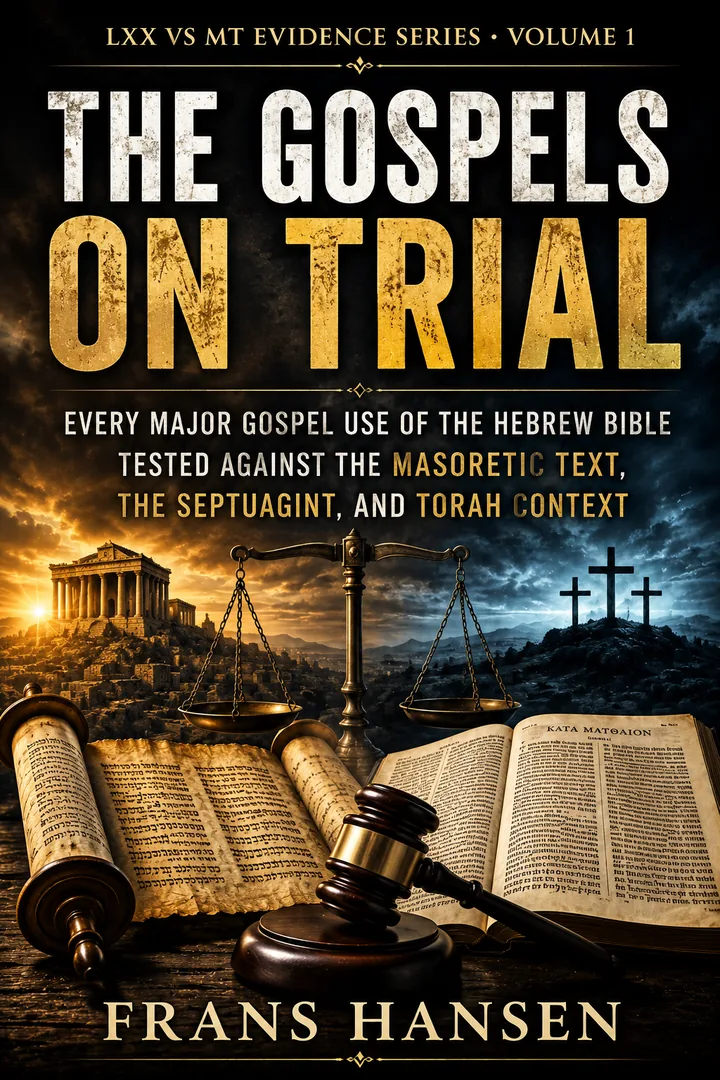
From the wider question raised by “Does this claim survive a Torah-first reading: The Gospels on Trial: LXX vs MT: Every Major Gospel Use of the Hebrew Bible Tested Against the Masoretic Text, the Septuagint, and Torah Context: LXX vs MT?”, the book choice becomes specific: The Gospels on Trial: LXX vs MT: Every Major Gospel Use of the Hebrew Bible Tested Against the Masoretic Text, the Septuagint, and Torah Context carries the investigation into Matthew through John tested line by line against Hebrew Bible, Septuagint and Torah context.