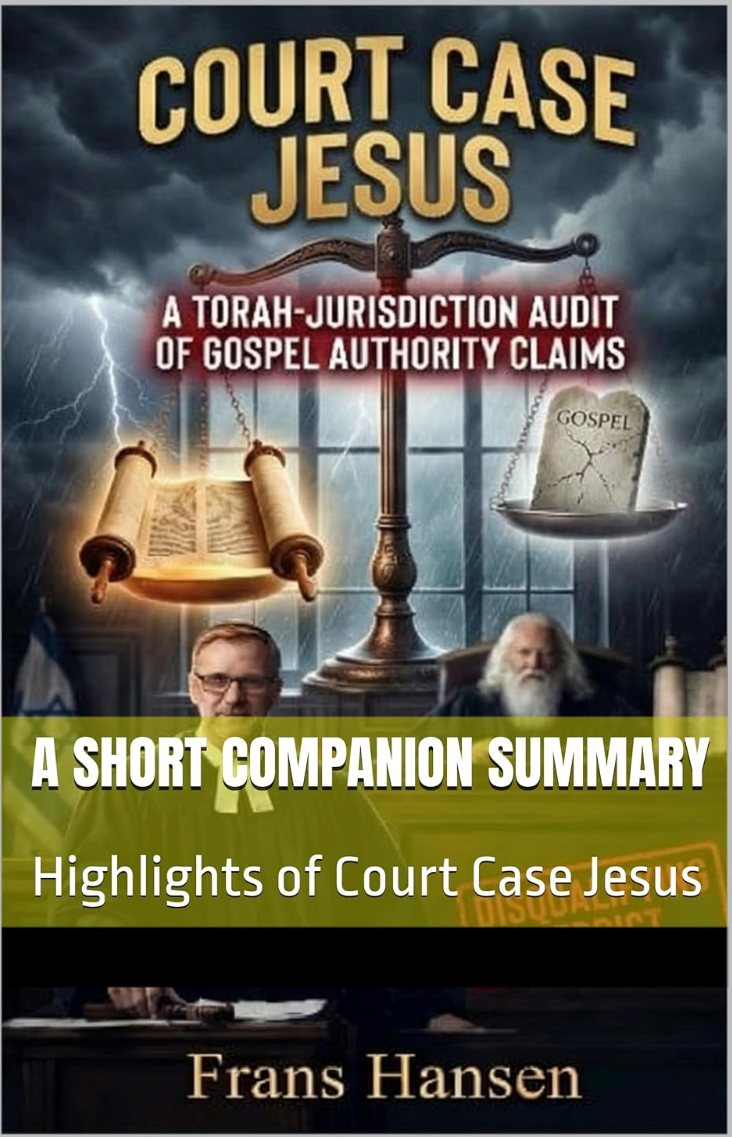
Court Case Jesus — A Short Companion Summary: Highlights of Court Case Jesus
The quickest way in: the “court case” method, the strongest findings, and the clearest takeaways—without committing to the full case file first.
This page exists for readers — but also for SEO fairness. It links to every book page with consistent prominence, helping search engines crawl and evaluate each title independently.
The quickest way in: the “court case” method, the strongest findings, and the clearest takeaways—without committing to the full case file first.

The full case file: jurisdiction first, then evidence. Tests Gospel authority claims under stable Torah categories and rules of admissible argument.
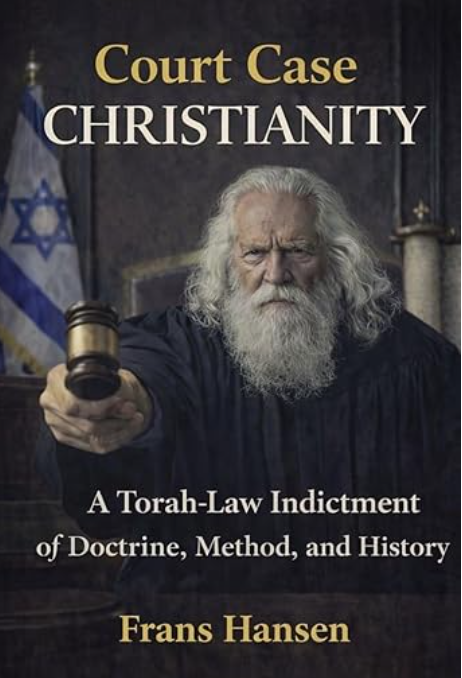
A structured indictment: doctrines, methods, and historical claims tested under Torah categories—what’s assumed, what’s smuggled in, what survives.
A forensic test of “fulfilled prophecy” claims: quotations, context, translation choices, and category shifts.
Tracks interpretive moves: selective quoting, re-framing, and meaning carried by translation choices.
A line-by-line audit: where Luke rewrites Tanakh frames, reshapes terms, and relocates meanings.
John’s biggest leaps tested under context-first reading where Tanakh defines its own terms.
Where theology becomes policy: how breaks from Torah categories are justified—and where they fail.
“Better covenant” tested inside Torah rules for priesthood, covenant, and atonement—no category switching allowed.
Romans under stable Torah categories—where legal terms can’t be moved mid-argument and definitions don’t get “adjusted.”
Master all 150 Psalms with disciplined Hebrew precision. This 561-page guide trains you to read Tehillim as covenant speech—structural, contextual, and text-faithful—protecting against misinterpretation while deepening serious Torah-based understanding.
A rigorous 150,000‑word investigation asking whether Trinitarian doctrine coheres with the ontological revelation at Sinai—tested under divine simplicity, necessary being, and covenant-faithful monotheism.